
Facebook Groups grow communities when they give members a reason to show up that a business page can't: conversation, belonging, and exclusive value. The most effective tactics in 2026 are themed weekly posts, challenges, live Q&As and workshops, member spotlights, organized guides and resource libraries, exclusive early access, collaborative content, events and meetups, mentorship or accountability pods, and member-led discussions. Groups show up prominently in members' feeds and notifications, so an engaged group often reaches more people than a page. Here are 10 creative ideas — plus how to set up, moderate, and measure your group.
Why Facebook Groups Still Matter in 2026
- Stronger reach: group posts often appear in members' feeds and notifications more reliably than page posts
- Two-way conversation: members talk to each other, not just to your brand
- Loyalty and retention: customers who belong to a community tend to stick around longer
- Customer insight: questions and discussions reveal pain points and content ideas
- Word of mouth: members invite friends and colleagues
Setup basics are covered in creating and managing Facebook groups for your business.
Group Types and What They're Good For
| Group Type | Best For | Example |
|---|---|---|
| Customer community | Retention, support, product feedback | "[Brand] Owners Club" |
| Interest or topic group | Awareness and lead generation | "South Florida Small Business Marketing Tips" |
| Local community | Local businesses and events | "Boca Raton Fitness & Wellness" |
| Paid or premium group | Membership, courses, coaching | "Accelerator Members Only" |
| Professional / B2B group | Thought leadership and networking | "Florida HR Leaders Network" |
| Event or challenge group | Short-term programs | "30-Day Social Media Challenge" |
Topic-based groups usually grow faster than brand-named groups because people join for the subject, not the company.
1. Run Themed Weekly Posts
Recurring prompts create habits. Examples:
- Monday Wins: members share a success from last week
- Tip Tuesday: you or members share one practical tip
- Workshop Wednesday: members post work for feedback
- Feature Friday: promote members' businesses or projects
Schedule them in advance with a content plan — see how to create a social media content calendar.
2. Launch Challenges
Five-, seven-, or 30-day challenges give members a goal and daily reasons to post. A fitness studio might run a "7-Day Mobility Challenge," while a marketing agency might run "5 Days to a Better Instagram Profile." Use daily units or posts, a progress thread, and a small prize or recognition for completion.
3. Host Live Q&As and Mini Workshops
Go live in the group for "Ask Me Anything" sessions, product demos, expert interviews, or 20-minute workshops. Collect questions in advance, save the replay, and pin it for new members.
4. Spotlight Members
Feature a "Member of the Week" with a short interview, photo, and story. Spotlights make members feel valued, encourage others to participate, and show prospective members the kind of people they'll meet.
5. Build a Resource Library With Guides
Use Facebook's Guides or Units (where available) and pinned posts to organize your best content: start-here posts, FAQs, templates, tutorials, and recorded lives. New members get immediate value, and you answer repeated questions once.
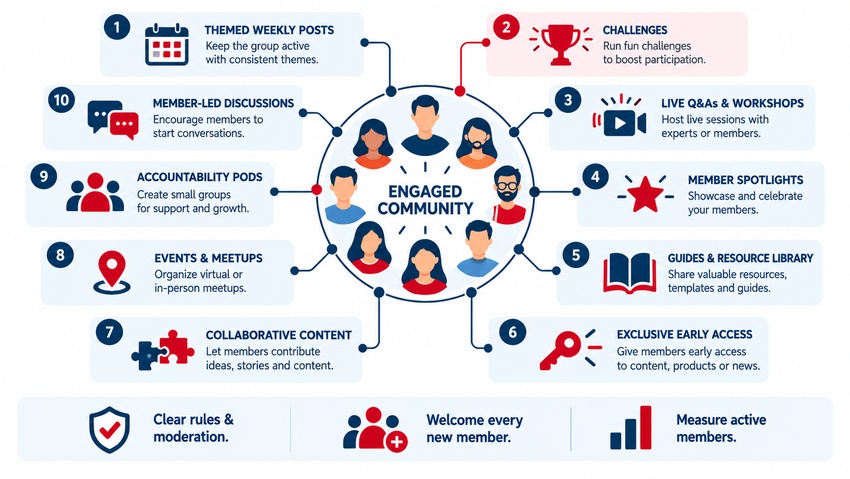
6. Offer Exclusive Early Access and Perks
Make membership valuable: first look at new products, members-only discounts, beta testing opportunities, or early event registration. Exclusivity encourages people to join and stay active.
7. Create Content With Members
Ask members to vote on product names, contribute tips to a group e-book, share before-and-after photos, or submit questions for a future video. Collaborative content builds ownership and gives you authentic user-generated content — with permission.
8. Host Events and Meetups
Use the group to organize virtual networking sessions, local meetups, workshops, or watch parties. In-person events turn online connections into real relationships, especially for local businesses — see the importance of local SEO for brick-and-mortar businesses for local marketing ideas.
9. Form Accountability Pods or Mentorship Circles
Break large groups into small pods of five to eight members with shared goals, such as growing a business, losing weight, or learning a skill. Pods create deeper bonds and higher retention.
10. Encourage Member-Led Discussions
The healthiest groups don't depend on the admin to post everything. Ask open-ended questions, invite experienced members to answer newcomers, and appoint community moderators or ambassadors — see how to build brand ambassadors from your customer base.
Setting Up Your Group for Growth
- Clear name and description with keywords people search for
- Membership questions to qualify members and collect email addresses (with consent)
- Group rules covering respect, self-promotion, and spam
- Welcome post and a pinned "Start Here" guide
- Cover image that communicates value and matches your brand
- Link the group to your business page and promote it in emails, websites, and other social channels — see how to integrate email with social media campaigns
Moderation Best Practices
- Approve posts or new members during early growth if spam is a risk
- Remove spam quickly and enforce rules consistently
- Respond to member posts and questions within a day
- Use admin tools such as keyword alerts and scheduled posts
- Handle conflicts privately when possible
Response strategies are covered in the art of responding to comments.
How to Measure Group Success
| Metric | What It Shows |
|---|---|
| Member growth | Whether your promotion and value attract people |
| Active members | How many people view, post, comment, or react |
| Posts and comments per week | Overall engagement health |
| Member-generated posts | Whether the community is self-sustaining |
| Event or live attendance | Value of interactive programming |
| Leads, sales, or retention from members | Business impact |
Use Facebook's Group Insights and track conversions with UTM links — see how to measure engagement on social media.
Common Mistakes
- Using the group as a promotion-only channel
- Posting inconsistently or abandoning the group after launch
- No rules, leading to spam
- Ignoring new members' first posts
- Measuring only member count instead of activity
Key Takeaways
- Facebook Groups build loyalty, reach, and insight through two-way conversation.
- Topic-based groups often grow faster than brand-named groups.
- Weekly themes, challenges, lives, spotlights, guides, and events keep members engaged.
- Clear rules, welcome processes, and active moderation keep groups healthy.
- Measure active members, member-generated posts, and business outcomes.
Frequently Asked Questions
How do I grow a Facebook Group for my business?
Choose a topic your audience cares about, set clear rules and onboarding, promote the group across your website, email, and social channels, and post consistent value such as themed weekly prompts, challenges, live Q&As, spotlights, and exclusive resources.
Should my Facebook Group be public or private?
Private groups often feel more exclusive and safe, which can encourage open discussion and higher engagement. Public groups can be easier to discover. Many businesses choose private but visible groups so people can find them while discussions stay member-only.
How often should I post in a Facebook Group?
Post at least a few times per week, ideally with recurring themed prompts, and respond to member posts daily. As the group grows, member-generated discussions should make up an increasing share of activity.
Can I sell products in my Facebook Group?
Yes, but balance promotion with value. Share exclusive offers, early access, or product launches occasionally, while focusing most content on education, support, and community. Too much promotion can reduce engagement and trust.
How do I measure the success of a Facebook Group?
Track member growth, active members, posts and comments per week, member-generated content, event attendance, and business outcomes such as leads, sales, or customer retention. Group Insights and UTM-tagged links help connect activity to results.
Want a thriving community around your brand? AiScope Digital's social media management services launch, grow, and moderate Facebook Groups that drive loyalty and leads — get a free consultation today.