
A full stack developer builds complete web applications — the frontend users see, the backend that powers it, and the database beneath — and in 2026 the path there is clearer than ever: HTML/CSS/JavaScript, one frontend framework, one backend runtime, one database, then Git, APIs, and deployment, practiced through real projects over roughly 9–18 months of consistent learning. AI coding assistants have changed how developers work, but they've raised — not lowered — the value of understanding the full stack. Here's the complete skills map and a stage-by-stage roadmap.
What Does a Full Stack Developer Actually Do?
Full stack developers move across the entire application:
- Frontend: layouts, interactivity, and responsive UI in the browser
- Backend: server logic, authentication, APIs, and business rules
- Database: modeling, querying, and protecting data
- DevOps basics: version control, deployment, hosting, monitoring
The role's superpower is context: you can trace a bug from a button click through an API call to a database query, and ship a feature end to end without waiting on three teams. That breadth is why startups and agencies prize the role — and why it commands strong salaries, with US full stack developers typically earning six figures at mid-level according to industry salary surveys.
The Core Skills, Layer by Layer
| Layer | Must-Learn in 2026 | Common Choices |
|---|---|---|
| Frontend foundations | HTML5, CSS3, modern JavaScript (ES2024+) | — |
| Frontend framework | Component model, state, routing | React (most jobs), Vue, Svelte |
| Styling | Responsive design, Flexbox/Grid | Tailwind CSS, CSS Modules |
| Backend runtime | HTTP, REST APIs, auth, validation | Node.js/Express, Python/Django, PHP/Laravel |
| Database | Modeling, SQL, one NoSQL store | PostgreSQL/MySQL + MongoDB |
| Version control | Branching, PRs, code review flow | Git + GitHub |
| Deployment | Hosting, env vars, CI basics, HTTPS | Vercel, Render, Docker basics |
| AI tooling | Prompting, reviewing AI output critically | Copilot-class assistants |
Two notes on the 2026 landscape: TypeScript has become the default expectation in professional JavaScript codebases — learn it as soon as plain JS feels comfortable. And AI assistants generate code fast, which makes the ability to read, evaluate, and debug code the real differentiator; teams don't need people who can paste suggestions, they need people who know when the suggestion is wrong.
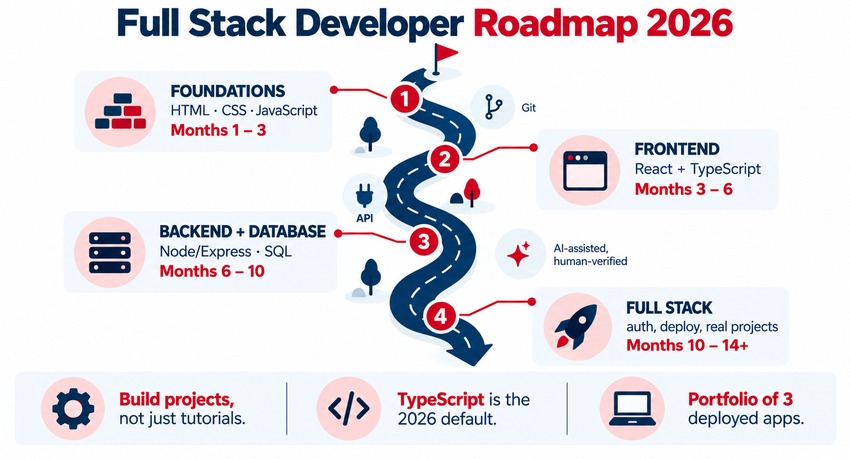
The Roadmap: Four Stages to Job-Ready
Stage 1 — Foundations (Months 1–3)
HTML, CSS, and JavaScript, learned by building: a personal site, a landing page clone, small DOM projects (to-do list, calculator). Master Flexbox, Grid, and responsive layouts. Resources like MDN Web Docs are the canonical free reference.
Stage 2 — Frontend Depth (Months 3–6)
Pick React (the job-market default) and learn components, props/state, hooks, and routing. Add TypeScript. Build something real with API data — a weather dashboard, a movie browser. Learn Git properly now: feature branches, meaningful commits, pull requests.
Stage 3 — Backend and Databases (Months 6–10)
Choose one backend path and go deep: Node/Express pairs naturally with React. Build REST APIs with authentication (sessions and JWTs), validation, and error handling. Learn relational modeling with PostgreSQL, then MongoDB for the document model. Security fundamentals are non-negotiable from day one — start with our top 10 web security practices every developer should know.
Stage 4 — Full Stack Integration (Months 10–14+)
Connect everything: a complete application with signup/login, CRUD features, and deployment. The MERN stack (MongoDB, Express, React, Node) remains a beginner-friendly integration path — our step-by-step MERN application guide walks the full build. Learn how the layers talk cleanly — contracts, error states, loading states — covered in integrating frontend and backend: best practices.
Portfolio Projects That Get Interviews
Tutorials teach syntax; projects teach engineering. Three deployed applications beat thirty certificates:
- A CRUD app with auth — task manager, recipe box, booking tool: proves the fundamentals
- An API-integration app — dashboard pulling and visualizing third-party data: proves you can read docs
- One ambitious capstone — an e-commerce store, a social feed, a SaaS prototype: proves you can scope and finish
For each: clean README, live deployed URL, and honest commit history. Employers click the link before they read the resume.
Full Stack vs. Specialist: Which Path Pays?
| Factor | Full Stack | Frontend/Backend Specialist |
|---|---|---|
| Job breadth | Widest — startups, agencies, freelance | Deep roles at larger companies |
| Learning curve | Longer, broader | Shorter to first job |
| Early salary | Comparable | Comparable |
| Senior ceiling | Architecture, lead roles, founding engineer | Deep-domain expert roles |
| Freelance fit | Excellent — ship whole products | Harder solo |
Many developers start full stack to stay employable, then specialize where they find pull. There's no wrong order — only unfinished fundamentals.
Key Takeaways
- The 2026 stack: HTML/CSS/JS → React + TypeScript → Node + SQL/NoSQL → Git, APIs, deployment.
- Expect 9–18 months to job-ready with consistent, project-driven practice.
- AI assistants accelerate output but raise the bar on understanding — learn to verify, not just generate.
- Three deployed portfolio projects outweigh any stack of certificates.
- Security and Git hygiene are professional fundamentals, not advanced topics.
Frequently Asked Questions
How long does it take to become a full stack developer?
Typically 9–18 months of consistent study (10–20 hours weekly) for career-changers learning independently, or 3–6 months full-time via intensive programs. The variable that matters most is project volume — developers who build and deploy real applications progress several times faster than tutorial-only learners.
Which stack should I learn first in 2026?
JavaScript end-to-end is the most practical start: React with TypeScript on the frontend and Node.js/Express on the backend, with PostgreSQL and MongoDB for data. One language across the stack reduces cognitive load, and it matches the largest share of job postings.
Do I need a degree to become a full stack developer?
No. Employers increasingly hire on demonstrated ability: a portfolio of deployed applications, clean GitHub history, and problem-solving in technical interviews. A CS degree helps with fundamentals and some enterprise filters, but self-taught and bootcamp paths are well-established routes into the role.
Will AI replace full stack developers?
AI has automated boilerplate, not engineering. Developers now ship faster with AI assistants, but designing systems, evaluating generated code, debugging integration issues, and making security and architecture decisions remain human work. The developers at risk are those who only ever copied code — understanding the stack is the moat.
What salary can a full stack developer expect?
In the US, entry-level roles typically start around $70,000–$90,000, mid-level developers commonly earn $100,000–$140,000, and senior or lead roles exceed that, varying by region and industry. Freelance full stack developers with portfolio proof often bill $50–$150+ per hour.
Building a product and need the full stack handled by pros? AiScope Digital's website development and design services cover frontend, backend, and everything between — start the conversation about your project.