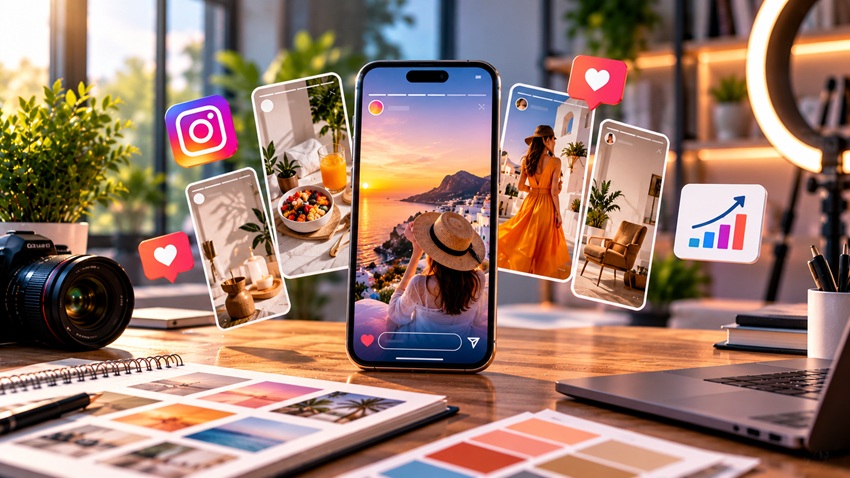
Instagram Stories convert when they combine a scroll-stopping first frame, one clear message per frame, and an explicit call to action — usually the link sticker — within a sequence of three to five frames. With over 500 million daily Stories users and the format's full-screen, sound-on environment, Stories remain the most direct line between your brand and a purchase decision on the platform in 2026. This playbook covers the specs, the design formulas, the interactive stickers, and the conversion structure that separates tap-throughs from sales.
Why Stories Convert Better Than Feed Posts
- Full-screen attention. No competing posts, no sidebar — one brand, one screen.
- Urgency built in. The 24-hour lifespan triggers fear of missing out that evergreen posts can't.
- Friction-free action. Link stickers, product tags, and DM prompts move viewers from interest to action in one tap.
- Casual trust. Stories tolerate — and reward — authenticity. Behind-the-scenes beats studio-polished here, which lowers production cost while raising believability.
- Placement economics. Story ad inventory is typically cheaper than feed placements, and organic Stories warm audiences for retargeting.
Get the Technical Specs Right First
Nothing says amateur like letterboxed, cropped, or blurry Stories:
| Spec | Requirement |
|---|---|
| Dimensions | 1080 × 1920 px (9:16) |
| Safe zone | Keep text/CTAs ~250 px from top & bottom (UI overlays) |
| Video length | Up to 60s per card; 15s segments auto-split for ads |
| File type | MP4/MOV video; JPG/PNG images |
| Text size | Minimum ~24pt — readable in 1–2 seconds |
| Sound | Design sound-on, but caption everything |
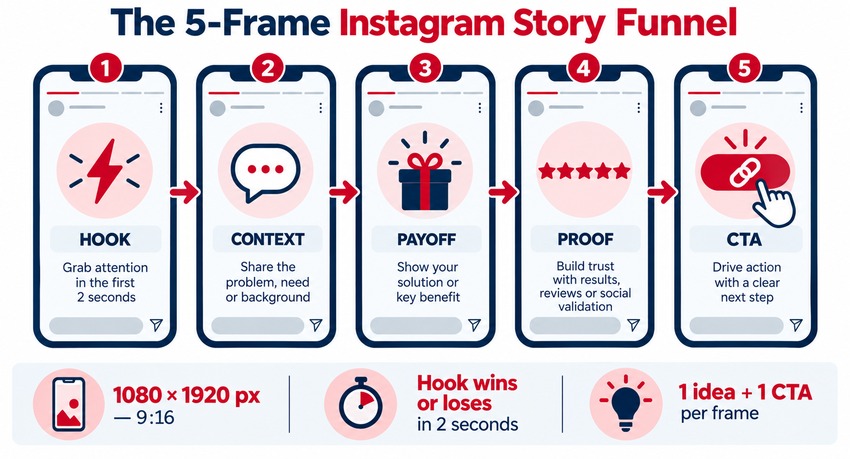
The 5-Frame Story Structure That Converts
Treat a Story like a micro funnel, not a single post:
- Frame 1 — The Hook (1–2 seconds to win). Bold claim, question, or motion. "We tested 7 CRMs so you don't have to" beats a logo card every time.
- Frame 2 — The Context. The problem your audience feels, in their words.
- Frame 3 — The Payoff. Your product/offer as the answer — show it in use, not on a white background.
- Frame 4 — The Proof. A testimonial screenshot, review count, before/after, or quick demo.
- Frame 5 — The CTA. One instruction, one sticker: "Tap to get 20% off" with the link sticker front and center.
Three frames minimum, five ideal — completion rates fall sharply after that, so earn every additional frame.
Design Formulas for "Stunning" (Without a Designer)
- One idea per frame. If a frame needs explaining, split it.
- Brand consistently: same 2–3 colors, same font pairing, same sticker style across every Story — recognition compounds in the Stories tray.
- Layer for depth: background photo or video, a semi-transparent color block, then text on top. Instant polish.
- Motion wins: even subtle animated text or boomerangs out-perform static frames; native camera effects keep it feeling organic.
- Faces and product-in-use outperform flat lays; strong source material matters, and our guide to capturing high-quality photos for social media covers it with a phone camera.
- Caption every spoken word — a large share of Stories are watched muted despite the sound-on design intent.
Tools that keep it fast: Instagram's native text/sticker tools (the algorithm-friendly default), Canva's Story templates for branded frames, and CapCut for captioned video cuts.
Interactive Stickers: The Conversion Multipliers
Stickers are not decoration — every tap is an engagement signal that boosts your Story's distribution and a micro-commitment that warms the viewer:
| Sticker | Best Conversion Use |
|---|---|
| Link | The direct CTA — product page, booking, lead magnet |
| Poll / Quiz | Engagement bait + instant market research |
| Question box | Collect objections; answer them in follow-up Stories |
| Countdown | Launches and sales — viewers subscribe to reminders |
| Product tag | In-app shopping without leaving Instagram |
| Slider | Low-effort engagement that lifts reach |
A proven cadence: run a poll ("Struggling with X?") in frame two, then show the solution — respondents are pre-qualified and the poll interaction tells the algorithm to show your next frames to more people.
Turning Views into Measurable Revenue
- Track taps, not views. Link clicks, sticker taps, replies, and profile visits are the conversion metrics; reach is just the top of the funnel.
- Use UTM parameters on every link sticker so Stories revenue shows up attributed in GA4.
- Watch drop-off per frame in Instagram Insights — the frame where viewers exit is the frame to rewrite.
- Retarget engagers: Story viewers and sticker-tappers are custom audiences for ads — the warmest prospecting pool you own. Pair organic Stories with paid amplification using the tactics in crafting high-converting social media ads.
- Highlight the winners: save converting Stories to themed Highlights (Offers, Reviews, FAQ) so they keep selling after 24 hours.
Benchmarks to beat: 3–7% link-tap rates are strong for most niches; completion rates above 70% on a 5-frame sequence signal a working structure.
Stories vs. Reels: Use Both, Differently
Stories nurture the audience you have; Reels recruit the audience you don't. Reels reach non-followers through the algorithm; Stories convert followers through frequency and CTAs. The brands winning Instagram in 2026 run Reels for discovery, then convert that new audience with Story sequences — our guide to mastering Instagram Reels covers the discovery half. And whichever format you post, the words matter: see writing captions that convert.
Key Takeaways
- Stories are micro funnels: hook → context → payoff → proof → CTA, in 3–5 frames.
- Design at 1080×1920, keep text out of the top/bottom UI zones, caption all audio.
- One idea and one CTA per frame; consistent brand colors and fonts across all frames.
- Interactive stickers double as engagement signals and micro-commitments — use one per sequence minimum.
- Measure link taps and per-frame drop-off, UTM-tag every link, and retarget engagers with ads.
Frequently Asked Questions
What size should Instagram Stories be?
1080 × 1920 pixels in 9:16 aspect ratio. Keep text, logos, and CTAs roughly 250 pixels away from the top and bottom edges, where Instagram's interface elements overlay your content. Design for sound-on, but caption everything for muted viewers.
How many frames should a Story sequence have?
Three to five frames converts best for most brands: hook, context, payoff, proof, and CTA. Completion rates drop sharply on longer sequences, so every extra frame must earn its place. Single-frame Stories work only for simple announcements or reminders.
How do I add a link to my Instagram Story?
Use the link sticker from the sticker tray when composing — available to all accounts. Customize the sticker text ("Get 20% off") instead of showing the raw URL, place it in the lower-middle safe zone, and point at it visually or verbally in the frame.
Why aren't my Stories converting?
Usually one of four causes: a weak first frame (viewers exit before your offer), no explicit CTA, too many ideas per frame, or an audience mismatch. Check Insights for per-frame drop-off, rewrite the frame where exits spike, and end every sequence with one clear tap instruction.
Should I use Stories or Reels for my business?
Both, for different jobs. Reels reach new audiences through algorithmic discovery; Stories convert existing followers with offers, proof, and link stickers. An effective 2026 rhythm is several Reels weekly for growth plus near-daily Stories for nurture and conversion.
Want Stories, Reels, and a content engine that actually produces revenue? AiScope Digital's social media management services handle strategy, creative, and optimization end to end — get a free consultation today.