
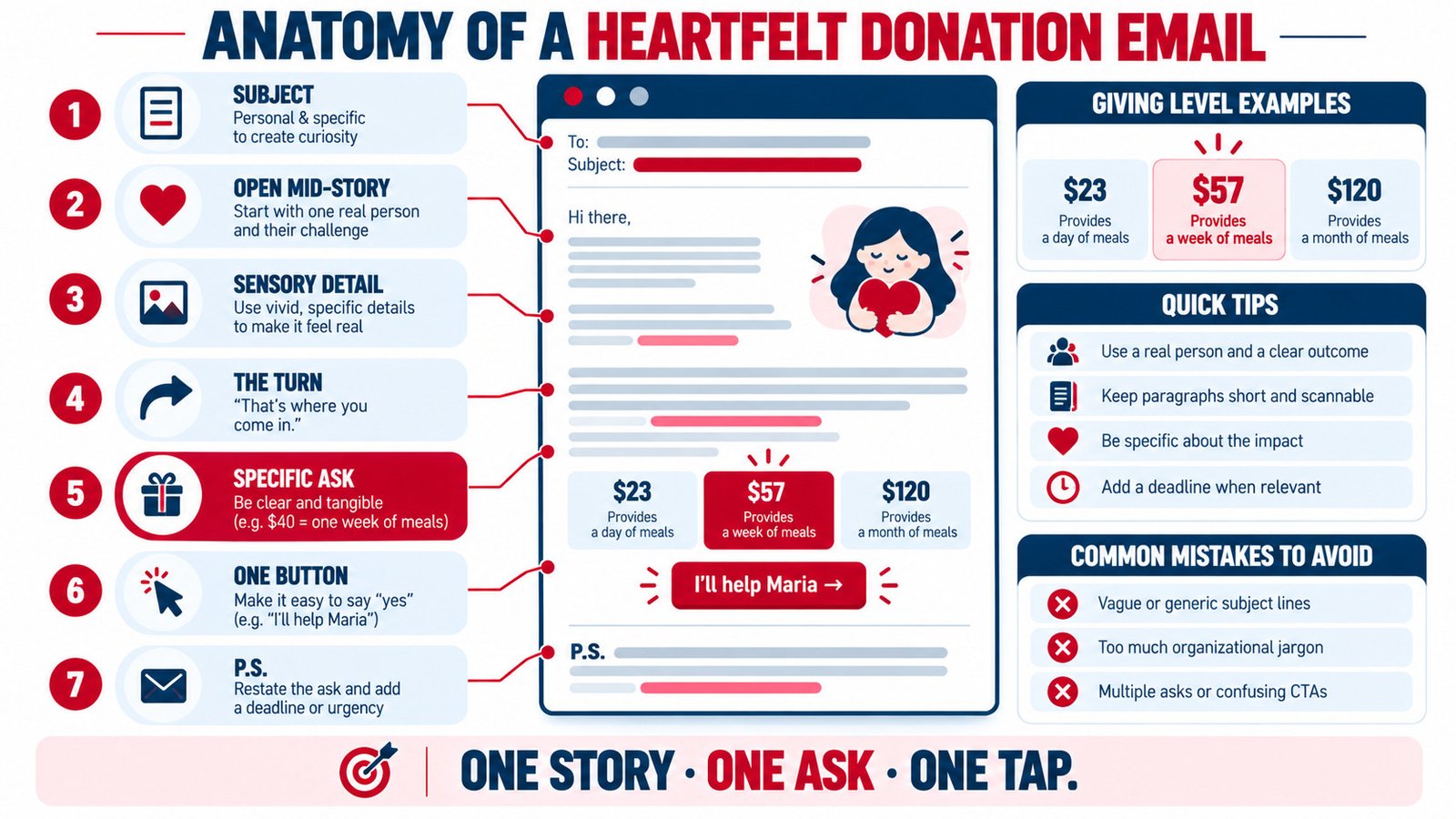
A heartfelt donation request email does three things in under 300 words: tells one person's story, connects that story to a specific gift amount, and makes giving take one tap. Email remains the workhorse of nonprofit fundraising — it drives a substantial share of all online giving according to the M+R Benchmarks studies — but inboxes are unforgiving, and generic "support our mission" blasts raise little. Here's how to write appeals that feel personal, honor your donors, and move them to give.
The Psychology: Why One Story Beats One Thousand Statistics
Decades of giving research converge on the identifiable victim effect: people give more to one named person than to large anonymous numbers. "Two million people face hunger" numbs; "Maria skips dinner so her sons don't have to" moves.
The working rules:
- One protagonist per email — a person, family, animal, or place your work touched
- Concrete sensory details — what they saw, said, felt; specificity is what reads as true
- The donor is the hero, not your organization — "you provided," "your gift built," not "we achieved"
- Dignity always — tell stories with people, not about them; consent and respectful framing aren't just ethics, donors feel the difference
The craft of narrative appeals runs deeper than one email — our guide to the impact of storytelling in nonprofit emails covers story selection, arcs, and consent practices.
The Anatomy of a High-Converting Appeal
| Element | What Works | Example |
|---|---|---|
| Subject line | Personal, curiosity or urgency, no "newsletter" | "Maria's fridge is empty tonight" |
| Preheader | Continues the subject, hints the ask | "You can change that for $23" |
| Opening line | Drop into the story mid-scene | "The school bus stopped coming in March." |
| The turn | Where the donor enters | "That's where you come in." |
| The ask | Specific amount tied to specific impact | "$40 feeds Maria's family for a week" |
| CTA button | First person, single action | "I'll help Maria" |
| P.S. | Restate ask + deadline (most-read line) | "P.S. Gifts doubled until Friday." |
Subject Lines That Get Opened
Fundraising subject lines live or die on feeling personal: lowercase and conversational often beats formal title case; a first name merge helps when it doesn't feel robotic; deadline framing works near campaign ends ("3 days left to double your gift"). Test relentlessly — the mechanics are the same ones in our subject line hacks to boost open rates.
The Ask: Specific, Anchored, Repeated
- Tie amounts to outcomes: "$23 = one week of school meals" converts better than "any amount helps"
- Anchor with giving levels (e.g., $23 / $57 / $120) — most donors pick the middle
- Use past-gift data: asking a $50 donor for "$50 or $65" lifts average gifts; asking them for $10 shrinks them
- One ask per email. Appeals that also promote the gala and the volunteer drive raise less for all three — focused CTAs are a discipline, covered in writing compelling CTAs for email campaigns
Make Giving Frictionless
Heartfelt copy dies on a clunky donation page:
- The CTA links straight to a pre-filled donation form (amount carried from the button they clicked)
- Mobile-first everything — most nonprofit email opens are on phones
- Express payment options (Apple Pay, Google Pay, PayPal) and a monthly-gift toggle
- Match the donation page's imagery and story to the email — continuity reassures
Timing, Cadence, and Campaign Structure
When to send: Tuesday–Thursday mornings are reliable defaults; year-end (especially the Giving Tuesday-through-December 31 window) remains the season when a large share of annual giving happens — plan your strongest stories for it.
Campaign structure beats single sends. A proven 3-email arc over 7–10 days:
- The story — full narrative, soft-to-medium ask
- The reminder — new angle on the same story, progress update ("62% to goal"), medium ask
- The deadline — urgency honest and explicit (match expiring, campaign closing), direct ask + P.S.
Segment before sending: past donors (reference their impact), lapsed donors ("we've missed you"), non-donor subscribers (lower entry ask), and monthly donors (never send them the standard ask — invite upgrades instead).
And always close the loop: the thank-you and impact-report emails you send after the gift are what create the second gift. Gratitude is a revenue strategy.
Quick Templates to Adapt
The story appeal (new campaign):
Subject: the bus stopped coming
[Story: 3 short paragraphs on one person] → "That's where you come in. $40 keeps [Name]'s family fed for a week. Will you help today?" → [I'll help →] → P.S. Every gift this week is matched.
The lapsed-donor appeal:
Subject: we saved your seat
"Two years ago, your gift did [specific thing]. Families like [Name]'s still need that kindness — and $25 restarts it today." → [Count me back in →]
The deadline send:
Subject: 6 hours left (gifts doubled)
"Quick note: the match ends at midnight. [Name]'s story — and 40 families like hers — are 82% of the way to the goal. $23 finishes the job." → [Double my gift →]
These frameworks extend naturally to adjacent nonprofit sends — event promotion emails and volunteer recruitment emails run on the same story-plus-specific-ask engine.
Measure What Matters
| Metric | Healthy Nonprofit Range | Lever If Low |
|---|---|---|
| Open rate (directional) | 25–35% | Subject lines, sender name |
| Click-through rate | 1.5–3% | Story strength, CTA clarity |
| Page conversion | 15–25% | Form friction, continuity |
| Average gift | Trend upward | Anchoring, past-gift asks |
| Revenue per 1,000 emails | Benchmark vs. M+R | Whole-funnel review |
| Unsubscribe rate | < 0.3% per send | Frequency, segmentation |
Key Takeaways
- One named protagonist beats any statistic — the identifiable victim effect is the engine of giving.
- Make the donor the hero: "you" language, specific amounts tied to specific outcomes.
- One story, one ask, one button — and a P.S. that restates the ask.
- Run 3-email arcs with honest urgency; segment donors, lapsed donors, and subscribers.
- The post-gift thank-you sequence is where the second gift is won.
Frequently Asked Questions
How do you write a donation request email?
Open mid-story with one real person your work touched, add concrete details, then turn to the reader: "that's where you come in." Make one specific ask tied to a tangible outcome ("$40 feeds a family for a week"), end with a single CTA button, and restate the ask in a P.S.
How long should a donation request email be?
150–300 words for most appeals — long enough for one vivid story and one clear ask, short enough for a phone screen. Year-end or major-campaign emails can run longer when the story earns it, but every added paragraph must strengthen the case to give.
What is a good subject line for a fundraising email?
Personal, specific, and human: "Maria's fridge is empty tonight," "we saved your seat," or deadline-driven "gifts doubled until Friday." Avoid organization-centric lines like "Our Spring Appeal." Test conversational lowercase against title case — the personal register usually wins.
How much should I ask for in a donation email?
Anchor with three giving levels tied to outcomes (e.g., $23/$57/$120) — most donors choose the middle. For past donors, ask at or slightly above their previous gift. Always translate amounts into impact; unexplained numbers convert worse at every level.
When is the best time to send fundraising emails?
Tuesday through Thursday mornings perform reliably, and the year-end window — Giving Tuesday through December 31 — accounts for an outsized share of annual online giving. Structure campaigns as 3-email arcs over 7–10 days, with the deadline email sent the final morning.
Your mission deserves emails that move people. AiScope Digital's email marketing services help nonprofits build story-driven campaigns, automation, and donor journeys — get a free consultation today.