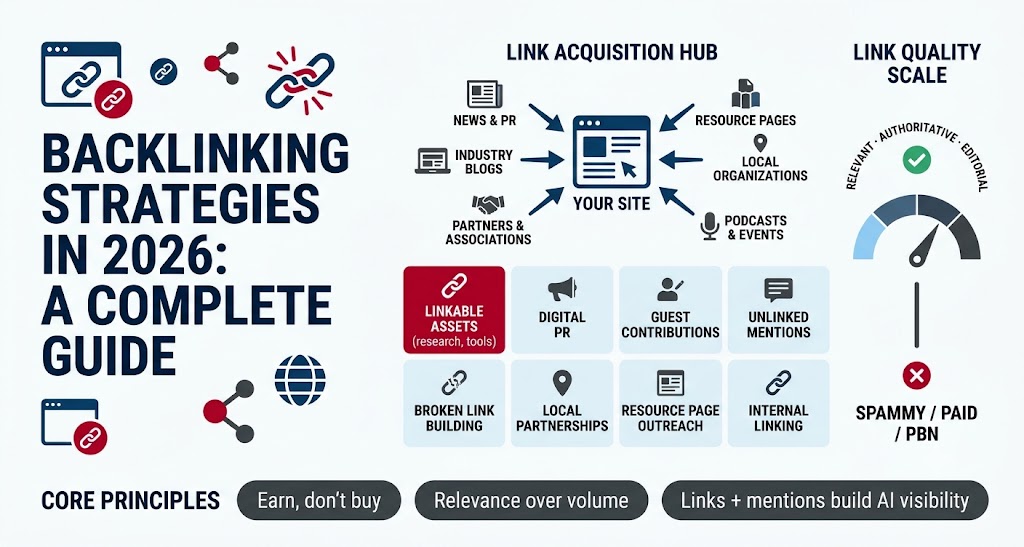
Backlinks — links from other websites to yours — remain one of the strongest signals search engines use to judge authority and trust, and in 2026 they also help AI systems understand which brands are credible sources on a topic. The strategies that work now focus on earning links rather than buying them: create linkable assets (original research, tools, guides, data), run digital PR campaigns, contribute expert commentary to journalists, publish genuinely useful guest content on relevant sites, build local and industry partnerships, reclaim unlinked brand mentions, and fix broken links that point to your content. Quality, relevance, and natural patterns matter far more than volume — and manipulative tactics like paid links or private blog networks risk penalties. Here's how to build a backlink strategy that grows rankings sustainably.
Why Backlinks Still Matter in 2026
- Authority signal: links from trusted sites tell search engines your content is credible
- Discovery: search engines find new pages by following links
- Referral traffic: relevant links send qualified visitors
- Brand visibility: mentions on respected sites build awareness
- AI search: brands cited across authoritative sources are more likely to be recognized and referenced by AI tools — see AI backlink building: how AI is shaping SEO
What Makes a High-Quality Backlink?
| Factor | High Quality | Low Quality |
|---|---|---|
| Relevance | Same or related industry/topic | Unrelated sites |
| Authority | Trusted, established publications | Spammy or newly created sites |
| Placement | Editorial link within content | Footer, sidebar, or comment spam |
| Anchor text | Natural and descriptive | Over-optimized exact-match keywords |
| Traffic | Site has real visitors | No audience |
| Link type | Earned editorial follow link | Paid or manipulative links |
| Context | Surrounded by relevant content | Lists of unrelated links |
Nofollow, sponsored, and UGC-tagged links can still bring traffic and visibility, and a natural profile includes a mix.
Strategy 1: Create Linkable Assets
People link to resources that are uniquely useful:
- Original research, surveys, and industry statistics
- Free tools and calculators
- Comprehensive guides and templates
- Data visualizations and infographics — see creating effective infographics: a step-by-step guide
- Expert roundups and benchmark reports
Strategy 2: Digital PR
Pitch newsworthy stories, data, and expert insights to journalists and publications. Respond to journalist requests on expert-sourcing platforms with fast, quotable answers. Digital PR earns authoritative links and brand mentions — see AiScope's public relations services.
Strategy 3: Guest Contributions on Relevant Sites
Write genuinely helpful articles for respected industry publications. Focus on audience value, not link placement — see guest blogging for SEO: how to get started.
Strategy 4: Reclaim Unlinked Mentions
Find mentions of your brand without links and politely ask publishers to add one — see the power of brand mentions in off-page SEO.
Strategy 5: Broken Link Building
Find broken links on relevant sites (pointing to pages that no longer exist) and suggest your similar, high-quality resource as a replacement.
Strategy 6: Local and Industry Partnerships
Sponsorships, associations, chambers of commerce, suppliers, partners, events, and community involvement create natural local links — see local citation building tips and best practices.
Strategy 7: Resource Page and Directory Outreach
Many industry sites maintain resource pages that link to helpful tools and guides. Suggest your content where it genuinely fits. Use reputable, relevant directories only.
Strategy 8: Podcasts, Webinars, and Events
Guest appearances and speaking engagements often include show notes or event pages with links — see hosting virtual events to engage your audience.
Strategy 9: Strengthen Internal Linking
Internal links distribute authority from pages that earn backlinks to your priority service and product pages — a critical complement to off-site efforts. See how onsite SEO services can boost your website traffic.
Tactics to Avoid
| Risky Tactic | Why It's Harmful |
|---|---|
| Buying links for ranking purposes | Violates Google's spam policies; risks manual actions |
| Private blog networks (PBNs) | Manipulative; often detected and devalued |
| Excessive link exchanges | Unnatural patterns |
| Low-quality directory and comment spam | Little value; potential spam signals |
| Exact-match anchor overuse | Looks manipulative |
| Large-scale low-quality guest posting | Devalued and risky |
If a past provider built spammy links, focus on earning quality links; consider the disavow tool only for clear manipulative link schemes or manual actions.
Measuring Backlink Success
- Number of referring domains (more important than total links)
- Quality and relevance of linking sites
- Referral traffic from links
- Rankings for target keywords and pages
- Brand mentions and share of voice
- Organic traffic growth to linked pages
Track progress with SEO tools and Search Console's Links report — see essential technical SEO tools for 2026.
Example: A Data-Driven Link Campaign
A South Florida marketing agency surveys local small business owners about their biggest marketing challenges:
- Publishes a report with charts and key findings on its blog
- Creates an infographic summarizing the top insights
- Pitches local business journalists and chambers of commerce
- Shares findings on LinkedIn and in its newsletter
- Offers expert commentary to reporters covering small business trends
The campaign earns links and mentions from local news, business associations, and industry blogs, strengthening authority for related service pages. Broader link-building techniques are covered in the art of link building: techniques that work.
How Long Does Link Building Take?
Link building is a long-term investment. Individual links can be indexed within days or weeks, but ranking improvements usually build gradually over several months as authority accumulates. Consistent effort — publishing linkable assets, pitching regularly, and nurturing relationships with publishers — outperforms short bursts of activity.
Building Relationships That Earn Links
The most valuable links often come from relationships rather than cold outreach:
- Follow and engage with journalists and editors in your industry
- Share useful data and insights without always asking for links
- Collaborate with partners on co-branded content and events
- Offer expert quotes quickly when reporters need sources
- Thank publishers who link to you and keep them updated with new resources
Relationship-driven link building produces more natural, authoritative links and makes future outreach much more successful.
Key Takeaways
- Backlinks remain a major authority signal and support AI search visibility.
- Prioritize relevant, authoritative, editorial links over volume.
- Earn links with linkable assets, digital PR, guest contributions, mentions, and partnerships.
- Avoid paid links, PBNs, and manipulative tactics that risk penalties.
- Measure referring domains, link quality, referral traffic, and ranking growth.
Frequently Asked Questions
Are backlinks still important for SEO in 2026?
Yes. Backlinks remain one of the strongest signals of authority and trust. Links from relevant, reputable sites help pages rank and also contribute to the brand authority that AI search tools rely on when recommending sources.
What is a high-quality backlink?
A high-quality backlink comes from a relevant, authoritative website, appears naturally within useful content, uses descriptive anchor text, and is earned editorially rather than paid for or manipulated.
How can I get backlinks without buying them?
Create linkable assets like original research and tools, run digital PR campaigns, provide expert quotes to journalists, write guest content for relevant publications, reclaim unlinked mentions, use broken link building, and build local and industry partnerships.
How many backlinks do I need to rank?
There's no fixed number. It depends on competition, keyword difficulty, and the quality of competitors' backlinks. Focus on earning links from relevant, authoritative domains and improving content quality rather than chasing a specific count.
Can bad backlinks hurt my website?
Google generally ignores many low-quality links, but participating in manipulative link schemes can lead to devaluation or manual actions. If you have a manual action or clear evidence of a past link scheme, clean up what you can and consider using the disavow tool.
Want authoritative backlinks that move rankings? AiScope Digital's search engine optimization services and public relations services earn high-quality links through content and digital PR — get a free consultation today.