
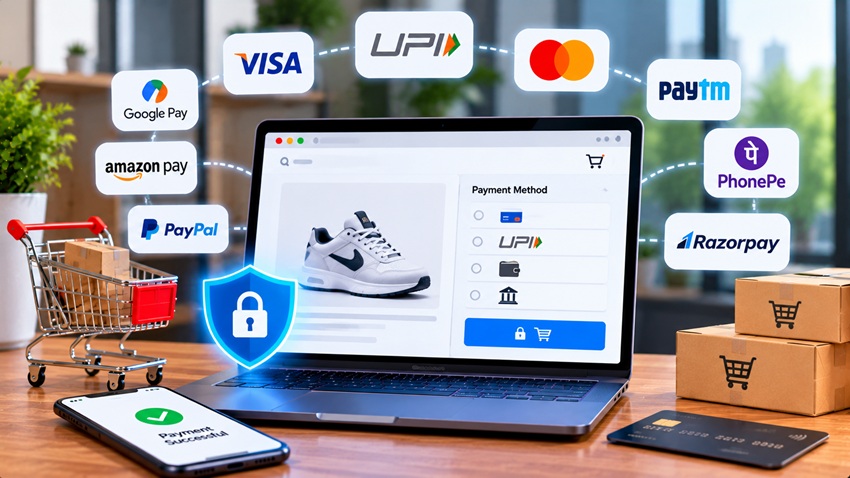
A payment gateway securely authorizes and processes card and digital payments between your online store, your customer's bank, and your merchant account. The top e-commerce payment gateways in 2026 are: Stripe, PayPal, Shopify Payments, Square, Adyen, Authorize.net, Braintree, Amazon Pay, Worldpay, and Checkout.com. The best choice depends on your platform, sales volume, target countries, preferred payment methods, fees, and need for features like subscriptions, fraud protection, and in-person sales. A great gateway supports digital wallets (Apple Pay, Google Pay), buy now, pay later options, and fast, mobile-friendly checkout — all of which reduce cart abandonment. This guide compares the leading options and explains how to choose.
How Payment Gateways Work
- A customer enters payment details or taps a digital wallet at checkout
- The gateway encrypts and sends the data to the payment processor
- The processor routes the request through card networks to the customer's bank
- The bank approves or declines the transaction
- The gateway returns the result to your store, and funds settle to your account
Many modern providers combine the gateway, processor, and merchant account in one service, simplifying setup.
Top 10 E-Commerce Payment Gateways Compared
| Gateway | Best For | Key Strengths | Considerations |
|---|---|---|---|
| Stripe | Online businesses, SaaS, custom checkouts | Developer-friendly APIs, subscriptions, many payment methods, global reach | Custom setups may need developer help |
| PayPal | Broad consumer trust and reach | Widely recognized, PayPal and Venmo wallets, buyer confidence | Fees and dispute processes vary |
| Shopify Payments | Shopify stores | Built-in, Shop Pay accelerated checkout, simplified management | Available only on Shopify and in supported countries |
| Square | Retailers selling online and in person | Unified POS and online sales, easy setup | Best suited to Square's ecosystem |
| Adyen | Larger, global, omnichannel merchants | Enterprise-grade, global payment methods, unified commerce | Typically suited to higher volumes |
| Authorize.net | Established U.S. businesses | Long-standing gateway, wide integrations | Separate merchant account may be needed |
| Braintree (PayPal) | Growing online and mobile businesses | Cards, PayPal, Venmo, wallets in one integration | Integration requires technical setup |
| Amazon Pay | Brands targeting Amazon shoppers | Familiar checkout using Amazon accounts | Limited to supported regions |
| Worldpay | High-volume and international merchants | Broad acquiring capabilities, many currencies | Contracts and onboarding can be complex |
| Checkout.com | Global digital businesses | Strong international processing, performance analytics | Generally targets mid-size and larger merchants |
Fees, availability, and features change frequently, so confirm current pricing and terms directly with providers before choosing.
Essential Payment Methods to Support
| Payment Method | Why It Matters |
|---|---|
| Credit and debit cards | Universal expectation |
| Apple Pay and Google Pay | Fast, secure one-tap mobile checkout |
| PayPal / Venmo | Trusted wallet with stored details |
| Shop Pay (Shopify) | Accelerated checkout for returning shoppers |
| Buy now, pay later (Klarna, Afterpay, Affirm) | Can increase order value for higher-priced items |
| Local payment methods | Essential for international markets |
| ACH / bank transfers | Useful for B2B and high-value orders |
Mobile-friendly wallets are especially important — see the importance of mobile optimization for e-commerce.
How to Choose the Right Payment Gateway
1. Platform Compatibility
Check native integration with your e-commerce platform. Shopify Payments works seamlessly on Shopify; WooCommerce supports Stripe, PayPal, Square, and many others via plugins — see the best e-commerce platforms for small businesses in 2026.
2. Fees and Pricing Structure
Compare transaction fees, fixed per-transaction charges, monthly fees, international and currency conversion fees, chargeback fees, and payout timing. Model costs at your expected sales volume.
3. Payment Methods and Countries
Make sure the gateway supports the payment methods and currencies your customers prefer, especially if you sell internationally.
4. Security and Compliance
Look for PCI DSS compliance, tokenization, 3D Secure authentication, and built-in fraud detection. Hosted payment fields reduce your PCI scope — see e-commerce security: protecting your customers and business.
5. Checkout Experience
Seamless, embedded checkout with saved payment details and wallets reduces friction — see strategies for e-commerce checkout optimization to boost conversions.

6. Subscriptions and Recurring Billing
If you sell subscriptions, confirm support for recurring billing, card updaters, dunning management, and proration.
7. Payout Speed and Reporting
Check how quickly funds reach your bank and how detailed reporting and reconciliation tools are.
8. Support and Reliability
Look for strong uptime, responsive support, and clear dispute and chargeback processes.
Best Gateway by Business Type
| Business Type | Strong Options |
|---|---|
| Shopify store | Shopify Payments plus PayPal and wallets |
| WooCommerce store | Stripe, PayPal, Square |
| Retail with physical locations | Square, Shopify Payments with POS |
| Subscription or SaaS | Stripe, Braintree |
| International or enterprise | Adyen, Checkout.com, Worldpay, Stripe |
| Established U.S. merchant with existing bank relationship | Authorize.net |
Example: Choosing Gateways for a Growing Apparel Brand
An apparel brand on WooCommerce relied on a single card gateway. Mobile shoppers frequently abandoned checkout. The brand added Stripe with Apple Pay and Google Pay, kept PayPal for shoppers who preferred it, and introduced a buy now, pay later option for higher-priced jackets. Mobile checkout completion improved, and average order value increased for BNPL purchases. Use your real figures to evaluate results.
Common Payment Gateway Mistakes
- Choosing on headline fees alone without modeling real costs
- Offering only card payments
- Redirecting shoppers to clunky external pages unnecessarily
- Ignoring international payment preferences
- Weak fraud protection leading to chargebacks
- Not testing checkout on mobile devices
Payment Gateway Selection Checklist
- Native integration with your platform confirmed
- Total fees modeled at expected volume
- Cards, wallets, PayPal, and BNPL supported as needed
- Currencies and local methods for target countries
- PCI compliance, tokenization, 3D Secure, and fraud tools
- Embedded, mobile-friendly checkout
- Subscription features if needed
- Payout timing and reporting reviewed
- Support and dispute process evaluated
- Test transactions completed on desktop and mobile
Reducing Fraud and Chargebacks
Payment gateways include tools to protect your revenue, but they work best with good store practices:
- Enable 3D Secure authentication for higher-risk transactions
- Use AVS (address verification) and CVV checks
- Review the gateway's fraud scoring rules and adjust thresholds
- Flag unusual orders: mismatched addresses, rush shipping on high-value items, multiple failed attempts
- Use clear billing descriptors so customers recognize charges on statements
- Respond quickly to disputes with order, delivery, and communication evidence
- Provide easy contact options so customers reach you before filing chargebacks
Monitor your chargeback rate monthly, since card networks may penalize merchants whose dispute rates rise too high.
Key Takeaways
- Payment gateways securely authorize and process online payments.
- Leading options include Stripe, PayPal, Shopify Payments, Square, Adyen, and more.
- Support cards, digital wallets, PayPal, and BNPL to reduce friction.
- Evaluate platform fit, total fees, security, checkout experience, and payouts.
- Test checkout regularly and confirm current pricing with providers.
Frequently Asked Questions
What is a payment gateway in e-commerce?
A payment gateway is the technology that securely captures, encrypts, and transmits customer payment information from your online store to payment processors and banks for authorization, then returns the approval or decline.
Which payment gateway is best for small businesses?
Many small businesses choose Stripe, PayPal, Shopify Payments, or Square because they're easy to set up and support popular payment methods. The best option depends on your platform, products, and customers.
Should I offer multiple payment options?
Yes. Offering cards, digital wallets like Apple Pay and Google Pay, PayPal, and buy now, pay later options where appropriate can reduce checkout friction and cart abandonment.
Are payment gateways secure?
Reputable gateways comply with PCI DSS standards and use encryption, tokenization, and fraud detection. Using hosted or embedded payment fields from your provider also reduces your security and compliance burden.
How much do payment gateways cost?
Most charge a percentage of each transaction plus a fixed fee, and some add monthly, international, or chargeback fees. Pricing varies by provider, volume, and region, so compare current terms directly.
Need a checkout that converts and keeps payments secure? AiScope Digital's website development and design services integrate and optimize payment gateways for online stores — get a free e-commerce consultation today.