
Website architecture is the way your pages are organized, linked, and structured so that users and search engines can find content easily — and in 2026 it is one of the highest-leverage SEO investments you can make. A flat, logical structure where every important page sits within three clicks of the homepage helps Google crawl efficiently, concentrates link equity on money pages, and keeps visitors moving toward conversion. This guide covers the principles, the process, and the mistakes to avoid.
What Is Website Architecture and Why Does It Matter?
Website architecture (or site structure) is the hierarchy of your pages — how your homepage connects to categories, categories to subcategories, and subcategories to individual pages — expressed through navigation, internal links, and URLs.
It matters for three reasons:
- Crawlability. Googlebot discovers pages by following links. Orphan pages (no internal links pointing to them) often go unindexed entirely.
- Authority flow. Internal links pass PageRank. A deliberate structure channels authority from your strongest pages to the pages you need to rank.
- User experience. Clear paths reduce bounce, increase pages per session, and lift conversions — signals that correlate with better rankings and, just as important in 2026, with how AI search engines evaluate and cite your site.
Google's own SEO Starter Guide lists logical site hierarchy among its foundational recommendations — this isn't optional polish, it's infrastructure.
The Golden Rules of Site Structure
Keep It Flat: The Three-Click Rule
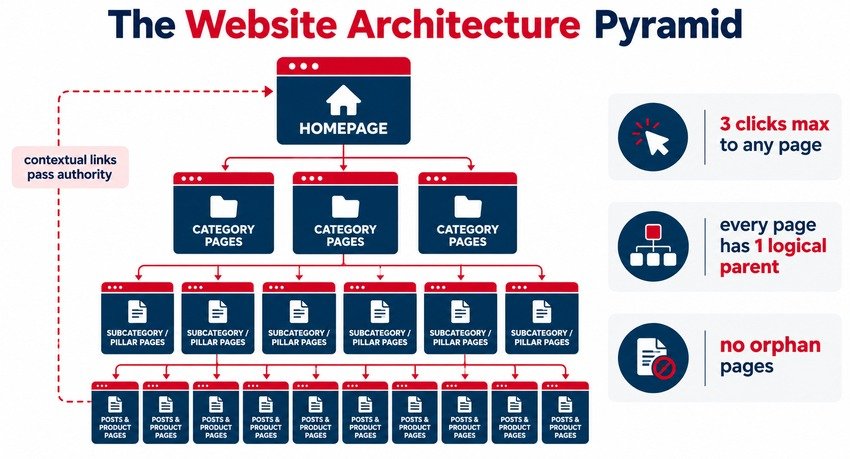
Every important page should be reachable within three clicks of the homepage. Deep structures (home → category → sub → sub-sub → product) bury pages where crawlers visit rarely and users never do.
Build a Pyramid, Not a Web
The proven model is a pyramid: homepage at the top, main categories beneath it, subcategories and detail pages below those. Every page belongs to exactly one logical parent.
Use Topic Clusters and Pillar Pages
Group related content around pillar pages. A pillar on "Email Marketing" links down to cluster posts (subject lines, deliverability, automation), and every cluster post links back up. This structure signals topical authority — a major factor in how both Google and AI answer engines decide which sites to trust and cite.
| Architecture Model | Structure | Best For | SEO Impact |
|---|---|---|---|
| Flat pyramid | Home → categories → pages | Most business sites | Strong, concentrated authority |
| Topic clusters | Pillar pages + cluster content | Content/blog-driven sites | Topical authority, AEO citations |
| Silo | Strictly separated verticals | Large niche sites | Strong relevance, less flexible |
| Flat/no hierarchy | Everything off the homepage | Tiny sites (<15 pages) | Fine at small scale only |
How Should You Structure URLs?
URLs should mirror your hierarchy and stay human-readable:
- Short and descriptive:
/services/seo/beats/index.php?id=283. - Lowercase, hyphen-separated, no dates (dates force you to either look stale or break URLs later).
- One canonical version — enforce HTTPS and a single www/non-www variant with 301 redirects.
- Avoid deep folder nesting that doesn't match real site sections.
Change URLs only when necessary, and always 301-redirect old paths — every migration leaks a little equity.
Internal Linking: The Engine of Architecture
Navigation defines your skeleton; in-content internal links are the circulatory system. Best practices for 2026:
- Link from strong to weak. Your most-linked pages (usually the homepage and top blog posts) should link to pages that need ranking help.
- Use descriptive anchor text. "Read our guide to using header tags to improve SEO" tells crawlers exactly what the target page is about — "click here" tells them nothing.
- Fix orphan pages. Crawl your site quarterly (Screaming Frog, Sitebulb, or Ahrefs) and give every orphan at least two or three contextual links.
- Add breadcrumbs with BreadcrumbList schema. They reinforce hierarchy for users and earn breadcrumb display in search results.
- Keep sitewide footer links lean. Dozens of footer links dilute meaning; keep the handful users actually need.
Technical Foundations That Support Your Structure
Architecture succeeds or fails on technical execution:
- XML sitemap submitted in Search Console, listing only canonical, indexable URLs.
- Robots.txt that doesn't accidentally block CSS, JS, or key sections.
- Canonical tags on every page to prevent duplicate-content dilution (especially with filtered/faceted URLs).
- Pagination handling for large archives so deep items remain discoverable.
- Mobile parity — Google indexes the mobile version, so navigation hidden on mobile is navigation that doesn't exist.
- Speed — crawl budget stretches further on fast sites; architecture and performance compound, as we show in how to speed up your website.
Crawlability deserves its own audit pass — our guide on improving your site's crawlability and indexability walks through it step by step.
A 6-Step Process to Optimize an Existing Site
| Step | Action | Tool |
|---|---|---|
| 1 | Crawl the site; export all URLs, depths, and inlinks | Screaming Frog / Sitebulb |
| 2 | Map pages to a pyramid; flag orphans & pages deeper than 3 clicks | Spreadsheet |
| 3 | Define topic clusters; assign each post a pillar | Content audit |
| 4 | Rebuild navigation & breadcrumbs around the new hierarchy | CMS |
| 5 | Add contextual internal links (strong → weak, descriptive anchors) | Manual / Link Assistant |
| 6 | 301-redirect changed URLs; resubmit sitemap; monitor | Search Console |
E-commerce sites deserve special care — faceted navigation and category trees create crawl traps fast; see our dedicated guide to e-commerce site structure best practices.
Common Architecture Mistakes to Avoid
- Burying key pages four or more clicks deep
- Orphan pages with zero internal links
- Multiple pages competing for the same keyword (cannibalization) instead of one consolidated page
- Session IDs or parameters creating infinite duplicate URLs
- Navigation menus with 50+ links, diluting every one of them
- Redesigning URLs without 301 redirects
Key Takeaways
- Website architecture determines how search engines crawl and how authority flows — it's SEO infrastructure, not decoration.
- Use a flat pyramid: every important page within three clicks of the homepage.
- Organize content into topic clusters with pillar pages to build topical authority for Google and AI engines alike.
- Internal links with descriptive anchors are your most controllable ranking lever.
- Audit quarterly for orphan pages, crawl depth, and cannibalization.
Frequently Asked Questions
What is the ideal website structure for SEO?
A flat pyramid: homepage → main categories → subcategories → detail pages, with every important page reachable within three clicks. Pair the hierarchy with topic clusters, descriptive internal links, breadcrumbs, and clean URLs that mirror the structure. This maximizes crawl efficiency and concentrates authority on priority pages.
How many clicks deep should pages be?
Keep revenue-critical and rankable pages within three clicks of the homepage. Pages at depth four or more get crawled less often and receive less link equity. Large sites can use hub pages, HTML sitemaps, and pagination to pull deep content closer to the surface.
Does website architecture really affect rankings?
Yes. Structure controls whether pages get crawled and indexed, how PageRank distributes internally, and how clearly Google understands topical relationships. Sites that consolidate content into logical clusters routinely see ranking improvements without earning a single new backlink.
What's the difference between site architecture and navigation?
Architecture is the full structural plan — hierarchy, URLs, and every internal link. Navigation is just its visible subset: menus, breadcrumbs, and footers. A site can have clean menus and still suffer from orphan pages, crawl traps, and poor link flow underneath.
How often should I audit my site structure?
Quarterly for most businesses, and immediately after redesigns, migrations, or large content pushes. Each audit should check crawl depth, orphan pages, broken links, redirect chains, and duplicate URLs — catching structural drift early is far cheaper than recovering lost rankings.
Strong architecture is the foundation every other tactic builds on. AiScope Digital's search engine optimization services include full architectural audits and restructuring roadmaps — talk to our team for a free assessment of your site's structure.