

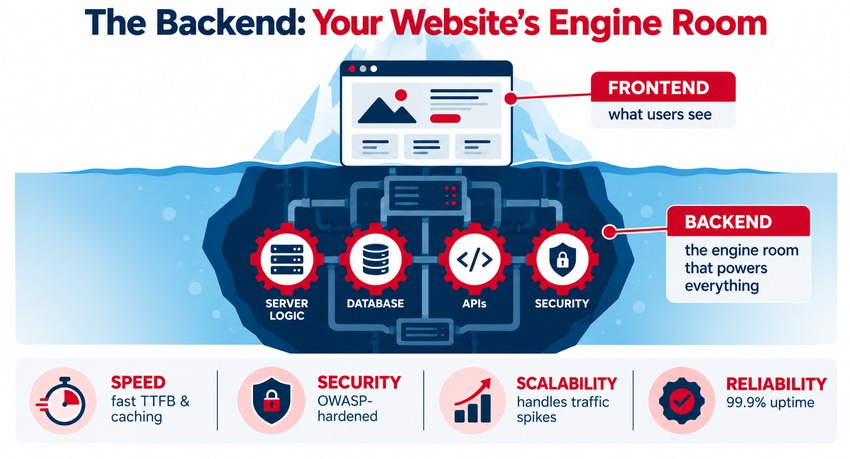
Robust backend development is crucial because everything your visitors experience — page speed, search results, checkout, logins, data security — is powered by server-side code they never see. The frontend is your storefront; the backend is the engine room, and when it's weak, the symptoms surface everywhere: slow pages, broken forms, security breaches, and sites that crash the moment a campaign actually works. Here's what a robust backend does for your business in 2026, and how to tell whether yours is helping or hurting.
What Exactly Is Backend Development?
Backend development covers everything that runs on the server rather than in the visitor's browser:
- Server-side logic — the code (PHP, Node.js, Python, etc.) that processes requests, runs business rules, and assembles pages
- Databases — where products, users, orders, and content live (MySQL, PostgreSQL, MongoDB)
- APIs — the connectors that let your site talk to payment processors, CRMs, shipping tools, and mobile apps
- Authentication and security layers — logins, permissions, encryption
- Server and hosting infrastructure — caching, load balancing, backups
When a visitor hits "Buy Now," the frontend shows the button animation; the backend validates stock, charges the card, writes the order, updates inventory, and fires the confirmation email — in under a second, reliably, for the thousandth simultaneous user. How the two layers cooperate cleanly is its own craft — see our guide to integrating frontend and backend: best practices.
Why the Backend Decides Your Site's Speed
Before a page can even start rendering, the server must respond — that's TTFB (time to first byte), a pure backend metric. Google's Core Web Vitals effectively grade your backend: a slow server caps your Largest Contentful Paint no matter how optimized your images are.
Robust backends stay fast through:
- Query optimization and indexing — one unindexed database query can add seconds under load
- Caching layers (object caching, Redis, full-page caching) that serve repeat requests from memory
- Efficient code paths — fewer redundant calls, async processing for heavy tasks
- CDN and server-level compression working together with application logic
The business stakes are well documented: Google found bounce probability rises 32% as load time grows from one to three seconds. Speed is a backend feature first.
Security: The Non-Negotiable Backend Job
The backend is where breaches happen — injection attacks, broken authentication, and leaky APIs all target server-side weaknesses. The OWASP Top 10 catalogs the most exploited vulnerability classes, and nearly all of them are backend responsibilities:
| Threat | What a Robust Backend Does | What a Weak Backend Risks |
|---|---|---|
| SQL injection | Parameterized queries, input validation | Entire database stolen |
| Broken authentication | Hashed passwords, MFA, session hardening | Account takeovers |
| Sensitive data exposure | Encryption at rest & in transit | Compliance fines, lost trust |
| Vulnerable components | Dependency updates, patching | Known exploits walk right in |
| Misconfiguration | Hardened servers, least-privilege access | Admin panels exposed |
For a small business, a single breach means downtime, blacklisting, legal exposure, and a reputation hit that outlasts the fix. We cover the defensive checklist in top security practices in backend development.
Scalability: Surviving Your Own Success
A robust backend is built to grow. The painful alternative is discovering your limits during your biggest sales day:
- Vertical readiness — efficient code that doesn't waste the server it has
- Horizontal readiness — stateless design, load balancing, and database replication so you can add capacity instead of rebuilding
- Queue-based processing — email sends, report generation, and imports run in background jobs instead of blocking checkout
- Graceful degradation — if a third-party API dies, the site slows instead of crashing
How Backend Quality Shapes SEO and UX
Search engines experience your backend directly:
- Crawl efficiency — fast, error-free responses let Googlebot index more pages per visit
- Uptime — repeated 5xx errors suppress rankings
- Clean redirects and status codes — server-side logic determines them
- Structured data delivery — rendered server-side, it's reliably readable by crawlers and AI engines alike
And users feel it in a hundred small moments: search results that return instantly, forms that never lose their data, carts that persist, logins that just work. The connection runs deep enough that we wrote a full piece on how backend development enhances user experience.
Custom Backend vs. Off-the-Shelf: Which Do You Need?
| Factor | Off-the-Shelf (WordPress, Shopify, SaaS) | Custom Backend |
|---|---|---|
| Launch speed | Days–weeks | Months |
| Upfront cost | Low | Higher |
| Unique workflows | Limited to plugins/apps | Built exactly to spec |
| Scalability ceiling | Platform-dependent | Engineered to your growth |
| Maintenance | Vendor handles core | You own the roadmap |
| Best for | Standard sites & stores | Complex logic, integrations, platforms |
Most businesses start off-the-shelf and add custom layers (APIs, integrations, custom plugins) as needs mature — the decision framework is in custom backend solutions vs. off-the-shelf software.
Signs Your Backend Needs Attention
- Pages hesitate before anything appears (slow TTFB)
- The site slows or crashes during traffic spikes or sales
- Forms fail silently, or orders occasionally vanish
- Plugins are the answer to everything, and they conflict
- No staging environment, no automated backups, no monitoring
- PHP/Node/database versions are years out of date
- Integrations are held together with manual exports
Any two of these are a flashing warning light — and they compound quietly until a launch day exposes them all at once.
Key Takeaways
- The backend powers everything users experience: speed, security, checkout, search, and uptime.
- TTFB and Core Web Vitals are backend metrics first — no frontend polish can rescue a slow server.
- Nearly every major breach class in the OWASP Top 10 is a backend responsibility.
- Scalable architecture (caching, queues, stateless design) turns traffic spikes into revenue instead of outages.
- Start off-the-shelf, go custom where your business logic is genuinely unique.
Frequently Asked Questions
What is the difference between frontend and backend development?
Frontend is everything rendered in the browser — layout, buttons, animations — built with HTML, CSS, and JavaScript. Backend is the server side: databases, application logic, APIs, and security. The frontend asks for data and displays it; the backend processes, stores, and protects it.
How does backend development affect SEO?
Directly. Server response time feeds Core Web Vitals, uptime and correct status codes keep crawlers happy, server-side rendering makes content reliably indexable, and clean redirect logic preserves link equity. A weak backend suppresses rankings no matter how good the content is.
What makes a backend "robust"?
Fast response times under load, OWASP-aligned security, automated backups and monitoring, scalable architecture (caching, queues, load-balancing readiness), updated dependencies, and clean API integrations. Robustness means the site behaves the same on your busiest day as on a quiet one.
Do small business websites really need strong backend development?
Yes — proportionally. A small site still handles customer data, payments, and forms, and a breach or extended outage hurts a small brand more than a large one. Solid hosting, updates, backups, and hardened forms are the affordable baseline every business needs.
How much does backend development cost?
Maintenance and hardening for an existing small-business site typically runs a few hundred dollars monthly. Custom backend builds — bespoke APIs, portals, integrations — range from $10,000 to $100,000+ depending on complexity. Scope it against the revenue the system supports.
Your website is only as strong as the engine behind it. AiScope Digital's website development and design services cover backend architecture, security hardening, and performance engineering — talk to our team for a free technical assessment.