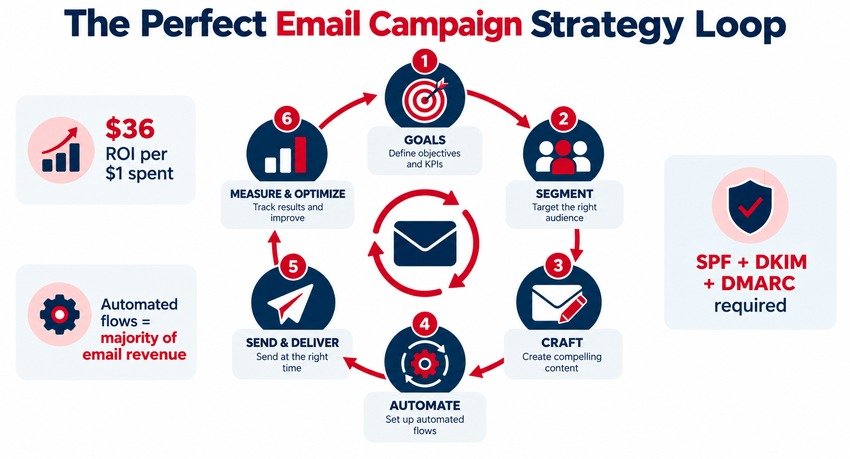
A perfect email campaign strategy is a documented plan that defines who you email, what you send, when you send it, and how you measure it — and it remains the highest-ROI channel in digital marketing, returning roughly $36 for every $1 spent according to Litmus research. In 2026, with AI-assisted personalization and stricter inbox-provider rules, the winners aren't the brands that send the most email; they're the brands that send the most relevant email. Here's how to build that strategy step by step.
Why Email Still Wins in 2026
- You own the channel. Social algorithms throttle organic reach; your email list is yours, unmediated.
- Intent and permission. Subscribers asked to hear from you — the warmest cold audience there is.
- AI has raised the ceiling. Modern platforms predict send times, generate subject-line variants, and assemble dynamic content per recipient at scale.
- Measurability. Every step — delivery, open, click, conversion — is trackable to revenue.
The catch: Gmail, Yahoo, and Apple now enforce authentication (SPF, DKIM, DMARC), low spam-complaint thresholds, and easy one-click unsubscribe. Strategy is no longer optional hygiene; it's the price of inbox placement.
Step 1: Set Goals and Define Your Audience
Every campaign needs one primary goal tied to a business metric — revenue from a promotion, demo bookings, reactivation of lapsed customers — and a number attached ("generate 150 qualified leads in Q2").
Then segment. Batch-and-blast is the fastest way to train inboxes to ignore you. High-performing 2026 segmentation layers:
| Segmentation Type | Example Segments | Best Used For |
|---|---|---|
| Lifecycle stage | New subscriber, active customer, lapsed 90+ days | Onboarding, winback |
| Behavior | Browsed category, abandoned cart, clicked last 3 sends | Triggered automations |
| Purchase history | First-time buyer, VIP, seasonal shopper | Offers, loyalty |
| Engagement level | Highly engaged, cooling, dormant | Send frequency & sunset policy |
| Declared preferences | Topics chosen at signup | Content newsletters |
Personalization beyond "Hi {FirstName}" — dynamic content blocks, predicted products, send-time optimization — is where the compounding gains live; our guide on how to personalize your emails for maximum engagement goes deeper.
Step 2: Choose Your Campaign Mix
A complete strategy blends three send types:
- Automated flows (the profit engine): welcome series, abandoned cart, post-purchase, winback. They run 24/7 and typically generate the majority of email revenue from a minority of volume. Abandoned-cart sequences alone recover meaningful lost revenue — tactics in boost sales with these abandoned cart email strategies.
- Campaign sends: promotions, launches, newsletters — planned on a calendar, mapped to seasons and inventory.
- Transactional emails: receipts and notifications; the highest-opened emails you send, so brand them properly.
Step 3: Craft Emails That Get Opened and Clicked
Subject lines (the gatekeeper): under ~45 characters, lead with the benefit or curiosity gap, personalize when it adds meaning, and A/B test relentlessly. Ten proven formulas are in our subject line hacks to boost open rates.
Preheader: treat it as subject line part two — never leave it to default to "View in browser."
Body copy: one message, one CTA. Write to one person, front-load value, keep paragraphs to 1–3 lines, and make the email skimmable (bolded key phrases, a single clear button). Design mobile-first — the majority of opens are on phones — with a single column, 16px+ body text, and buttons at least 44px tall.
CTA: specific beats generic — "Get my 20% code" outperforms "Learn more."
Step 4: Nail Timing, Frequency, and Deliverability
- Timing: Tuesday–Thursday mid-morning remains a safe default, but let your platform's AI send-time optimization personalize per subscriber.
- Frequency: consistency beats volume. Set expectations at signup and honor them. Watch unsubscribe and complaint rates (keep complaints under 0.1–0.3%).
- Deliverability non-negotiables for 2026: authenticate with SPF, DKIM, and DMARC; use double opt-in; sunset subscribers who haven't engaged in 6–12 months; never buy lists. Google's own sender guidelines spell out the thresholds — violate them and no amount of good copy will reach the inbox. Full checklist in our tips for improving email deliverability.
Step 5: Measure, Test, and Optimize
Open rates became unreliable after Apple Mail Privacy Protection; judge campaigns on deeper metrics:
| Metric | Healthy Benchmark (varies by industry) | What It Tells You |
|---|---|---|
| Click-through rate | 2–5% | Content & offer relevance |
| Click-to-open rate | 10–15% | Body copy & design quality |
| Conversion rate | 1–5% | Landing page + offer match |
| Unsubscribe rate | < 0.5% per send | Frequency & expectation fit |
| Spam complaint rate | < 0.1% | List quality & consent |
| Revenue per email | Trend upward | Overall program health |
Run one A/B test per send (subject, CTA, offer, or layout — never several at once), let tests reach significance, and fold every win back into your templates. Review automations quarterly; they decay silently as products and audiences shift.
Common Email Strategy Mistakes to Avoid
- Sending the same message to the whole list
- Buying or scraping email addresses (deliverability poison)
- No welcome series — the highest-open-rate automation you can run
- Ignoring list hygiene until deliverability collapses
- Designing desktop-first
- Measuring opens instead of clicks and revenue
Key Takeaways
- Email returns roughly $36 per $1 spent — but only for senders with strategy, segmentation, and authentication in place.
- Automated flows (welcome, cart, winback) are the profit engine; build them before scaling campaign volume.
- Segment by lifecycle, behavior, and engagement; personalize beyond first names.
- Mobile-first design, one CTA per email, subject lines under ~45 characters.
- Authenticate (SPF/DKIM/DMARC), keep complaints under 0.1%, and sunset dormant subscribers.
- Judge success on clicks, conversions, and revenue per email — not opens.
Frequently Asked Questions
What is an email campaign strategy?
It's a documented plan covering goals, audience segments, campaign types (automated flows, promotional sends, transactional emails), content standards, send cadence, deliverability practices, and KPIs. A written strategy turns email from ad-hoc blasts into a predictable, optimizable revenue channel.
How many emails should I send per week?
Most brands perform well at one to three sends weekly, plus triggered automations. The right number is whatever you promised at signup and whatever your engagement supports — rising unsubscribes and complaints mean cut frequency; strong clicks mean you can test more.
What is a good ROI for email marketing?
Industry research by Litmus pegs average email ROI at about $36 per $1 spent, with retail and e-commerce often higher. Your realized ROI depends on list quality, automation coverage, and segmentation — programs with welcome and cart flows dramatically outperform broadcast-only senders.
Which email metrics matter most in 2026?
Click-through rate, conversion rate, revenue per email, unsubscribe rate, and spam-complaint rate. Open rates are inflated by privacy proxies like Apple MPP, so treat them as directional only. Deliverability metrics — inbox placement and complaint rate — gate everything else.
How do I keep emails out of the spam folder?
Authenticate your domain with SPF, DKIM, and DMARC; use double opt-in; send consistently; make unsubscribing one click; remove subscribers inactive for 6–12 months; and keep complaint rates under 0.1%. Never purchase lists — consent is the foundation of deliverability.
Want campaigns engineered to hit the inbox and the revenue target? AiScope Digital's email marketing services cover strategy, automation builds, copy, and optimization — get a free consultation and we'll map your first 90 days.