
Abandoned cart emails are the highest-ROI automation in e-commerce: roughly 70% of online shopping carts are abandoned according to Baymard Institute research, and a well-built recovery sequence typically wins back a meaningful share of that lost revenue on autopilot. The strategy is simple — a 3-email sequence sent at the right times, with the right psychology in each message — but the details decide whether you recover 1% of carts or 10%. Here's the complete playbook for 2026.
Why Carts Get Abandoned (Know the Enemy First)
Baymard's long-running research attributes abandonment to a familiar list:
- Unexpected costs — shipping, taxes, and fees revealed late (the #1 cause)
- Forced account creation before checkout
- Long or confusing checkout flows
- Payment security doubts or missing payment options
- Comparison shopping and "saving for later" — genuine not-yet-ready buyers
Your emails must answer these objections, not just shout "come back!" And recovery email is only half the battle — fixing the checkout itself prevents abandonment upstream; see our guide to reducing shopping cart abandonment on your online store.
The 3-Email Recovery Sequence That Works
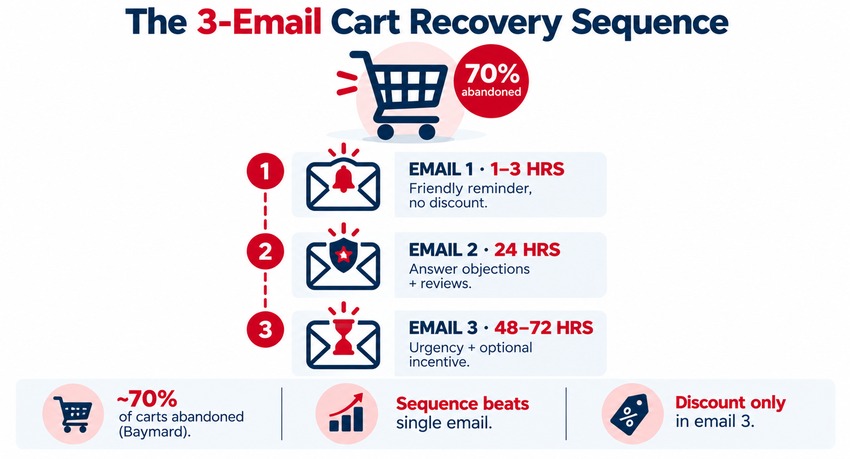
One email recovers some revenue; a sequence recovers multiples of it. The proven cadence:
| Send Time | Job | Incentive? | |
|---|---|---|---|
| #1 — The Reminder | 1–3 hours after abandonment | Helpful nudge: "your cart is saved" | No |
| #2 — The Objection Handler | 24 hours | Answer doubts: shipping, returns, reviews | Optional (free shipping) |
| #3 — The Closer | 48–72 hours | Urgency: cart expiring, stock limited | Yes, if margins allow |
Email #1: The Reminder (1–3 Hours)
Sent while intent is hottest — no discount, no pressure. Show the exact cart contents with images, one big "Return to your cart" button that restores the session in a single click, and a helpful tone ("We saved this for you"). Many brands see this first email outperform the other two combined.
Email #2: The Objection Handler (24 Hours)
Assume something stopped them, and remove it: restate free shipping thresholds and easy returns, add a short testimonial or review stars for the product left behind, and offer a support channel ("Questions? Reply to this email"). Social proof placement here routinely lifts the sequence's total recovery.
Email #3: The Closer (48–72 Hours)
Now urgency, honestly deployed: cart expiration, low-stock notices (only if true — fake scarcity destroys trust and can violate consumer-protection rules), or a time-boxed incentive. Done well, urgency converts the fence-sitters — the mechanics are covered in creating urgency: limited-time offers in email marketing.
The Discount Question: Protect Your Margin
Discounting every abandoned cart trains customers to abandon on purpose. Smarter 2026 patterns:
- Tier by cart value: free shipping for small carts, percentage off only above a threshold
- Tier by customer: new visitors may need 10% off; repeat buyers usually just need the reminder
- Lead with non-price incentives: free shipping beats equivalent percentage discounts in most tests
- Hold the discount until email #3 — never teach shoppers that abandoning triggers instant coupons
Writing Emails That Get Opened and Clicked
Subject lines: short, specific, and cart-aware — "You left something behind 👀", "Your cart expires tonight", "Still thinking it over, {FirstName}?". Formulas and testing frameworks are in our subject line hacks to boost open rates.
Body essentials:
- Product images of the actual abandoned items (dynamic content, not generic banners)
- One dominant CTA button — "Complete my order" — that deep-links into a restored cart
- Mobile-first layout: single column, large tap targets, minimal copy
- Trust signals near the CTA: payment icons, guarantee, returns policy
- A cross-sell row ("pairs well with…") only in emails #2–3, never crowding the primary CTA — tactics in how to use product recommendations in your emails
Technical Setup and Compliance
- Capture email early — email field first in checkout, plus exit-intent and browse-abandonment capture for anonymous visitors
- Platform triggers: Klaviyo, Mailchimp, Omnisend, and WooCommerce/Shopify native flows all support cart webhooks and dynamic cart blocks
- Suppress completed purchases instantly — nothing erodes trust like "you forgot this" after someone bought it
- Authenticate (SPF, DKIM, DMARC) and honor unsubscribes immediately; abandoned-cart emails are marketing messages under CAN-SPAM and GDPR, so consent and identification rules apply — the obligations are summarized in our guide to the CAN-SPAM Act and its implications
Measure and Optimize
| Metric | Healthy Target | Lever If Low |
|---|---|---|
| Open rate (directional) | 35–45% | Subject lines, send timing |
| Click-through rate | 8–15% | Cart imagery, CTA clarity |
| Recovery rate (sequence) | 3–10% of abandoned carts | Objection handling, incentive tiering |
| Revenue per recipient | Trend upward | Cross-sells, cart-value tiers |
| Unsubscribe rate | < 0.5% | Frequency, tone |
Test one variable at a time — send delay on email #1, incentive presence in email #3, social proof placement in email #2 — and fold winners into the default flow. Review quarterly; product lines, margins, and shipping offers drift, and the sequence should drift with them. Cart recovery is one flow inside a larger program — the full architecture is in our guide to crafting the perfect email campaign strategy.
Key Takeaways
- ~70% of carts are abandoned — a 3-email sequence recovers 3–10% of them on autopilot.
- Timing: 1–3 hours, 24 hours, 48–72 hours. Reminder → objection handler → closer.
- Show the actual cart, deep-link back to a restored checkout, one dominant CTA.
- Save discounts for email #3 and tier them — don't train shoppers to abandon.
- Honest urgency only; fake scarcity destroys trust and risks compliance trouble.
- Judge the flow on recovery rate and revenue per recipient, then test one variable at a time.
Frequently Asked Questions
How many abandoned cart emails should I send?
Three is the proven sweet spot: a reminder at 1–3 hours, an objection-handling email at 24 hours, and a closer with urgency or an incentive at 48–72 hours. One email leaves revenue behind; more than four risks unsubscribes and spam complaints.
When should the first abandoned cart email be sent?
Within one to three hours of abandonment, while purchase intent is still warm. Sending within the first hour often performs best for impulse-priced products; higher-consideration purchases tolerate the full three-hour window. Same-session instant emails can feel invasive.
Do abandoned cart emails really work?
Yes — they're consistently the highest-converting automation in e-commerce. Typical sequences recover 3–10% of abandoned carts, with open rates around 35–45%, because they reach people who already chose products. Results depend on timing, dynamic cart content, and a one-click return to checkout.
Should I offer a discount in abandoned cart emails?
Not immediately. Lead with a reminder and objection handling; reserve incentives for the final email, tier them by cart value or customer type, and prefer free shipping over percentage discounts. Instant coupons train repeat customers to abandon carts deliberately.
Are abandoned cart emails legal?
Yes, when compliant: they're marketing messages, so CAN-SPAM and GDPR rules apply — identify your business, honor unsubscribes promptly, and in consent-based jurisdictions email only shoppers who opted in or are existing customers. Suppress anyone who completed the purchase.
Lost carts are found revenue waiting for a system. AiScope Digital's email marketing services build, write, and optimize complete recovery flows — get a free consultation and we'll audit your abandonment funnel.