
The best SEO service for your business is a partner who understands your goals, uses transparent and sustainable strategies, communicates clearly, and measures success by leads and revenue — not just rankings. To choose one: define your goals and budget, decide which services you need (technical, local, content, links, AI search), review the provider's case studies and industry experience, ask how they'll audit and prioritize your site, understand exactly what's included and who does the work, insist on transparent reporting tied to business outcomes, check references and reviews, compare pricing models, and avoid red flags like guaranteed rankings, secret methods, or cheap bulk backlinks. This guide gives you the questions to ask and the criteria to compare providers side by side.
Step 1: Define Your Goals and Budget
Before talking to providers, clarify:
- Primary goal: more leads, online sales, local visibility, brand awareness, or traffic recovery
- Target markets: local, regional, national, or international
- Priority services or products to promote
- Current situation: new site, existing traffic, recent drops, migrations
- Budget range and timeline expectations
- Internal resources: who can write, approve content, or make website changes
Clear goals help providers propose relevant strategies and help you compare them fairly.
Step 2: Understand the Types of SEO Services
| Service | What It Covers | Who Needs It Most |
|---|---|---|
| SEO audit | Technical, content, and backlink review with priorities | Every business at the start |
| Technical SEO | Crawlability, indexing, speed, schema, migrations | Larger or complex sites, redesigns |
| Local SEO | Google Business Profile, reviews, citations, location pages | Service-area and storefront businesses |
| On-page and content SEO | Keyword research, page optimization, new content | Most businesses |
| Link building / digital PR | Earning authoritative links and mentions | Competitive markets |
| E-commerce SEO | Category, product, and faceted navigation optimization | Online stores |
| AI search / AEO | Optimizing for AI answers and citations | Businesses targeting informational queries |
| Reporting and analytics | Tracking rankings, traffic, conversions, ROI | Everyone |
Learn more about audits in how to conduct a comprehensive SEO audit in 2026 and technical work in what is technical SEO and why does it matter.
Step 3: Evaluate Experience and Results
- Case studies: Do they show the challenge, strategy, and measurable outcomes?
- Industry experience: Have they worked with businesses like yours?
- Local knowledge: For local SEO, do they understand your market?
- Team expertise: Who will work on your account, and what are their backgrounds?
- Reviews and references: Can you speak with current or past clients?
Step 4: Ask the Right Questions
- How will you audit my site, and what will you prioritize first?
- What specific deliverables are included each month?
- Who will do the work — in-house team or outsourced?
- How do you approach link building?
- How will you measure success, and how often will you report?
- What do you need from my team?
- How do you stay current with algorithm and AI search changes?
- What is the contract length and cancellation policy?
- Who owns the content, accounts, and data?
- What results are realistic in the first 3, 6, and 12 months?
Step 5: Insist on Transparent Reporting
Good reporting connects SEO activity to business outcomes:
- Organic traffic and engagement
- Keyword visibility for priority terms
- Leads, calls, form submissions, and sales from organic search
- Google Business Profile actions for local businesses
- Work completed and next priorities
- Access to your own GA4 and Search Console accounts
See how to calculate and maximize marketing ROI.
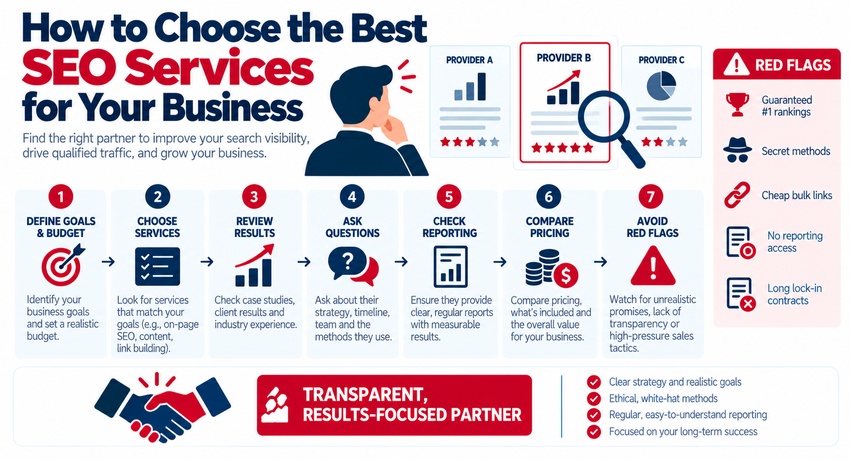
Step 6: Compare Pricing Models
| Pricing Model | How It Works | Pros | Considerations |
|---|---|---|---|
| Monthly retainer | Ongoing fee for defined services | Consistent progress, long-term strategy | Ensure clear deliverables |
| Project-based | Fixed price for a defined project (audit, migration) | Clear scope and cost | Limited ongoing support |
| Hourly consulting | Pay for expert time | Flexible for in-house teams | Costs can vary |
| Performance-based | Fees tied to specific results | Aligns incentives | Can encourage short-term tactics; define metrics carefully |
Prices vary by market competitiveness, scope, and provider expertise. Compare value and deliverables, not just price — see cost-effective small business SEO strategies for success.
Step 7: Watch for Red Flags
- Guaranteed #1 rankings — no one controls search engine algorithms
- Secret or proprietary methods they won't explain
- Cheap bulk backlinks or private blog networks that risk penalties
- No access to your analytics, Search Console, or reporting data
- Vague deliverables with no clear plan
- Long lock-in contracts without performance reviews
- Keyword-stuffed or mass-produced AI content with no expert review
- Ownership issues where the provider keeps your content or accounts
In-House vs. Agency vs. Freelancer
| Option | Best For | Trade-Offs |
|---|---|---|
| In-house SEO | Larger companies with ongoing needs | Salary and tools; may lack specialist depth |
| Agency | Businesses needing a full team of specialists | Higher cost; quality varies by agency |
| Freelancer/consultant | Specific projects or smaller budgets | Limited capacity; fewer specialties |
| Hybrid | Teams with some in-house skills | Requires coordination |
Example: Choosing an SEO Partner
A dental group with three locations interviewed four SEO providers. One promised first-page rankings in 30 days; another offered 200 backlinks per month. The group chose a provider that started with a technical and local audit, explained a 6-month plan prioritizing Google Business Profiles, location pages, and reviews, gave the group full access to analytics, and reported on calls and appointment requests. Visibility in local results improved steadily, and the group could see which locations benefited most. Use your real figures to evaluate providers.
SEO Provider Evaluation Checklist
- Goals, budget, and target markets documented before interviews
- Relevant case studies with measurable outcomes reviewed
- Team members and their roles identified
- Audit approach and first 90-day priorities explained
- Monthly deliverables listed in writing
- Link-building methods explained and white-hat
- Reporting tied to leads and revenue, with your own account access
- Contract terms, cancellation, and ownership clarified
- References checked
- No guarantees of specific rankings
Key Takeaways
- Define your goals, budget, and needs before evaluating providers.
- Look for proven results, relevant experience, and clear communication.
- Ask how they audit, prioritize, build links, and measure success.
- Insist on transparent reporting and ownership of your data.
- Avoid guaranteed rankings, secret methods, and low-quality links.
Frequently Asked Questions
How do I choose the right SEO company?
Define your goals and budget, review case studies and industry experience, ask how they audit and prioritize, confirm deliverables and who does the work, require transparent reporting tied to business results, check references, and avoid providers promising guaranteed rankings.
How much do SEO services cost?
Costs vary widely based on market competitiveness, website size, scope of services, and provider expertise. Pricing models include monthly retainers, project-based fees, hourly consulting, and performance-based arrangements.
What should be included in SEO services?
Typical services include an audit, keyword research, technical optimization, on-page improvements, content creation, local SEO, link building or digital PR, and regular reporting on traffic, rankings, and conversions.
How long before SEO services show results?
Some improvements can appear within weeks, especially technical fixes and local optimizations, but meaningful growth usually takes several months. Competitive markets and new websites may require longer.
What are red flags when hiring an SEO agency?
Red flags include guaranteed rankings, secret methods, cheap bulk backlinks, no access to your data, vague deliverables, long lock-in contracts, and low-quality or mass-produced content.
Looking for a transparent, results-driven SEO partner? AiScope Digital's search engine optimization services focus on measurable leads and revenue — get a free SEO consultation today.