

Engaging blog posts start with a clear understanding of who you're writing for and what they need, then deliver it in a format that's easy to read and act on. The recipe: pick a topic your audience actively cares about, write a specific headline that promises a benefit, hook readers in the first two sentences, answer the main question early, structure the post with descriptive subheadings and short paragraphs, add examples, stories, data, and visuals, write conversationally, include internal links and one clear next step, and optimize for search without sacrificing readability. Engaging content earns longer reading time, more shares, more backlinks, and more leads — and it's exactly the kind of helpful content search engines and AI tools reward. Here's how to write posts people actually finish.
What Makes a Blog Post Engaging?
| Element | Engaging | Disengaging |
|---|---|---|
| Topic | Solves a real audience problem | Company news nobody searched for |
| Headline | Specific benefit and clear promise | Vague or clickbait |
| Introduction | Gets to the point quickly | Long warm-up before the answer |
| Structure | Scannable headings, lists, tables | Walls of text |
| Voice | Conversational and confident | Jargon-heavy and stiff |
| Evidence | Examples, data, stories, screenshots | Generic statements |
| Visuals | Supporting images, charts, infographics | None, or irrelevant stock photos |
| Ending | Clear takeaway and next step | Abrupt finish or hard sell |
Step 1: Know Your Audience
Define who the post is for:
- Their role, experience level, and goals
- The problem or question that brings them to the post
- What they already know and what confuses them
- Objections and concerns
- The words they use to describe the problem
Sources of insight include customer interviews, sales and support teams, comments, reviews, forums, and keyword research — see keyword research: the foundation of on-page SEO.
Step 2: Choose Topics With Demand and Value
Strong topics sit at the intersection of what your audience needs, what people search for, and what your business can expertly address. Mix evergreen guides — see evergreen content: what it is and how to create it — with timely, opinionated, or data-driven pieces.
Step 3: Write a Headline That Earns the Click
Headline formulas that work:
- How-to: "How to [Achieve Result] Without [Common Pain]"
- List: "[Number] Ways to [Benefit] in [Timeframe]"
- Question: "Is [Option] Worth It in 2026?"
- Guide: "The Complete Guide to [Topic] for [Audience]"
- Mistakes: "[Number] [Topic] Mistakes That Cost You [Outcome]"
- Comparison: "[A] vs. [B]: Which Is Better for [Use Case]?"
Be specific and honest. Your SEO title tag can differ slightly from the on-page headline.
Step 4: Hook Readers Immediately
The first two or three sentences decide whether people stay. Effective openings:
- Answer first: state the key takeaway immediately (great for SEO and AI answers)
- Relatable problem: "If your emails keep landing in spam, you're not alone."
- Surprising fact: a credible, sourced statistic
- Short story: a quick scenario your reader recognizes
- Bold claim: a confident statement you'll back up
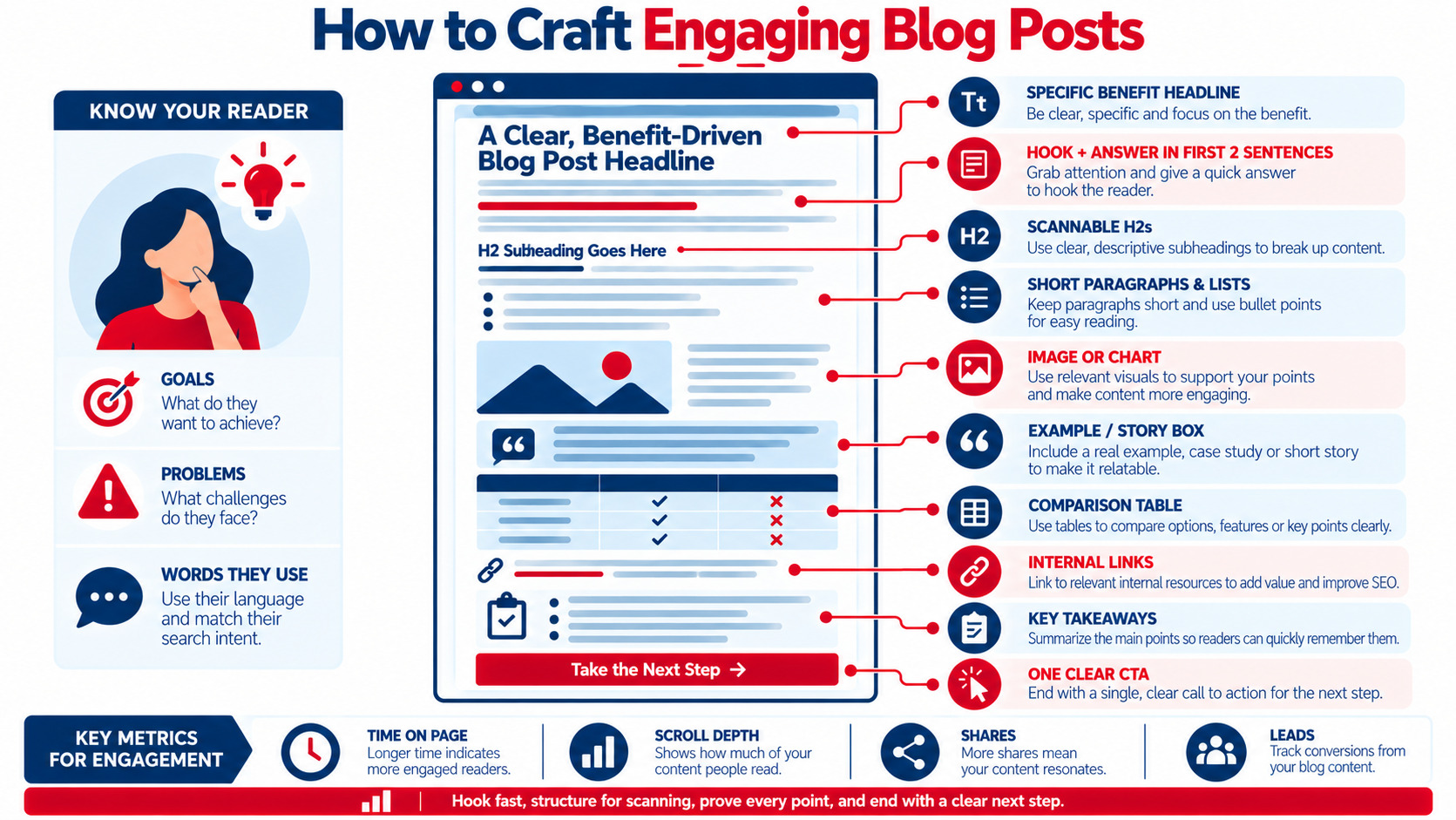
Step 5: Structure for Scanning
Most readers skim before they commit:
- Descriptive H2 and H3 subheadings (often phrased as questions)
- Paragraphs of two to four sentences
- Bulleted and numbered lists for steps and options
- Tables for comparisons
- Bold key phrases sparingly
- A summary or "Key Takeaways" section
Heading structure also helps SEO — see using header tags to improve your SEO.
Step 6: Write Conversationally
- Write as if explaining to one smart friend
- Use "you" and active voice
- Replace jargon with plain language (or define terms)
- Vary sentence length for rhythm
- Cut filler words and repetition
Step 7: Add Proof and Personality
Engagement grows when content feels real and credible:
- Examples and case studies from your experience
- Data and research with sources
- Expert quotes and original opinions
- Screenshots, templates, and checklists readers can use immediately
- Stories that show the problem and solution in action
These elements also support E-E-A-T (experience, expertise, authoritativeness, trustworthiness).
Step 8: Use Visuals Strategically
Add images that explain, not just decorate: diagrams, charts, annotated screenshots, infographics, and short videos. Optimize images for speed and add descriptive alt text — see creating effective infographics: a step-by-step guide and image optimization best practices.
Step 9: Optimize for SEO Without Hurting Readability
- Include the primary keyword in the title, intro, a subheading, and URL
- Answer related questions in subheadings and FAQs
- Link to related posts and service pages with descriptive anchor text
- Write a compelling meta description
- Add schema where appropriate
The full approach is in blogging for SEO: how to create content that ranks.
Step 10: End With a Clear Call to Action
Tell readers what to do next: download a related guide, subscribe to your newsletter, read the next article, or book a consultation. Keep one primary CTA that fits the post's intent. Lead generation strategies are in lead generation with content marketing.
Blog Post Publishing Checklist
| Area | Check |
|---|---|
| Audience and intent | Post answers a specific reader question |
| Headline | Specific, benefit-driven, under ~60 characters for SEO title |
| Introduction | Hook and key answer within the first paragraph |
| Structure | Descriptive subheadings, short paragraphs, lists, tables |
| Evidence | Examples, data with sources, visuals |
| Links | Relevant internal and authoritative external links |
| SEO | Keyword placement, meta description, alt text, schema |
| CTA | One clear next step |
| Proofreading | Grammar, accuracy, broken links, mobile preview |
Promote and Improve
Share new posts in newsletters and on social media, repurpose them into carousels and short videos, and update top posts regularly. Planning cadence is covered in the importance of a content calendar for SEO. Track engagement time, scroll depth, conversions, and rankings to learn what resonates.
Common Mistakes
- Writing for search engines instead of people
- Burying the answer deep in the post
- Long, dense paragraphs
- No examples or original insight
- Missing internal links and CTAs
- Publishing and never updating
Key Takeaways
- Start with your audience's real questions and choose topics with demand and value.
- Write specific headlines and hook readers with an early answer or relatable problem.
- Structure posts for scanning and write conversationally.
- Add proof, personality, and helpful visuals to build trust and engagement.
- Optimize for SEO, end with one clear CTA, and promote and update posts over time.
Frequently Asked Questions
How long should a blog post be?
Length should match the topic and search intent. Many in-depth guides run 1,500 to 2,500 words, while quick answers can be shorter. Focus on fully answering the reader's question with no filler, rather than hitting a specific word count.
How do I make my blog posts more engaging?
Choose topics your audience cares about, write specific headlines, hook readers in the first sentences, use scannable structure, write conversationally, add examples, data, stories, and visuals, and end with a clear call to action.
How often should I publish blog posts?
Consistency matters more than frequency. Many businesses publish weekly or a few times per month. Choose a schedule you can sustain while maintaining quality, and update existing posts regularly.
What should a blog post introduction include?
A strong introduction hooks the reader, shows you understand their problem, and quickly states the main answer or what they'll learn. Answer-first introductions also help with featured snippets and AI search visibility.
How do I measure blog post engagement?
Track average engagement time, scroll depth, bounce or engagement rate, comments, social shares, backlinks, newsletter sign-ups, and conversions. Compare posts to identify topics and formats that resonate with your audience.
Want blog content that readers love and search engines reward? AiScope Digital's content marketing services research, write, and optimize engaging blog posts that drive traffic and leads — get a free consultation today.