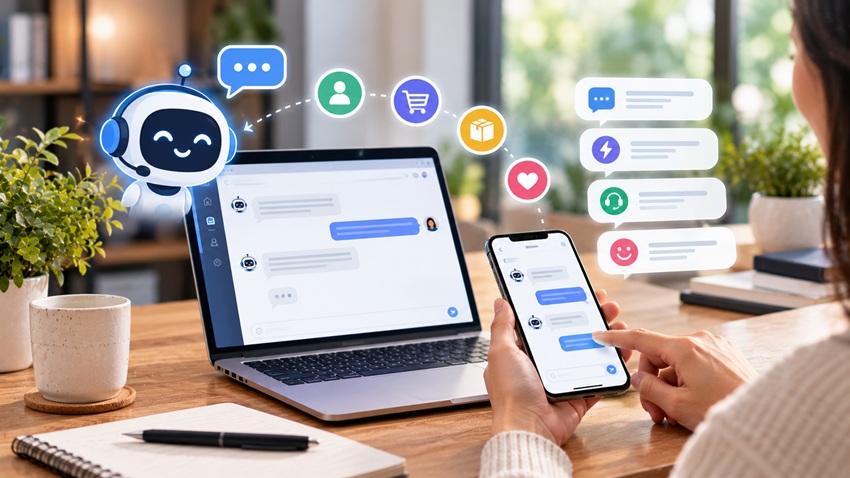
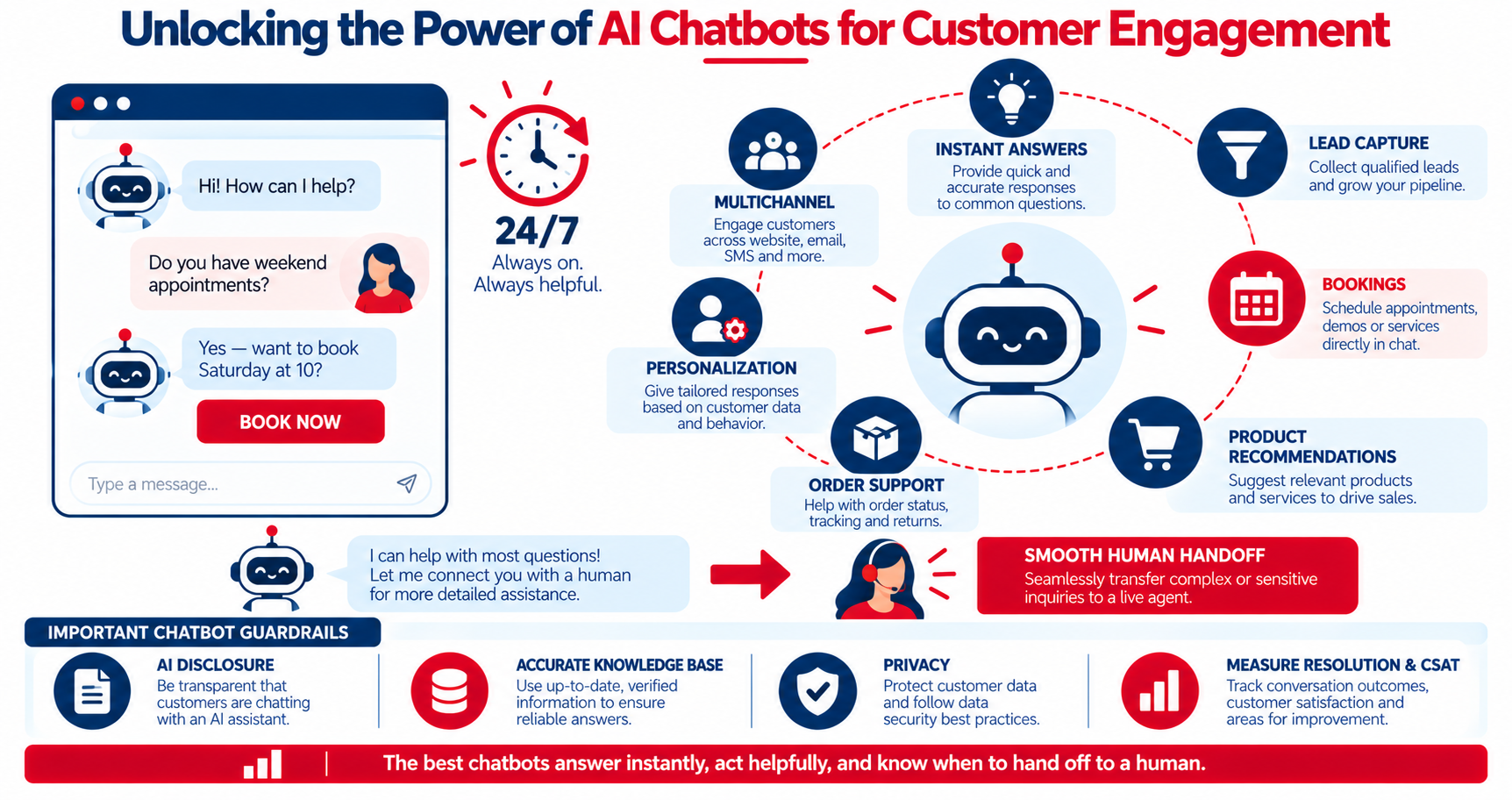
AI chatbots boost customer engagement by answering questions instantly, guiding visitors to the right products or services, capturing and qualifying leads, booking appointments, and resolving routine support requests — 24 hours a day, across your website, messaging apps, and social channels. Modern chatbots powered by large language models understand natural language far better than older rule-based bots, so conversations feel more helpful and human. To use them well: define clear goals, train the bot on accurate business information, design for specific use cases, provide a smooth handoff to humans, personalize responses with customer data where appropriate, disclose that customers are talking with AI, protect privacy, and measure resolution rates, satisfaction, and conversions. Here's how to put AI chatbots to work.
Rule-Based Bots vs. AI Chatbots
| Feature | Rule-Based Chatbot | AI Chatbot |
|---|---|---|
| How it works | Predefined decision trees and keywords | Natural language understanding and generation |
| Flexibility | Limited to scripted paths | Handles varied phrasing and follow-ups |
| Setup | Simple flows | Requires knowledge base, guardrails, testing |
| Best for | Simple FAQs, menu-driven tasks | Complex questions, conversational support, recommendations |
| Risks | Frustrating dead ends | Inaccurate answers without good data and guardrails |
Many businesses combine both: structured flows for bookings or payments and AI for open-ended questions.
How AI Chatbots Improve Customer Engagement
1. Instant, 24/7 Responses
Customers get answers when they need them, even outside business hours, reducing wait times and lost opportunities.
2. Lead Capture and Qualification
Chatbots can ask qualifying questions (budget, timeline, service needed), collect contact details, and route hot leads to sales — see lead nurturing emails best practices for B2B.
3. Appointment Booking
Integrate with scheduling tools so visitors can book consultations, demos, or service visits directly in the chat.
4. Product Recommendations
E-commerce chatbots can ask about needs and preferences, then suggest products, sizes, or bundles — see how to use upselling and cross-selling in e-commerce.
5. Customer Support and Order Help
Handle order status, returns, shipping questions, account help, and troubleshooting, freeing human agents for complex issues.
6. Personalization
With appropriate data access and consent, chatbots can greet returning customers, reference past orders, and tailor recommendations.
7. Multichannel Presence
Deploy on your website, Facebook Messenger, Instagram, WhatsApp, SMS, and other channels to meet customers where they are.
Chatbot Use Cases by Industry
| Industry | High-Value Chatbot Use Cases |
|---|---|
| E-commerce | Product finder, order tracking, returns, size guidance |
| Healthcare | Appointment scheduling, office hours, insurance FAQs (no diagnosis) |
| Real estate | Property questions, showing bookings, lead qualification |
| Legal and professional services | Intake questions, consultation scheduling, practice area info |
| Home services | Quote requests, service area checks, emergency routing |
| SaaS | Onboarding help, feature questions, demo booking |
| Hospitality | Reservations, menus, event inquiries |
How to Implement an AI Chatbot
- Define goals: support deflection, lead capture, bookings, or sales
- Choose a platform: website chat tools, CRM-integrated chatbots, or custom solutions
- Build a knowledge base: FAQs, policies, product data, service details, pricing guidance
- Design conversation flows: greetings, common paths, qualifying questions
- Set guardrails: topics to avoid, approved answers for sensitive questions, escalation rules
- Integrate systems: CRM, scheduling, order management, help desk
- Test thoroughly: real questions, edge cases, and failure scenarios
- Launch and monitor: review transcripts, fix gaps, update content
Best Practices for Trustworthy Chatbots
- Disclose AI: let users know they're chatting with an automated assistant
- Offer human handoff: make it easy to reach a person, especially for complex or sensitive issues
- Keep answers accurate: ground responses in approved business information
- Protect privacy: collect only necessary data, follow privacy laws, and secure integrations
- Avoid sensitive advice: don't let bots give medical, legal, or financial advice beyond general information
- Match your brand voice: friendly, professional, and consistent
- Keep it fast: short, clear responses with quick-reply options
Measuring Chatbot Success
| Metric | What It Shows |
|---|---|
| Resolution / containment rate | Share of conversations resolved without human help |
| Customer satisfaction (CSAT) | How users rate the experience |
| Leads captured and qualified | Sales impact |
| Bookings or conversions | Revenue contribution |
| Handoff rate | Where the bot needs improvement |
| Response accuracy | Quality of answers (from transcript reviews) |
| Average handling time saved | Support efficiency |
See must-track marketing success metrics for effective measurement.
Example: AI Chatbot for a Dental Practice
A dental practice added an AI chatbot trained on its services, hours, insurance policies, and new patient process. The bot answered common questions, booked cleanings through the practice's scheduling system, collected contact details for treatment inquiries, and handed off to staff for billing or clinical questions. The front desk received fewer routine calls, and after-hours appointment requests increased. Use your real figures to measure impact.
Common Chatbot Mistakes
- Launching without an accurate knowledge base
- No easy path to a human
- Pretending the bot is a person
- Overly long or robotic responses
- Collecting unnecessary personal data
- Never reviewing transcripts
AI Chatbot Readiness Checklist
- Goals and use cases defined
- Knowledge base with accurate, current information
- Guardrails for sensitive topics
- CRM, scheduling, and help desk integrations
- AI disclosure and privacy notice
- Human handoff during business hours and after-hours fallback
- Testing with real customer questions
- Metrics dashboard and monthly transcript reviews
Writing Chatbot Conversations That Convert
- Open with a helpful prompt: "Looking for pricing, booking, or something else?"
- Use quick-reply buttons for common paths to speed up conversations
- Ask one question at a time when qualifying leads
- Confirm details before submitting bookings or forms
- Close with a next step: booking link, resource, or human contact
- Trigger proactively on high-intent pages like pricing or checkout, but avoid interrupting every page
Review transcripts weekly in the first month to identify unanswered questions, confusing replies, and new topics to add to the knowledge base. Small improvements to wording often raise resolution and conversion rates.
Getting Started Small
Start with one high-value use case — such as answering top FAQs or booking appointments — prove results, then expand to lead qualification, order support, and new channels.
Key Takeaways
- AI chatbots provide instant, 24/7, conversational engagement.
- They capture leads, book appointments, recommend products, and resolve support requests.
- Success depends on accurate knowledge, guardrails, and human handoff.
- Disclose AI use and protect customer privacy.
- Measure resolution, satisfaction, and conversions, and improve continuously.
Frequently Asked Questions
What is an AI chatbot?
An AI chatbot is a conversational assistant that uses natural language processing and AI models to understand customer questions and respond helpfully, often integrated with business systems to complete tasks like bookings or order lookups.
How do AI chatbots improve customer engagement?
They respond instantly at any hour, guide visitors to relevant information, capture and qualify leads, book appointments, recommend products, and resolve routine support questions, creating faster and more convenient experiences.
Will chatbots replace customer service teams?
Chatbots handle routine questions efficiently, but human agents remain essential for complex, sensitive, or high-value interactions. The best approach combines AI automation with easy human handoff.
Are AI chatbots accurate?
Accuracy depends on the quality of the knowledge base, guardrails, and ongoing monitoring. Grounding responses in approved business information and reviewing transcripts regularly helps keep answers accurate.
Do I need to tell customers they're talking to a chatbot?
Transparency is best practice and may be required in some jurisdictions. Clearly disclosing that customers are interacting with an AI assistant builds trust and sets expectations.
Ready to engage customers around the clock? As an AI-powered agency, AiScope Digital's online marketing services design and deploy AI chatbots that capture leads and support customers — get a free consultation today.