

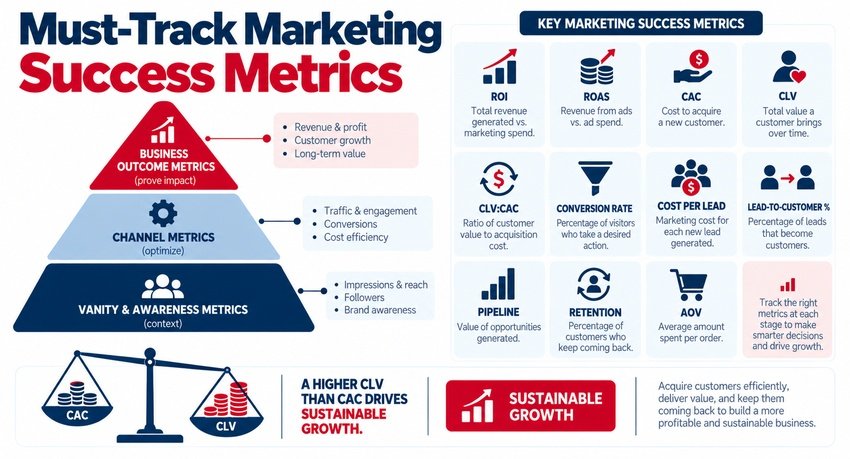
The marketing metrics that matter most are the ones that connect activity to revenue. The must-track metrics are: revenue attributed to marketing, marketing ROI, return on ad spend (ROAS), customer acquisition cost (CAC), customer lifetime value (CLV) and the CLV:CAC ratio, conversion rate, cost per lead (CPL), lead-to-customer rate, marketing-sourced pipeline, retention and churn, and average order value — supported by channel KPIs like organic traffic, email click-through rate, and social engagement. Vanity metrics like impressions and follower counts can be useful context, but they shouldn't define success. This guide explains each metric, how to calculate it, and how to build a measurement framework that guides better decisions.
Business Metrics vs. Channel Metrics vs. Vanity Metrics
| Level | Examples | Purpose |
|---|---|---|
| Business outcome metrics | Revenue, ROI, CAC, CLV, pipeline | Prove marketing's business impact |
| Channel performance metrics | CPL, ROAS, conversion rate, CTR, email CTR | Optimize campaigns and channels |
| Vanity / awareness metrics | Impressions, followers, likes | Context for reach; not success on their own |
The Must-Track Marketing Metrics
| Metric | Formula | What It Tells You |
|---|---|---|
| Marketing ROI | (Revenue attributed − marketing cost) ÷ marketing cost | Overall profitability of marketing |
| ROAS | Revenue from ads ÷ ad spend | Revenue efficiency of paid media |
| Customer acquisition cost (CAC) | Total sales and marketing cost ÷ new customers | Cost to win a customer |
| Customer lifetime value (CLV) | Average order value × purchase frequency × customer lifespan (simplified) | Long-term customer value |
| CLV:CAC ratio | CLV ÷ CAC | Sustainability of growth |
| Conversion rate | Conversions ÷ visitors (or clicks) | Effectiveness of pages and offers |
| Cost per lead (CPL) | Spend ÷ leads | Lead generation efficiency |
| Lead-to-customer rate | Customers ÷ leads | Lead quality and sales alignment |
| Marketing-sourced pipeline | Value of opportunities from marketing | B2B revenue contribution |
| Retention / churn rate | Customers retained or lost over a period | Loyalty and long-term value |
| Average order value (AOV) | Revenue ÷ orders | E-commerce basket size |
For ROI calculation details, see how to calculate and maximize marketing ROI.
1. Marketing ROI and ROAS
ROI includes all marketing costs (tools, people, agencies, ads) and ideally uses profit, not just revenue. ROAS focuses on ad spend efficiency. Use both: ROAS for campaign optimization, ROI for business decisions.
2. Customer Acquisition Cost (CAC)
CAC shows what it costs to win each new customer. Track it by channel to see where acquisition is most efficient. Rising CAC can signal market saturation, poor targeting, or weak conversion paths.
3. Customer Lifetime Value (CLV) and CLV:CAC
CLV estimates how much a customer is worth over the relationship. Comparing CLV to CAC shows whether growth is sustainable. Many businesses aim for CLV well above CAC; the right ratio depends on margins and payback period.
4. Conversion Rate
Track conversion rates by page, channel, device, and campaign. Low conversion rates often point to weak landing pages, mismatched messaging, or friction — see proven website conversion tips to turn visitors into paying customers.
5. Cost per Lead and Lead Quality
CPL measures efficiency, but cheap leads that never buy aren't a win. Track lead-to-customer rate and revenue per lead alongside CPL.
6. Pipeline and Revenue Contribution (B2B)
For B2B companies, track marketing-sourced and marketing-influenced pipeline, opportunities, win rates, and sales cycle length using CRM data.
7. Retention and Churn
Keeping customers is usually cheaper than acquiring new ones. Track repeat purchase rate, churn, and net revenue retention, and measure how email and loyalty programs influence them.
Channel-Specific KPIs
| Channel | Key KPIs |
|---|---|
| SEO | Organic traffic to key pages, rankings, organic conversions, impressions in Search Console |
| PPC | CTR, CPC, conversion rate, CPA, ROAS, impression share |
| Social media | Engagement rate, link clicks, social-driven conversions, follower growth |
| Click-through rate, conversion rate, revenue per email, unsubscribe and complaint rates | |
| Content | Organic visits, time engaged, assisted conversions, leads from content |
| Website | Conversion rate, bounce/engagement rate, Core Web Vitals |
| Local | GBP calls, direction requests, website clicks, review rating |
See key social media metrics every marketer should track and using analytics tools to measure email performance.
Building a Measurement Framework
- Start with business goals: revenue, customers, retention
- Choose a few north-star metrics for leadership
- Map channel KPIs that ladder up to those goals
- Set up tracking: GA4 key events, UTMs, call tracking, CRM integration
- Choose attribution: data-driven attribution, plus incrementality tests where possible
- Build dashboards for each audience
- Review regularly: weekly campaign checks, monthly performance reviews, quarterly strategy
See how data analytics marketing powers modern campaigns.
Example: Measurement for a B2B Software Company
A B2B software company reported website traffic and social followers but couldn't explain revenue impact. It connected forms and demo bookings to its CRM, tagged campaigns with UTMs, and began tracking cost per qualified lead, marketing-sourced pipeline, CAC by channel, and CLV:CAC. The data showed webinars produced fewer leads but higher win rates than paid social, so budget shifted accordingly. Use your real figures to set benchmarks.
Common Measurement Mistakes
- Reporting vanity metrics as success
- No connection between marketing data and CRM revenue
- Inconsistent UTMs and naming
- Relying solely on last-click attribution
- Tracking too many metrics without priorities
- Ignoring lead quality and retention
Marketing Measurement Checklist
- Business goals and north-star metrics defined
- GA4 key events and call tracking configured
- UTMs used consistently on every campaign
- CRM connected for revenue and pipeline reporting
- CAC, CLV, and ROI calculated by channel
- Dashboards tailored to executives and channel owners
- Attribution approach documented
- Regular review cadence scheduled
Leading vs. Lagging Indicators
Some metrics predict future results; others confirm what already happened. Track both:
| Leading Indicators | Lagging Indicators |
|---|---|
| Website engagement and returning visitors | Revenue and profit |
| Email list growth and click-through rate | Customer acquisition cost |
| Qualified lead volume | Customer lifetime value |
| Demo or consultation bookings | Retention and churn |
| Search impressions for priority topics | Marketing ROI |
Leading indicators help you course-correct during a quarter; lagging indicators confirm whether strategy is working over time. A drop in qualified leads this month warns you about revenue next quarter — giving you time to adjust campaigns before results suffer.
Key Takeaways
- Prioritize metrics that connect marketing to revenue and profit.
- Track ROI, ROAS, CAC, CLV, conversion rate, CPL, pipeline, and retention.
- Use channel KPIs to optimize, but don't confuse them with business outcomes.
- Build a measurement framework with clean tracking and CRM integration.
- Review metrics regularly and act on what they reveal.
Frequently Asked Questions
What are the most important marketing metrics?
The most important metrics connect marketing to business results: marketing ROI, ROAS, customer acquisition cost, customer lifetime value, conversion rate, cost per lead, lead-to-customer rate, pipeline contribution, and retention.
What's the difference between ROI and ROAS?
ROAS measures revenue generated per dollar of ad spend, while ROI measures overall profitability by comparing returns with all marketing costs. ROAS is useful for optimizing ads; ROI shows total business impact.
What is a good CLV to CAC ratio?
A healthy ratio depends on margins and payback period, but many businesses aim for customer lifetime value to be several times higher than acquisition cost to support sustainable growth.
What are vanity metrics in marketing?
Vanity metrics like impressions, likes, and follower counts look impressive but don't necessarily indicate business results. They provide context for reach and engagement but should be paired with conversion and revenue metrics.
How do I track marketing success metrics?
Use GA4 for website conversions, UTM parameters for campaigns, call tracking for phone leads, CRM integration for pipeline and revenue, and dashboards to monitor KPIs by channel and campaign.
Want marketing measurement that proves ROI? AiScope Digital's analytics and reporting services build dashboards and tracking tied to revenue — get a free analytics consultation today.