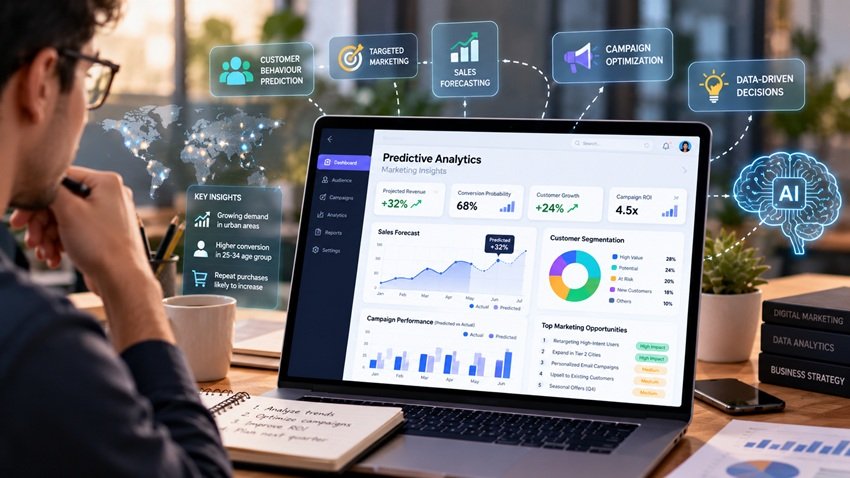
Predictive analytics marketing uses historical data, statistical models, and machine learning to forecast what customers are likely to do next — who will buy, who might churn, what they'll want, and how much they'll be worth. Instead of reacting to last month's results, marketers can act ahead of time. The most valuable applications are: lead scoring to prioritize sales follow-up, churn prediction to trigger retention campaigns, customer lifetime value forecasting to guide acquisition budgets, next-best-product recommendations, send-time and channel optimization, demand and seasonal forecasting, and budget allocation modeling. To get started, define a business question, gather clean first-party data, choose the right tools (many CRMs, email platforms, and GA4 include built-in predictions), test predictions against real outcomes, and turn insights into automated actions. Here's how it works and how to apply it.
What Predictive Analytics Can Forecast
| Prediction | Business Question | Marketing Action |
|---|---|---|
| Purchase probability | Who is likely to buy soon? | Target with offers or sales outreach |
| Lead scoring | Which leads are most likely to close? | Prioritize sales follow-up |
| Churn risk | Which customers may stop buying? | Trigger retention campaigns |
| Customer lifetime value | Which customers will be most valuable? | Invest more in acquiring similar customers |
| Next best product | What will this customer want next? | Personalized recommendations |
| Optimal send time | When is this subscriber most likely to engage? | Schedule emails individually |
| Demand forecasting | What will sell next season? | Inventory and campaign planning |
| Budget response | How will sales change if spend shifts? | Allocate budget across channels |
How Predictive Analytics Works
- Define the question: for example, "Which subscribers are likely to purchase in the next 30 days?"
- Collect data: purchase history, website behavior, email engagement, CRM records, demographics
- Prepare data: clean duplicates, fix missing values, standardize formats
- Build or select a model: regression, classification, clustering, or machine learning models
- Validate: test predictions on historical data the model hasn't seen
- Deploy: score customers or leads and feed results into marketing tools
- Act and measure: run campaigns based on predictions and track outcomes
- Refine: retrain models as behavior and markets change
Key Applications in Marketing
1. Lead Scoring
Predictive lead scoring analyzes which attributes and behaviors historically led to closed deals — job title, company size, pages viewed, content downloaded, emails clicked — and scores new leads accordingly. Sales teams focus on the highest-probability opportunities — see lead nurturing emails best practices for B2B.
2. Churn Prediction and Retention
Models flag customers showing early warning signs: declining purchase frequency, lower engagement, support complaints, or reduced logins. Trigger win-back emails, loyalty offers, or account manager outreach before customers leave.
3. Customer Lifetime Value Forecasting
Predicted CLV helps decide how much to spend acquiring customers and which segments to prioritize. Combine with CAC to evaluate channel profitability — see must-track marketing success metrics for effective measurement.
4. Personalized Recommendations
Recommendation models predict which products or content each customer is most likely to engage with, powering personalized emails and website experiences — see how to use product recommendations in your emails.
5. Email and Channel Optimization
Predictive send-time optimization and channel preference models increase engagement by reaching people when and where they're most responsive — see predictive analytics in email campaigns.
6. Demand Forecasting
Predict seasonal demand, product trends, and inventory needs so campaigns and stock levels align — see seasonal content: how to leverage trends for SEO.
7. Budget Allocation and Marketing Mix Modeling
Models estimate how changes in channel spend affect sales, helping allocate budgets more effectively, especially when user-level tracking is limited.

Tools With Built-In Predictive Features
| Tool Type | Predictive Capabilities |
|---|---|
| GA4 | Predictive metrics such as purchase probability, churn probability, and predicted revenue (when eligibility thresholds are met) |
| CRM platforms (e.g., HubSpot, Salesforce) | Predictive lead scoring, deal forecasting |
| Email and marketing automation | Send-time optimization, predicted CLV, churn risk segments |
| E-commerce platforms | Product recommendations, customer segments |
| Ad platforms | Automated bidding using conversion predictions |
| BI and data science tools | Custom models and forecasting |
Many businesses can start with built-in features before investing in custom models — see top CRM tools for email marketing.
Data Requirements and Quality
Predictions are only as good as the data behind them:
- Collect first-party data with clear consent
- Connect CRM, e-commerce, email, and website data
- Keep records clean, deduplicated, and consistently formatted
- Ensure enough historical data and outcomes for models to learn from
- Monitor for bias that could unfairly exclude groups
Privacy and Ethics
Use data transparently and within the scope customers agreed to. Comply with privacy laws, avoid sensitive inferences without explicit consent, and explain personalization in your privacy policy. Responsible use protects trust.
Example: Predictive Retention for a Subscription Box Company
A subscription box company used its email platform's churn-risk segments and order history to identify subscribers likely to cancel. High-risk subscribers received a personalized "customize your next box" email and a loyalty perk, while high-value customers were offered an exclusive preview. Cancellation rates among targeted subscribers declined compared with a control group. Use your real figures to measure impact.
Common Predictive Analytics Mistakes
- Starting without a clear business question
- Using messy, incomplete, or siloed data
- Trusting predictions without validating them
- Not acting on predictions in campaigns
- Ignoring privacy and fairness
- Never retraining models as behavior changes
Getting Started Checklist
- Business question and success metric defined
- First-party data sources connected
- Data cleaned and consented
- Built-in predictive features explored in existing tools
- Predictions validated against historical outcomes
- Campaigns or workflows triggered by predictions
- Control groups used to measure lift
- Regular model review and retraining scheduled
Predictive Analytics Use Cases by Business Type
| Business Type | Most Valuable Predictions |
|---|---|
| E-commerce | Purchase probability, next best product, churn risk, predicted CLV |
| B2B and SaaS | Lead scoring, deal close likelihood, renewal and expansion risk |
| Local services | Seasonal demand, repeat service timing, campaign response |
| Subscription businesses | Cancellation risk, upgrade likelihood, engagement decline |
| Healthcare and appointments | No-show risk and reminder timing (using permitted data only) |
| Nonprofits | Donor retention, upgrade potential, campaign response |
Start with the prediction closest to revenue for your business. For many companies, that means lead scoring or churn prevention, because both turn directly into actions your sales and retention teams can take this week. Prove value with one model, then expand to forecasting and personalization once the team trusts the results.
Key Takeaways
- Predictive analytics forecasts customer behavior to guide smarter decisions.
- Key uses include lead scoring, churn prediction, CLV, recommendations, and forecasting.
- Clean, connected first-party data is essential.
- Many CRMs, email tools, and GA4 offer built-in predictive features.
- Validate predictions, act on them, measure lift, and respect privacy.
Frequently Asked Questions
What is predictive analytics in marketing?
Predictive analytics in marketing uses historical data, statistical models, and machine learning to forecast future customer behavior, such as purchase likelihood, churn risk, lifetime value, and product preferences.
How is predictive analytics used in marketing?
Marketers use it for lead scoring, churn prevention, customer lifetime value forecasting, personalized recommendations, email send-time optimization, demand forecasting, and budget allocation.
Do small businesses need data scientists for predictive analytics?
Not necessarily. Many CRM, email, e-commerce, and analytics platforms include built-in predictive features. Custom models may require data science expertise for more complex needs.
What data is needed for predictive marketing?
Useful data includes purchase history, website and app behavior, email engagement, CRM records, customer service interactions, and campaign responses — collected with proper consent and kept clean and connected.
How accurate is predictive analytics?
Accuracy depends on data quality, model choice, and how stable customer behavior is. Validate predictions against real outcomes, use control groups to measure lift, and retrain models regularly.
Want marketing decisions powered by prediction? AiScope Digital's analytics and reporting services turn your data into forecasts and action — get a free analytics consultation today.