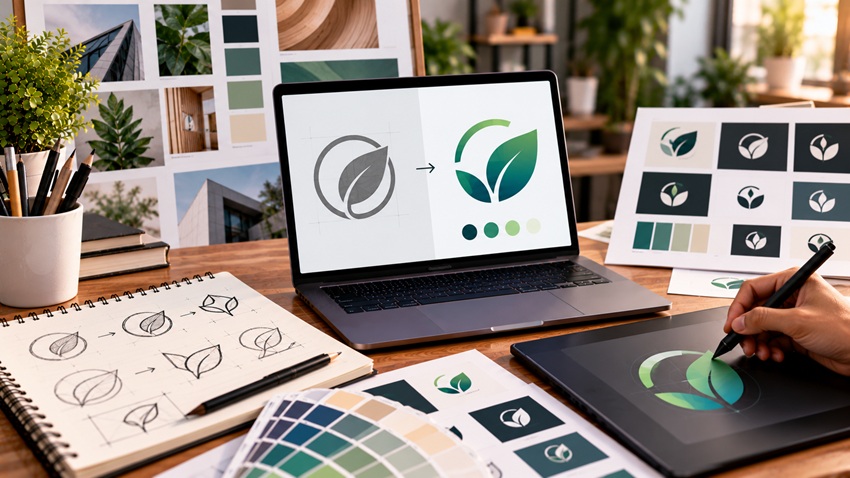
A logo refresh modernizes an existing logo while preserving the recognition customers already have — updating typography, simplifying shapes, refining colors, improving small-size legibility, and building a flexible logo system, without replacing the brand's core identity. It's the right choice when your brand is still trusted but its logo looks dated, performs poorly on screens, or no longer reflects how the business has grown. Done well, a refresh feels like the same brand at its best. Here's how to tell whether you need a refresh, what to keep and what to change, and how to roll it out smoothly.
Refresh vs. Rebrand: Know the Difference
| Factor | Logo Refresh | Full Rebrand / Redesign |
|---|---|---|
| Goal | Modernize while keeping recognition | Reposition or reinvent the brand |
| Scope | Typography, color, shape refinement, versions | New logo concept, name possibly, strategy, identity |
| Risk | Low — familiarity preserved | Higher — recognition must be rebuilt |
| Typical triggers | Dated look, digital problems, growth | Merger, new market, reputation issues, major pivot |
| Customer reaction | "They look sharper" | "Who is this now?" |
| Cost and time | Lower | Higher |
If the business itself has fundamentally changed, a full redesign may be better — see complete overhauls: when and how to redesign your logo.
Signs Your Logo Needs a Refresh
- It looks dated: heavy gradients, drop shadows, bevels, or fonts strongly tied to a past era
- It fails at small sizes: unreadable as a favicon, app icon, or social avatar
- It doesn't work in one color or on dark backgrounds
- Inconsistent versions exist across your website, signage, and print
- The business has grown into new services or markets the logo no longer reflects
- Competitors look more modern and your brand appears less credible by comparison
- Low-quality files: no vector source, pixelated versions, unclear color codes
What to Keep vs. What to Change
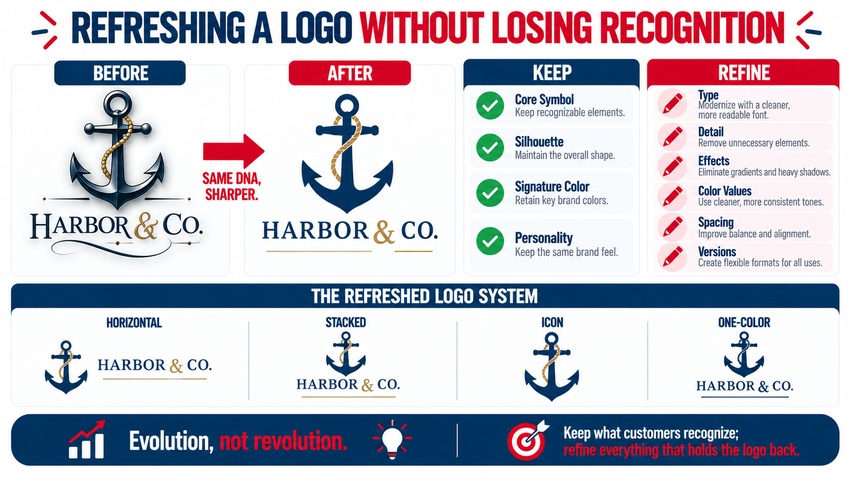
The goal of a refresh is to protect brand equity — the recognizable elements customers associate with you.
Usually Keep
- The core concept or symbol
- The general silhouette or shape
- Signature colors (possibly refined)
- The brand name and overall personality
Usually Change or Refine
- Typography: modernized, customized, or simplified
- Detail level: fewer lines, cleaner geometry, removal of unnecessary elements
- Effects: flattening gradients, shadows, and 3D treatments
- Color values: refined shades with better contrast and digital rendering
- Proportions and spacing: improved balance and kerning
- Versions: adding horizontal, stacked, icon-only, and one-color variations
Color refinement is covered in mastering color theory in logo design, and typography choices in typography in logos: choosing the right fonts.
The Logo Refresh Process
Step 1: Brand and Logo Audit
Collect every version of the logo in use, identify inconsistencies, and gather feedback from customers and employees about what feels distinctive. Review how the logo performs across digital and physical applications.
Step 2: Define Goals and Constraints
What should improve: modern appearance, scalability, consistency, alignment with new services? What must stay recognizable? Discovery methods are covered in research and discovery: laying the foundation for great logos.
Step 3: Competitive Review
Check how competitors present themselves today. The refresh should help you stand out, not move toward the same look everyone else uses.
Step 4: Explore Refinement Options
Develop a range of refinements, from subtle to bolder, so stakeholders can choose how far to evolve. Test each at large and small sizes, in color and one color, and on light and dark backgrounds.
Step 5: Build a Responsive Logo System
Modern brands need multiple versions for different spaces: full logo, simplified version, symbol or monogram, and favicon. The approach is detailed in responsive logos: designing for different screen sizes.
Step 6: Finalize Files and Guidelines
Deliver vector files, PNGs, SVGs, color codes (HEX, RGB, CMYK, Pantone), clear space rules, minimum sizes, and examples of incorrect usage. Production tips are in Adobe Illustrator: essential tips and tricks for logo design.
Step 7: Plan the Rollout
A refresh touches every customer touchpoint. List where the logo appears and prioritize updates.
Rollout Planning Checklist
| Priority | Touchpoints |
|---|---|
| Immediate (digital) | Website, favicon, social media profiles, email signatures, Google Business Profile, app icons |
| Short-term | Email templates, presentations, proposals, invoices, ads |
| Medium-term | Business cards, brochures, packaging, uniforms |
| Long-term (as replaced) | Signage, vehicle wraps, printed inventory, merchandise |
Digital updates can happen almost instantly; physical materials can be replaced gradually as existing stock runs out, which reduces cost and waste.
Announcing the Refresh
Not every refresh needs a big announcement; subtle updates can roll out quietly. For noticeable changes, share the story: why the logo evolved, what stayed the same, and what it says about the brand's future. Announce via email, social media, your website, and directly to key customers and partners. Ensure profile photos and listings update consistently so customers don't think they've found a different business. Broader brand visibility tactics are covered in the power of visual identity.
How Often Should a Logo Be Refreshed?
There's no fixed schedule, but many established brands make small refinements every several years, with larger refreshes when design norms or business needs shift significantly. Good triggers to review your logo include:
- A website redesign or new app launch
- Expansion into new services, products, or markets
- A merger or acquisition of a smaller brand into yours
- Repeated problems reproducing the logo on new platforms
- Feedback that the brand looks outdated compared with competitors
Frequent dramatic changes erode recognition, so aim for thoughtful evolution timed to meaningful business moments. If a refresh can't fix deeper strategic issues, revisit brand positioning first using brand strategy services.
Common Logo Refresh Mistakes
- Changing too much and losing recognition
- Following short-lived trends that will date quickly
- Refreshing the logo but not updating guidelines and templates
- Rolling out inconsistently, leaving old and new logos mixed for years
- Not testing small-size and one-color versions
- Skipping stakeholder alignment before design starts
Key Takeaways
- A logo refresh modernizes design while preserving recognition and brand equity.
- Refresh when the brand is strong but the logo looks dated or performs poorly on screens.
- Keep the core concept, silhouette, and signature color; refine typography, details, effects, and versions.
- Build a responsive logo system with complete files and brand guidelines.
- Roll out digital touchpoints first, then replace physical materials in a planned sequence.
Frequently Asked Questions
What is a logo refresh?
A logo refresh is an update to an existing logo that modernizes its appearance while keeping its core recognizable elements. It typically refines typography, simplifies details, updates colors, and adds versions for different sizes and uses, without changing the brand's fundamental identity.
When should a business refresh its logo?
Consider a refresh when your logo looks dated, is hard to read at small sizes, doesn't work in one color or on dark backgrounds, has inconsistent versions, or no longer reflects how your business has grown. Many established brands refresh periodically to stay current.
What's the difference between a logo refresh and a rebrand?
A refresh evolves the existing logo while preserving recognition. A rebrand changes the brand more fundamentally, often including a new logo concept, messaging, positioning, and sometimes the name, usually in response to major changes like mergers, new markets, or repositioning.
Will a logo refresh confuse my customers?
A well-executed refresh shouldn't confuse customers because it keeps the core symbol, shape, colors, and personality they recognize. Consistent rollout across digital touchpoints and a brief explanation for noticeable changes help customers connect the updated logo to your brand.
How much does a logo refresh cost?
Costs vary based on the extent of changes, number of logo versions, research involved, and whether brand guidelines and templates are included. A refresh usually costs less than a full rebrand, but should still include professional files, testing, and usage guidelines.
Ready to give your brand a sharper look without losing what customers love? AiScope Digital's logo and visual identity design services handle logo audits, refreshes, responsive systems, and rollout guidelines — start the conversation today.