
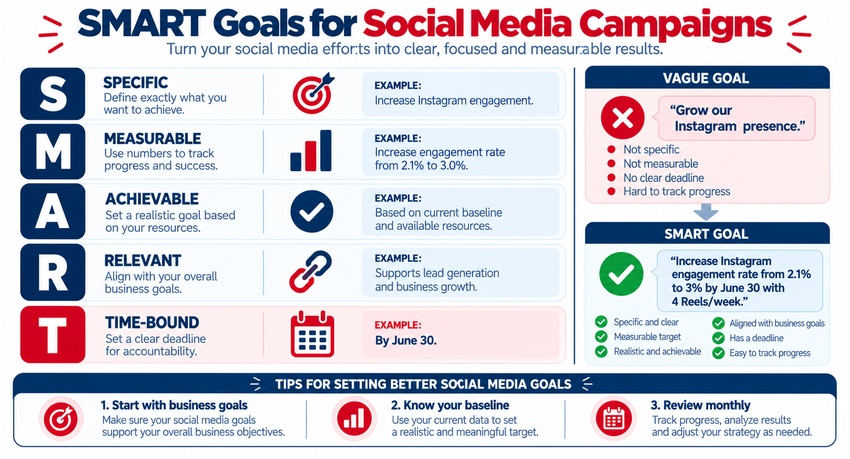
SMART goals make social media campaigns measurable and accountable by defining exactly what you want to achieve: goals that are Specific, Measurable, Achievable, Relevant, and Time-bound. Instead of "grow our Instagram," a SMART goal says "increase Instagram engagement rate from 2.1% to 3% by June 30 by publishing four Reels per week." Clear goals help teams choose the right platforms, content, budget, and metrics, and make it easy to prove social media's impact on business results. Here's how to set SMART social media goals, with templates and examples for every objective.
What SMART Means for Social Media
| Letter | Meaning | Social Media Question |
|---|---|---|
| S — Specific | Clearly defined outcome | What exactly do we want to improve, and on which platform? |
| M — Measurable | Quantified with a metric | Which number will show success? |
| A — Achievable | Realistic given resources | Is this possible with our budget, team, and baseline? |
| R — Relevant | Supports business goals | How does this help revenue, leads, retention, or brand? |
| T — Time-bound | Has a deadline | By when will we achieve it? |
Why SMART Goals Matter
- Focus: teams know which content and platforms to prioritize
- Measurement: clear metrics make reporting objective
- Accountability: owners and deadlines keep campaigns on track
- Budget decisions: results show where to invest more or less
- Alignment: social media connects to company objectives instead of vanity metrics
Step 1: Start With Business Objectives
Social goals should support a broader business goal: more leads, higher sales, better retention, recruitment, or launching a product. Ask: what does the business need this quarter, and how can social media contribute?
Step 2: Choose the Right Goal Type
| Business Need | Social Media Goal Type | Example Metrics |
|---|---|---|
| Be known by more people | Awareness | Reach, impressions, follower growth rate |
| Build community and trust | Engagement | Engagement rate, comments, saves, shares |
| Drive website visits | Traffic | Link clicks, CTR, social sessions |
| Generate leads | Lead generation | Form fills, cost per lead, lead-to-customer rate |
| Increase sales | Conversion | Revenue, ROAS, conversion rate, cost per acquisition |
| Improve customer experience | Community and support | Response time, response rate, sentiment |
| Recruit talent | Employer brand | Job post clicks, applications |
Metric definitions are covered in key social media metrics every marketer should track.
Step 3: Establish a Baseline
You can't set an achievable target without knowing where you're starting. Review the last three to six months in native analytics and GA4: average reach, engagement rate, clicks, leads, and sales from social. Tool options for gathering baselines are in the best social media analytics tools for 2026.
Step 4: Set Realistic Targets
Use your baseline, available budget, team capacity, and benchmarks to set a target that's ambitious but achievable. Doubling followers in a month with no ad budget may be unrealistic; increasing engagement rate by 20% through a better content mix may be reasonable.
Step 5: Add a Deadline and an Owner
Every goal needs a clear time frame (end of month, quarter, or campaign) and a person responsible for tracking it.
SMART Goal Templates
Use this formula:
Increase/decrease [metric] on [platform] from [baseline] to [target] by [date] by [key tactic].
SMART Goal Examples by Objective
Awareness: "Increase average monthly Instagram reach from 40,000 to 60,000 accounts by September 30 by publishing four Reels per week and partnering with three local micro-influencers."
Engagement: "Raise LinkedIn engagement rate from 2.5% to 3.5% by the end of Q2 by posting three educational posts per week and responding to all comments within four hours."
Traffic: "Grow website sessions from social media by 30% (from 2,000 to 2,600 per month) by July 31 using UTM-tracked links in every post and two link-focused Stories per week."
Lead generation: "Generate 120 qualified leads from Facebook and Instagram ads in Q3 at a cost per lead under $40 using a free audit offer and a dedicated landing page."
Sales: "Achieve a 3.0 ROAS on Meta ads during the holiday campaign (November 1–December 20) by retargeting website visitors and cart abandoners."
Community: "Reduce average social media response time from 12 hours to 2 hours during business hours by the end of March using a shared social inbox."
Step 6: Align Tactics and Content
Once goals are set, choose tactics that directly support them:
- Awareness: short-form video, influencer partnerships, paid reach campaigns — see finding the right influencers for your brand
- Engagement: polls, questions, carousels, community replies — see creating interactive polls that captivate your audience
- Traffic: link-focused posts, Stories with link stickers, Pinterest pins
- Leads and sales: targeted ads, lead forms, retargeting — see crafting high-converting social media ads
Plan execution in your social media content calendar.
Connecting Social Goals to Business Goals
A useful way to keep goals relevant is to link each social metric to a business outcome:
| Business Goal | Supporting Social Goal | Leading Indicator |
|---|---|---|
| Increase quarterly revenue 15% | Drive $25,000 in sales from social ads | Add-to-cart rate from social traffic |
| Book 40 more consultations | Generate 60 qualified leads from LinkedIn | Lead form completion rate |
| Launch a new product | Reach 100,000 target customers in launch month | Video view rate and saves |
| Improve customer retention | Grow private community engagement 25% | Comments per post in the group |
| Hire five new team members | Increase career post clicks 50% | Profile visits from job content |
Leading indicators help you spot problems early. If add-to-cart rates drop mid-campaign, you can adjust offers or creative before the revenue goal is missed.
Step 7: Track, Review, and Adjust
- Review progress weekly for active campaigns and monthly for ongoing goals
- Use dashboards combining platform analytics, GA4, and ad managers
- Adjust tactics if you're off track; adjust targets only when assumptions change
- Document lessons for future goals
Common Mistakes When Setting Social Media Goals
- Focusing only on follower counts or likes
- Setting goals without a baseline
- Choosing too many goals at once
- Goals disconnected from business outcomes
- No deadlines or owners
- Not using UTM tracking, making traffic and conversions impossible to attribute
ROI calculation methods are covered in how to calculate and maximize marketing ROI.
Key Takeaways
- SMART goals are Specific, Measurable, Achievable, Relevant, and Time-bound.
- Start from business objectives, then choose goal types like awareness, engagement, traffic, leads, or sales.
- Establish baselines before setting realistic targets.
- Use the template: increase metric on platform from baseline to target by date by tactic.
- Align tactics to goals, track progress regularly, and adjust based on results.
Frequently Asked Questions
What is a SMART goal for social media?
A SMART social media goal is specific, measurable, achievable, relevant, and time-bound. For example: "Increase Instagram engagement rate from 2.1% to 3% by June 30 by publishing four Reels per week." It defines the platform, metric, target, deadline, and tactic.
What are good social media goals for a small business?
Common goals include increasing local reach, growing engagement rate, driving website traffic, generating leads or bookings, increasing sales from social, and improving response times. Choose one to three goals tied to your most important business priorities.
How do I measure social media goals?
Use native platform analytics for reach and engagement, Google Analytics 4 with UTM parameters for website traffic and conversions, ad managers for paid metrics like cost per lead and ROAS, and CRM data to track leads and sales.
How many social media goals should I set?
Most businesses should focus on one to three primary goals per quarter or campaign. Too many goals spread resources thin and make it harder to choose effective content and tactics.
How often should I review social media goals?
Review active campaign goals weekly and ongoing goals monthly. Adjust tactics if performance is off track, and review targets quarterly based on results, budget changes, and evolving business priorities.
Want social media goals tied to real business results? AiScope Digital's social media management services set SMART goals, build strategies, and report on outcomes — get a free consultation today.