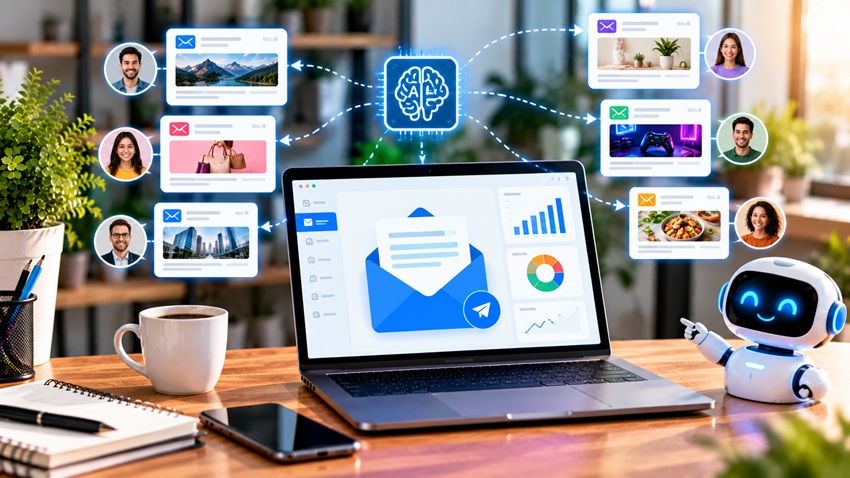
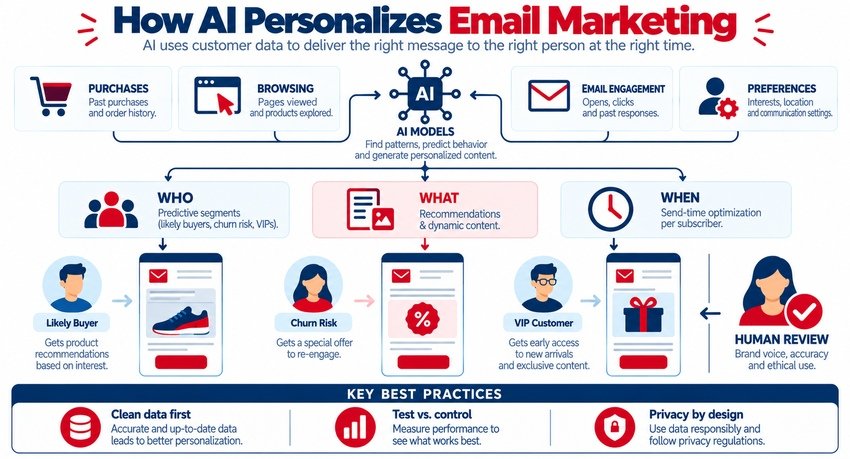
AI personalizes email marketing by analyzing customer data to decide who receives a message, what content they see, and when it arrives. Practical uses in 2026 include predictive segmentation (likely buyers, churn risks, high-value customers), AI product and content recommendations, send-time optimization for each subscriber, dynamic content blocks, AI-assisted subject lines and copy variations, and automated journeys that adapt to behavior. Done well, AI makes every email feel relevant at scale; done carelessly, it creates generic copy or privacy concerns. Here's how to use AI for email personalization effectively and responsibly.
Traditional vs. AI-Powered Personalization
| Approach | How It Works | Limitation / Advantage |
|---|---|---|
| Basic personalization | First name, location merge tags | Easy, but limited relevance |
| Rule-based segmentation | Manual rules: "bought X in last 30 days" | Useful, but time-consuming to maintain |
| Behavioral automation | Triggers from actions like cart abandonment | Strong, but limited by predefined flows |
| AI-driven personalization | Models predict behavior and choose content, timing, and offers | Scales relevance across many subscribers and variables |
Foundational personalization tactics are covered in how to personalize your emails for maximum engagement.
1. Predictive Segmentation
AI analyzes purchase history, engagement, browsing behavior, and other signals to predict outcomes:
- Likelihood to purchase in the next 30 days
- Predicted customer lifetime value (CLV)
- Churn risk for subscribers or customers
- Expected next order date for replenishment products
- Preferred product categories or price ranges
Use predictions to target VIP offers, winback campaigns, and replenishment reminders. The analytics behind this is explained in predictive analytics in email campaigns.
2. AI Product and Content Recommendations
Recommendation engines suggest products, articles, or offers based on each subscriber's behavior and similar customers' patterns:
- "Recommended for you" blocks in newsletters
- Complementary products after purchase
- Back-in-stock and price-drop alerts for viewed items
- Content recommendations for B2B nurturing
Recommendation strategy is covered in how to use product recommendations in your emails.
3. Send-Time Optimization
AI learns when each subscriber typically opens and clicks, then delivers emails at the individual's best time instead of one blast time for everyone. Many email platforms offer this feature.
4. Dynamic Content Blocks
AI and rules can swap images, headlines, offers, and product grids for each recipient within one template — see the power of dynamic content in emails.
5. AI-Assisted Copywriting and Subject Lines
Generative AI can:
- Draft subject lines and preheaders for testing
- Create copy variations for different segments
- Summarize long content into email-friendly formats
- Adapt tone for audiences (e.g., executives vs. practitioners)
Human review remains essential for accuracy, brand voice, and compliance. Combine AI drafts with proven techniques from top copywriting tips for email marketing and 10 subject line hacks to boost your open rates.
6. Adaptive Customer Journeys
AI-powered journeys adjust paths based on behavior: a subscriber who browses premium products might receive comparison content, while a price-sensitive subscriber sees value-focused offers. Journeys can also choose the best channel, such as email or SMS, where platforms support it.
AI Personalization Examples by Industry
- E-commerce: predicted next-purchase reminders for consumables, personalized product grids, price-drop alerts for viewed items, and VIP offers for high predicted lifetime value
- SaaS: onboarding emails that adapt to which features a user has adopted, churn-risk outreach with helpful resources, and upgrade prompts when usage nears plan limits
- B2B services: content recommendations based on pages visited, industry-specific case studies, and lead-score-based handoffs to sales
- Education: course recommendations based on interests, reminders tailored to application stage, and personalized event invitations
- Travel and hospitality: destination suggestions based on past trips and departure airports, plus timing tuned to typical booking windows
- Nonprofits: suggested gift amounts based on giving history and stories matched to programs donors care about
Getting Started: A Practical Roadmap
- Clean and connect your data: integrate your ESP with your store, CRM, and website tracking
- Start with high-impact automations: abandoned cart, browse abandonment, post-purchase, and winback
- Turn on built-in AI features: send-time optimization, predictive segments, and recommendation blocks
- Use AI for copy variations, then edit and test
- A/B test against control groups to confirm AI improves results — see A/B testing: what it is and how to do it right
- Scale what works to newsletters and campaigns
- Review regularly for performance, accuracy, and customer feedback
Platform comparisons are in top CRM tools for email marketing.
Privacy, Ethics, and Trust
AI personalization relies on customer data, so trust is critical:
- Get proper consent and follow laws such as GDPR, CAN-SPAM, and state privacy laws — see GDPR compliance: what you need to know
- Be transparent about data use in privacy policies
- Avoid creepy personalization: "We noticed you looked at this five times" feels invasive
- Be careful with sensitive data such as health, finances, or children's information
- Offer preference centers so subscribers control topics and frequency
- Review AI outputs to prevent errors, bias, or misleading claims
Measuring AI Personalization
| Metric | What to Compare |
|---|---|
| Click-through rate | AI-personalized vs. standard emails |
| Conversion rate | Recommendation blocks vs. static products |
| Revenue per recipient | Predictive segments vs. broad sends |
| Unsubscribe and complaint rates | Personalized vs. generic messages |
| Customer retention / repeat purchase | Journeys with AI vs. without |
| Time saved | Hours spent on segmentation and copy |
Measurement methods are covered in using analytics tools to measure email performance.
Balancing Automation and the Human Touch
AI handles scale; people handle judgment. Keep humans responsible for brand voice, offer strategy, sensitive messages, and final approval of new templates and journeys. Review AI-driven segments periodically to confirm they still make sense, and listen to customer replies and feedback — they often reveal personalization that feels off long before metrics do.
Common Mistakes
- Turning on AI features without clean data
- Publishing AI-written copy without review
- Personalizing in ways that feel intrusive
- Ignoring control groups and testing
- Over-segmenting into groups too small to learn from
Key Takeaways
- AI personalizes who receives emails, what they see, and when they receive them.
- Key uses include predictive segments, recommendations, send-time optimization, dynamic content, and AI-assisted copy.
- Start with clean, connected data and high-impact automations.
- Test AI against controls and review outputs for accuracy and brand voice.
- Respect privacy, consent, and transparency to maintain trust.
Frequently Asked Questions
How is AI used in email marketing personalization?
AI analyzes subscriber data to predict behavior, recommend products or content, choose optimal send times, select dynamic content, and generate copy variations. This lets marketers send more relevant emails to each subscriber without manually building every segment and version.
What is send-time optimization?
Send-time optimization uses AI to learn when each subscriber is most likely to open or click emails, then delivers messages at those individual times instead of sending to the entire list at once. Many email platforms include this feature.
Can AI write marketing emails?
AI can draft subject lines, preheaders, and email copy and create variations for different audiences. Human editors should review AI-generated content for accuracy, brand voice, compliance, and relevance before sending, and test performance against existing copy.
What data is needed for AI email personalization?
Common data includes purchase history, browsing behavior, email engagement, product preferences, location, and lifecycle stage. Integrating your email platform with your e-commerce store, CRM, and website tracking helps AI models make accurate predictions.
Is AI email personalization privacy compliant?
It can be when you collect data with proper consent, follow regulations like GDPR and CAN-SPAM, explain data use in your privacy policy, avoid sensitive data misuse, and give subscribers control over preferences. Review practices with legal or compliance advisors.
Ready to make every email feel one-to-one? AiScope Digital's email marketing services implement AI-powered segmentation, recommendations, and automated journeys — get a free consultation today.