
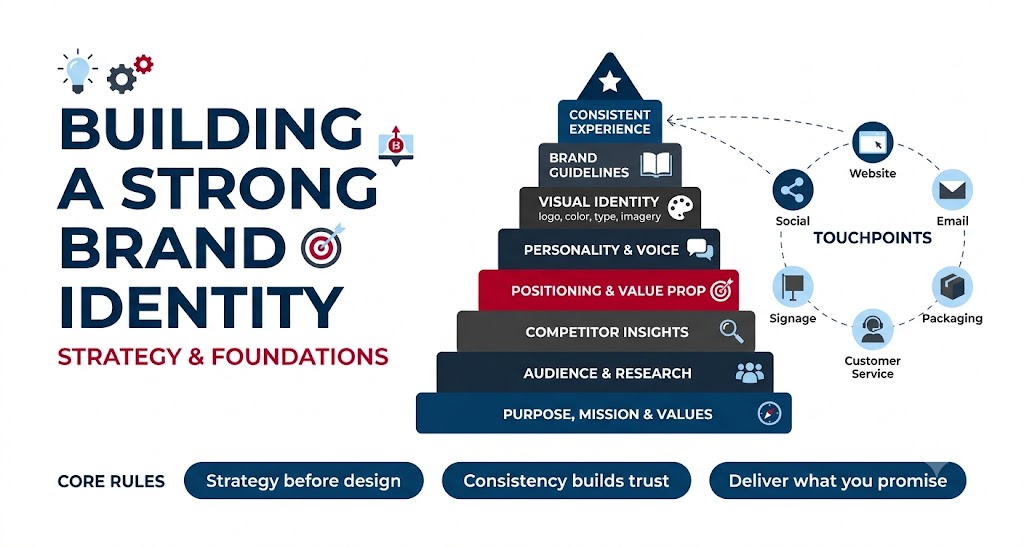
Building a strong brand identity means defining who your business is and expressing it consistently everywhere customers encounter you. The process follows a clear sequence: clarify your purpose, mission, and values; understand your target audience; research competitors; define your positioning and unique value proposition; shape your brand personality and voice; design the visual identity (logo, colors, typography, imagery); document everything in brand guidelines; and roll it out consistently across every touchpoint. A strong brand makes customers recognize, trust, remember, and choose you — often at a higher price than competitors. Here's the essential guide.
Brand vs. Brand Identity vs. Branding
| Term | Meaning |
|---|---|
| Brand | The perception and feelings people have about your business |
| Brand identity | The deliberate elements you create to shape that perception: name, logo, colors, voice, messaging |
| Branding | The ongoing process of building and managing the brand |
You can't fully control your brand — customers decide what it means — but you can control your brand identity and how consistently you deliver on it.
Why a Strong Brand Identity Matters
- Recognition: consistent visuals and voice make you memorable
- Trust: professional, coherent branding signals reliability
- Differentiation: clear positioning helps you stand out in crowded markets
- Pricing power: strong brands can command premium prices
- Loyalty: emotional connection keeps customers returning and referring
- Efficiency: clear guidelines speed up marketing decisions
Step 1: Define Purpose, Mission, Vision, and Values
- Purpose: why the business exists beyond making money
- Mission: what you do, for whom, and how
- Vision: the future you're working toward
- Values: principles that guide decisions and behavior
Keep these specific. "We value excellence" is generic; "We answer every client message within one business day" is a value customers can feel.
Step 2: Understand Your Audience
Build audience personas covering demographics, goals, challenges, buying motivations, objections, and where they spend time online. Interview customers, analyze reviews, and study search queries. Your identity should resonate with the people you want to attract, not just internal preferences.
Step 3: Research Competitors
Audit competitors' positioning, messaging, logos, colors, websites, social media, and pricing. Look for patterns and gaps. If every competitor says "affordable and reliable," that message won't differentiate you. Research methods are covered in research and discovery: laying the foundation for great logos.
Step 4: Define Positioning and Value Proposition
Positioning statement template: For [target audience] who [need], [brand] is the [category] that [key benefit], because [reason to believe].
Your unique value proposition explains clearly why customers should choose you. It should be specific, credible, and meaningful to your audience.
Step 5: Shape Brand Personality and Voice
Choose three to five personality traits (e.g., confident, approachable, innovative) and translate them into a voice:
| Trait | Voice Is | Voice Isn't |
|---|---|---|
| Confident | Clear, direct, decisive | Arrogant or pushy |
| Approachable | Warm, conversational, plain language | Overly casual or sloppy |
| Expert | Specific, insightful, evidence-based | Jargon-heavy or condescending |
| Innovative | Forward-looking, curious | Buzzword-filled |
Create messaging pillars — the core themes you'll communicate repeatedly — plus a tagline, elevator pitch, and boilerplate description.
Step 6: Design the Visual Identity
Visual identity elements include:
- Logo system: primary logo, stacked version, icon, and one-color variations — see responsive logos
- Color palette: primary, secondary, accent, and neutral colors — see mastering color theory in logo design
- Typography: heading and body typefaces
- Imagery: photography and illustration style
- Graphic elements: icons, patterns, shapes, and layout systems
The impact of a cohesive look is explored in the power of visual identity.
Step 7: Create Brand Guidelines
Brand guidelines document the rules so anyone can apply the brand correctly:
- Brand story, mission, values, positioning
- Voice and tone guidance with examples
- Logo usage, clear space, minimum sizes, and misuse examples
- Color codes (HEX, RGB, CMYK, Pantone)
- Typography hierarchy
- Imagery and iconography style
- Templates for social, presentations, email, and documents
Step 8: Roll Out Consistently
Apply the brand across every touchpoint:
| Touchpoint | Brand Elements to Apply |
|---|---|
| Website | Visual identity, voice, messaging, UX — see how custom web design boosts your brand identity |
| Social media | Profile images, templates, captions, tone — see establishing a strong brand identity on social media |
| Templates, signatures, voice | |
| Sales materials | Presentations, proposals, brochures |
| Packaging and print | Logo, color, typography, messaging |
| Physical spaces | Signage, interiors, uniforms |
| Customer service | Tone, scripts, response standards |
Train employees so the brand comes through in conversations, not just visuals.
Step 9: Measure and Evolve
Track brand awareness (branded search volume, direct traffic, social mentions), perception (surveys, reviews, sentiment), and business outcomes (conversion rates, pricing power, retention). Brands should evolve as businesses grow, without losing core recognition — see refreshing existing logos. Brand monitoring is covered in brand monitoring and reputation management services.
Branding on a Small-Business Budget
You don't need a large budget to build a strong brand. Prioritize in this order:
- Clarity first: a written positioning statement, value proposition, and three personality traits cost nothing but time
- A professional logo system with primary, compact, and icon versions
- A simple palette and font pair used consistently everywhere
- Templates for social posts, proposals, and emails so every piece looks on-brand
- A well-designed website that expresses the brand and converts visitors
- Customer experience standards — response times, tone, and follow-up — that deliver on the brand promise
Consistency matters more than spending. A modest brand applied everywhere outperforms an expensive brand applied inconsistently.
Common Branding Mistakes
- Designing a logo before defining strategy
- Trying to appeal to everyone
- Copying competitors' look and messaging
- Inconsistent use across channels
- Overpromising and underdelivering on the brand promise
- Treating branding as a one-time project
The full journey is described in from concept to reality: the journey of brand development.
Key Takeaways
- A brand is perception; brand identity is the elements you create to shape it.
- Start with purpose, values, audience, competitors, and positioning before design.
- Define personality, voice, and messaging pillars for consistent communication.
- Build a visual identity system and document it in brand guidelines.
- Roll out consistently across every touchpoint, measure, and evolve over time.
Frequently Asked Questions
What is brand identity?
Brand identity is the collection of elements a business creates to shape how people perceive it, including its name, logo, colors, typography, imagery, voice, messaging, and values. A strong brand identity is distinctive, consistent, and aligned with what customers experience.
How do you build a brand from scratch?
Define your purpose, mission, and values; research your audience and competitors; create positioning and a value proposition; establish personality and voice; design a visual identity; document brand guidelines; and apply everything consistently across your website, social media, marketing, and customer experience.
What are the key elements of a brand identity?
Key elements include brand name, logo, color palette, typography, imagery style, brand voice and tone, messaging and tagline, mission and values, and brand guidelines that explain how to use these elements consistently.
How long does it take to build a brand identity?
Developing a brand strategy and visual identity typically takes several weeks to a few months, depending on research, stakeholders, and deliverables. Building brand recognition and reputation is ongoing and grows through consistent experiences over time.
Why are brand guidelines important?
Brand guidelines ensure everyone who creates materials — employees, agencies, and partners — uses the logo, colors, fonts, imagery, and voice consistently. Consistency builds recognition and trust, saves time, and protects the brand as the business grows.
Ready to build a brand customers remember and trust? AiScope Digital's brand strategy services and logo and visual identity design services take you from strategy to complete brand systems — start the conversation today.