
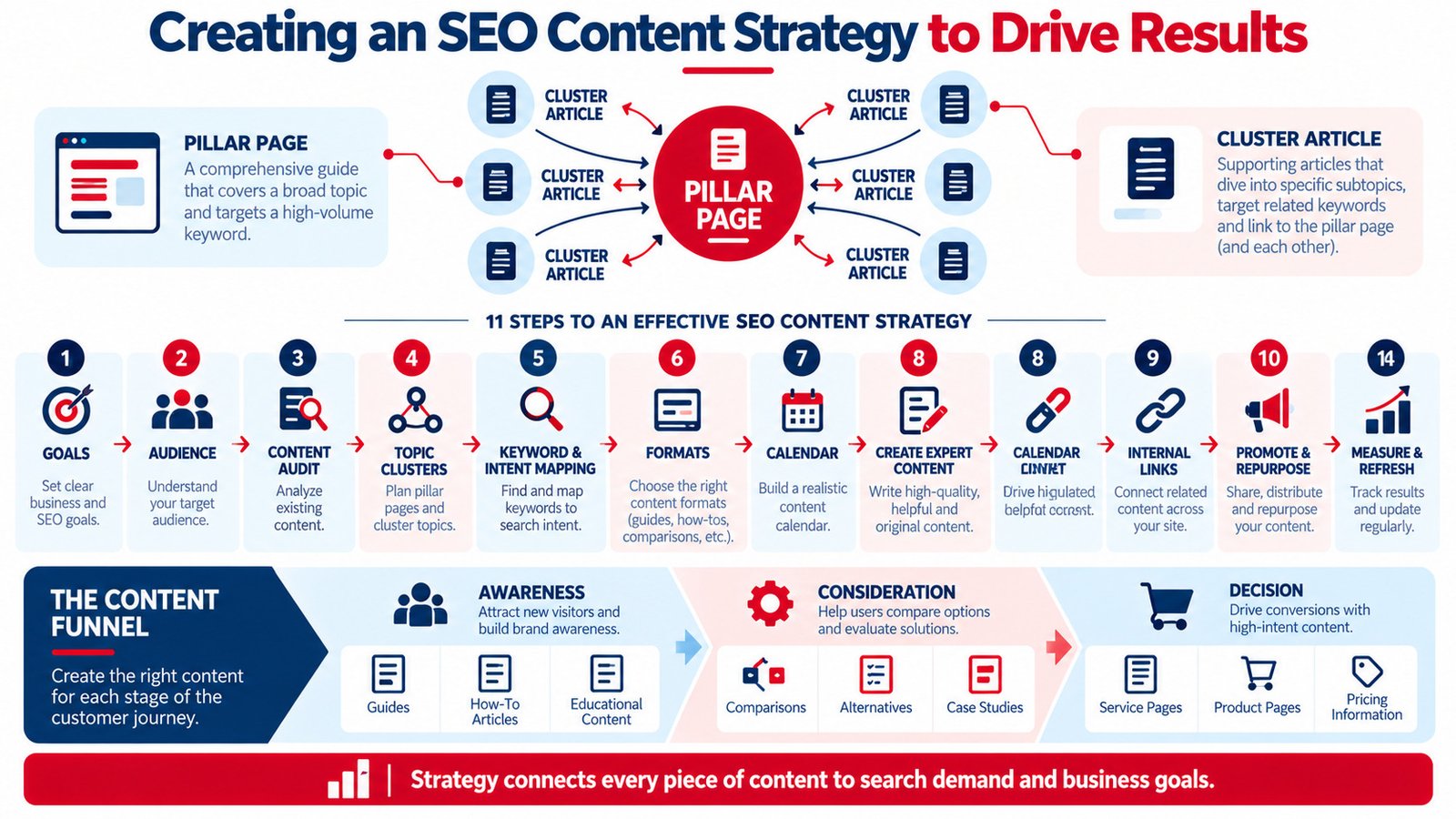
An SEO content strategy is a plan for creating, organizing, and improving content so it ranks in search, answers your audience's questions, and moves visitors toward becoming customers. To create one that drives results: define business goals and KPIs, research your audience and their questions, audit existing content, choose core topics and build topic clusters around pillar pages, map keywords and search intent to specific pages, plan formats that match each intent, set a realistic content calendar, create expert, helpful content with clear answers, build internal links between related pieces, promote and repurpose content, and measure and refresh regularly. A strategy turns random blog posts into a connected library that builds authority, traffic, and leads over time. Here's the step-by-step process.
Content Strategy vs. Random Publishing
| Random Publishing | SEO Content Strategy |
|---|---|
| Topics chosen on a whim | Topics chosen by demand, intent, and business value |
| Isolated posts | Topic clusters with pillar pages and internal links |
| No clear audience | Content mapped to personas and buyer stages |
| Inconsistent schedule | Realistic, consistent content calendar |
| Publish and forget | Measure, refresh, consolidate, and repurpose |
| Traffic without conversions | Content aligned with CTAs and lead generation |
Step 1: Define Goals and KPIs
Connect content to business outcomes: leads, sales, demo requests, newsletter signups, or brand awareness. Choose KPIs like organic traffic to priority pages, rankings for target clusters, conversions from organic visitors, and assisted conversions.
Step 2: Understand Your Audience
Build simple personas that describe:
- Roles, industries, and goals
- Pain points and questions
- Where they search and what formats they prefer
- What objections stop them from buying
Talk to sales and customer service teams — they hear real questions every day.
Step 3: Audit Existing Content
Review every page and post for traffic, rankings, conversions, backlinks, and freshness. Decide to keep, update, merge, or remove each one. Merging overlapping posts often fixes keyword cannibalization — see how to conduct a comprehensive SEO audit in 2026.
Step 4: Choose Core Topics and Build Topic Clusters
Topic clusters organize content around core subjects:
- Pillar page: a comprehensive guide to a broad topic
- Cluster content: detailed articles on subtopics, each linking to the pillar
- Internal links: connect pillar and clusters in both directions
| Pillar Page | Example Cluster Topics |
|---|---|
| Local SEO guide | Google Business Profile, NAP consistency, reviews, citations, local links |
| Email marketing guide | Deliverability, segmentation, automation, CTAs, analytics |
| Website design guide | UX basics, responsive design, speed, trust, conversion |
| PPC advertising guide | Keyword targeting, ad copy, landing pages, bidding, ROI |
Clusters build topical authority, which helps both search engines and AI systems recognize your expertise.
Step 5: Map Keywords and Intent to Pages
Assign one primary keyword cluster to each page and identify its intent (informational, commercial, transactional). This prevents cannibalization and ensures each page has a clear purpose — see keyword research importance for achieving online success and mastering search intent optimization.
Step 6: Match Content Formats to Intent and Funnel Stage
| Funnel Stage | Intent | Content Formats |
|---|---|---|
| Awareness | Informational | How-to guides, explainers, checklists, videos |
| Consideration | Commercial investigation | Comparisons, buyer's guides, case studies, webinars |
| Decision | Transactional | Service and product pages, pricing, demos, testimonials |
| Retention | Support and loyalty | Tutorials, FAQs, newsletters, community content |
Lead generation with content is covered in lead generation with content marketing.
Step 7: Build a Realistic Content Calendar
Consistency beats bursts. Plan topics, owners, deadlines, and publishing dates for the next one to three months, balancing new content with updates to existing pages — see the importance of a content calendar for SEO.
Step 8: Create Expert, Helpful Content
- Answer the main question in the opening paragraph
- Use clear headings, tables, and lists
- Include first-hand experience, examples, and original insights
- Credit expert authors with bios
- Cite reliable sources and update facts
- Add strong visuals and a relevant CTA
AI tools can speed up research and drafting, but human expertise and editing should shape the final content — see blogging for SEO: how to create content that ranks.
Step 9: Strengthen Internal Linking
Link new content to its pillar, related clusters, and relevant service pages using descriptive anchor text. Update older posts to link to new ones.
Step 10: Promote and Repurpose
Share content through email, social media, and partner channels. Repurpose guides into videos, carousels, infographics, and newsletters to extend reach — see boosting social media traffic to drive website visits.
Step 11: Measure and Refresh
Review performance monthly and refresh content quarterly or when rankings slip. Update outdated statistics, add new sections, improve titles, and consolidate weak posts. Evergreen content benefits most — see evergreen content: what it is and how to create it.
Example: A Content Strategy for an HVAC Company
An HVAC company with scattered blog posts built three pillar pages — AC repair, heating systems, and indoor air quality — each supported by six to eight cluster articles answering common questions like costs, warning signs, and maintenance tips. Every article linked to the pillar and the relevant service page with a "Schedule Service" CTA. The company published two new articles and updated one older post monthly. Organic leads for service calls increased steadily over the following quarters. Use your real figures to track results.
SEO Content Strategy Checklist
- Business goals and KPIs defined
- Personas and audience questions documented
- Content audit completed with keep, update, merge, remove decisions
- Core topics and pillar pages chosen
- Keyword clusters and intent mapped to pages
- Formats aligned with funnel stages
- Content calendar with owners and dates
- Expert authors, sources, and clear answers in every piece
- Internal links between pillars, clusters, and service pages
- Promotion and repurposing plan
- Monthly reporting and quarterly refreshes
Common Content Strategy Mistakes
- Publishing high volumes of thin or generic posts
- Writing about topics with no search demand or business relevance
- Multiple posts competing for the same keyword
- No internal links between related articles and service pages
- Ignoring older content that could be updated for quick gains
- Leaving out CTAs, so traffic never turns into leads
- Measuring only pageviews instead of conversions and assisted revenue

Avoiding these mistakes is often worth more than adding new content — a smaller, well-connected library of helpful articles usually outperforms a large collection of disconnected posts.
Key Takeaways
- An SEO content strategy aligns content with goals, audience needs, and search demand.
- Topic clusters with pillar pages build authority and internal linking.
- Map one keyword cluster and intent to each page.
- Create expert, helpful content on a consistent schedule.
- Promote, measure, and refresh content to sustain results.
Frequently Asked Questions
What is an SEO content strategy?
An SEO content strategy is a plan for creating and organizing content around topics and keywords your audience searches for, aligned with business goals, so it ranks in search, answers questions, and drives conversions.
What are topic clusters in SEO?
Topic clusters are groups of related content organized around a comprehensive pillar page, with cluster articles covering subtopics in depth and internal links connecting them, which helps build topical authority.
How often should I publish SEO content?
Publish on a consistent schedule your team can sustain, whether weekly, biweekly, or monthly. Quality and consistency matter more than volume, and updating existing content is often as valuable as publishing new posts.
How do I measure content strategy success?
Track organic traffic to target pages, rankings for keyword clusters, engagement, conversions from organic visitors, assisted conversions, and visibility in search features and AI answers.
Should I update old content or create new content?
Do both. Updating and consolidating high-potential older content often delivers fast results, while new content fills gaps in your topic clusters and targets new opportunities.
Want a content strategy that drives traffic and leads? AiScope Digital's content marketing services and search engine optimization services plan, create, and optimize content that performs — get a free consultation today.