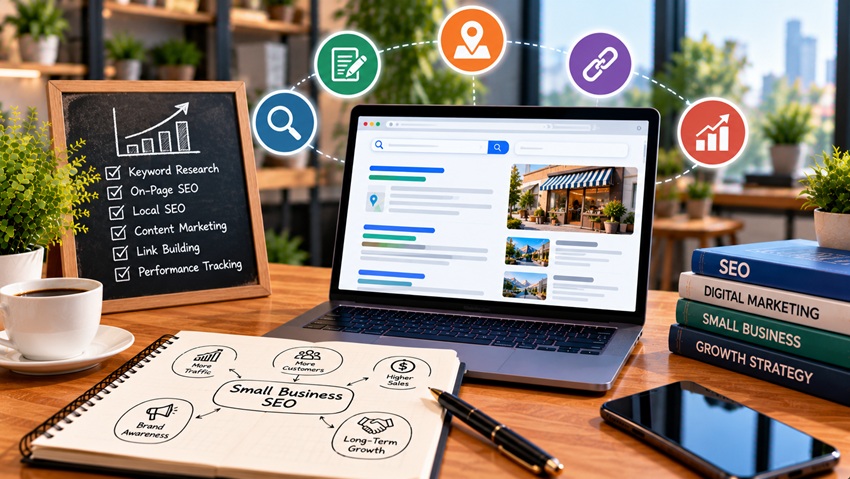
Small businesses can compete in search without enterprise budgets by focusing on high-impact, low-cost SEO activities. The most cost-effective strategies are: fully optimize your free Google Business Profile, target specific local and long-tail keywords instead of broad national terms, build a dedicated page for each core service and location, fix basic technical issues using free tools, improve titles and meta descriptions on existing pages, earn and respond to customer reviews, keep your business information consistent across directories, publish helpful content that answers real customer questions, earn local links from partners and community involvement, and track results with Google Search Console and GA4. Done consistently, these tactics build compounding visibility that keeps bringing in customers without paying for every click. Here's how to prioritize them.
Why SEO Is Cost-Effective for Small Businesses
| Marketing Channel | Cost Model | Long-Term Value |
|---|---|---|
| Paid search ads | Pay per click; stops when budget stops | Immediate but ongoing cost |
| Social media ads | Pay per impression/click | Short-lived reach |
| SEO | Time and/or agency investment | Compounding — content and rankings keep working |
| Local SEO (GBP, reviews) | Mostly free; time investment | High-intent local leads |
SEO isn't free — it takes time or budget — but each optimized page and earned review keeps delivering value long after the work is done.
Strategy 1: Optimize Your Google Business Profile
Google Business Profile (GBP) is free and drives calls, directions, and website visits for local searches.
- Choose the most accurate primary category and relevant secondary categories
- Complete services, hours, service areas, attributes, and description
- Add real photos regularly
- Publish updates and offers
- Answer common questions in your description and services
- Respond to every review
See the ultimate checklist for local SEO optimization in 2026.
Strategy 2: Target Local and Long-Tail Keywords
Broad terms like "plumber" are expensive and competitive. Specific terms like "emergency water heater repair Coral Springs" have less competition and higher intent. Use free tools — Google autocomplete, People Also Ask, Search Console, and Google Keyword Planner — to find them. See long-tail keywords: the key to voice search optimization.
Strategy 3: Create One Page per Service (and Key Locations)
A single "Services" page can't rank for everything. Build dedicated pages for each core service with unique content: what it includes, who it's for, process, pricing guidance, FAQs, and a clear CTA. For multiple service areas, create genuinely useful location pages — not copy-paste duplicates.
Strategy 4: Fix Technical Basics With Free Tools
- Google Search Console: indexing issues, Core Web Vitals, search queries
- PageSpeed Insights: speed diagnostics
- Bing Webmaster Tools: free site scan and indexing
- Free crawler tiers (e.g., Screaming Frog up to 500 URLs): broken links, missing titles
Fix broken links, missing titles, slow pages, and indexing problems first — see what is technical SEO and why does it matter.
Strategy 5: Improve Titles and Meta Descriptions
Rewriting titles and descriptions on existing pages is one of the fastest, cheapest wins. Include the primary keyword and location, a clear benefit, and stay within roughly 60 characters for titles and 155 for descriptions — see mastering on-page SEO: the complete guide.

Strategy 6: Earn and Respond to Reviews
Reviews influence local rankings and buying decisions. Ask happy customers at the right moment, make it easy with a direct link or QR code, and respond professionally to every review — see the role of customer reviews in online sales.
Strategy 7: Keep NAP Consistent
Ensure your business name, address, and phone number match across your website, GBP, Apple Business Connect, Bing Places, Yelp, and industry directories — see the importance of NAP consistency in local SEO.
Strategy 8: Publish Helpful, Question-Based Content
Turn the questions customers ask every day into blog posts or FAQ sections: costs, timelines, comparisons, and how-to guides. One genuinely helpful article per month can steadily expand your visibility — see creating an SEO content strategy.
Strategy 9: Earn Local Links Without Big Budgets
- Sponsor local events, teams, or charities
- Join the chamber of commerce and industry associations
- Partner with complementary businesses for guides or co-marketing
- Get featured in local news or community blogs
- List in reputable local and niche directories
Strategy 10: Track What Matters
Use free tools to track calls, form submissions, rankings for priority keywords, GBP actions, and organic traffic. Focus on leads and revenue, not just traffic — see how to calculate and maximize marketing ROI.
Budget Planning: DIY vs. Hybrid vs. Agency
| Approach | Best For | Typical Activities |
|---|---|---|
| DIY | Very small budgets, owners with time | GBP, reviews, titles, basic content |
| Hybrid | Owners who want expert strategy but handle some tasks | Agency audit and plan; in-house content and reviews |
| Agency or consultant | Competitive markets, limited time | Full technical, content, local, and link building |
Even with an agency, owners contribute valuable expertise for content and customer insights — see how to choose the best SEO services for your business.
A 90-Day Low-Cost SEO Plan
- Month 1: optimize GBP, fix technical basics, rewrite titles and descriptions
- Month 2: build or improve core service pages, start a review request process, clean up directory listings
- Month 3: publish two to four question-based articles, pursue three local link opportunities, review Search Console data and adjust
Example: A Local Bakery's Budget SEO Wins
A bakery with a limited budget completed its Google Business Profile with photos and menu items, created pages for custom cakes, catering, and wedding cakes, asked customers for reviews with a counter QR code, and published a guide to ordering custom cakes. It also sponsored a local school fundraiser that linked to its site. Calls and custom cake inquiries from search increased within a few months. Use your real figures to track progress.
Common Mistakes
- Targeting broad, highly competitive keywords
- One generic page for all services
- Ignoring Google Business Profile and reviews
- Buying cheap backlinks or "guaranteed rankings" packages
- Expecting overnight results and stopping too soon
Free SEO Tools Every Small Business Should Use
- Google Search Console: see the queries, pages, and indexing issues affecting your visibility
- Google Business Profile Insights: track calls, direction requests, and website clicks
- GA4: measure organic traffic, engagement, and conversions
- PageSpeed Insights: diagnose slow pages on mobile and desktop
- Bing Webmaster Tools: extra diagnostics and Bing visibility
- Google Keyword Planner and autocomplete: find specific, local keyword ideas
Set aside one hour each week to review these tools and act on one finding — small, steady improvements add up.
Key Takeaways
- Small businesses win with focused, local, high-intent SEO.
- Google Business Profile and reviews deliver outsized value for little cost.
- Dedicated service pages and specific keywords outperform generic pages.
- Free tools uncover technical fixes and keyword opportunities.
- Consistency and tracking turn small efforts into compounding growth.
Frequently Asked Questions
What is the most cost-effective SEO strategy for small businesses?
For most local small businesses, optimizing Google Business Profile, earning reviews, and creating dedicated service pages targeting local, specific keywords deliver the highest return for the lowest cost.
Can I do SEO for my small business myself?
Yes. Many foundational tasks — GBP optimization, review requests, title updates, and question-based content — can be done in-house with free tools. Competitive markets or technical issues may benefit from expert help.
How long does SEO take to work for small businesses?
Some improvements, like GBP updates and title changes, can show results within weeks, while content and link building typically take several months to build momentum. Timelines depend on competition and consistency.
How much should a small business spend on SEO?
Budgets vary widely by market, competition, and goals. Start by investing time in free, high-impact tasks, then allocate budget to areas where expertise delivers the biggest gains, and measure leads and revenue.
Are cheap SEO packages worth it?
Be cautious of very cheap packages promising guaranteed rankings or large numbers of backlinks. These often use low-quality tactics that can harm your site. Look for transparent strategies and clear reporting.
Want affordable SEO that brings in real customers? AiScope Digital's search engine optimization services create focused, budget-smart strategies for small businesses — get a free SEO consultation today.