Facebook ads remain one of the most cost-effective ways for small businesses to reach customers in 2026: with nearly 3.1 billion monthly active users and a median cost-per-click under $1 in most retail niches, no other platform combines this reach with this level of targeting precision. This guide walks you through everything — account setup, campaign structure, Advantage+ automation, budgeting, creative, and measurement — so you can launch profitable campaigns even on a modest budget.
Why Facebook Ads Still Work for Small Businesses in 2026
Despite rising competition from TikTok and retail media networks, Meta's ad platform keeps three structural advantages for small advertisers:
- Audience scale with granular reach. Facebook and Instagram share one ads engine, so a single campaign reaches both feeds, Stories, Reels, and Marketplace.
- AI-driven delivery. Meta's Advantage+ suite now automates targeting, placements, and creative variations, which levels the playing field — a two-person shop can run campaigns that once required an agency media buyer.
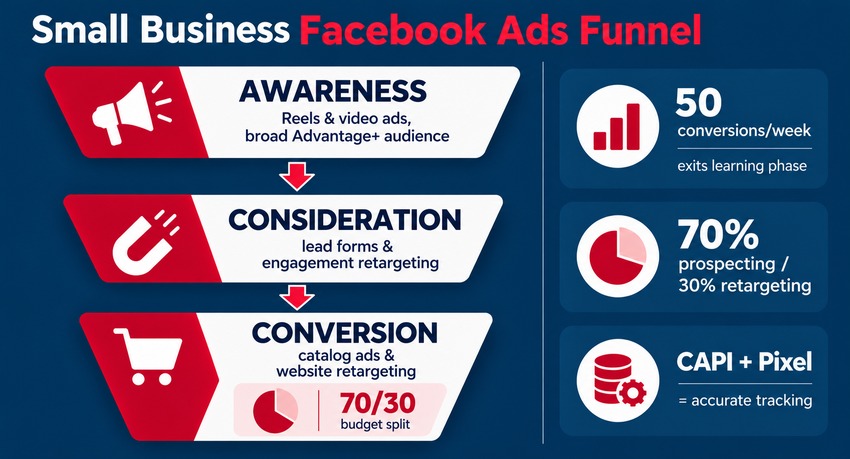
- Full-funnel formats. Awareness video, mid-funnel lead forms, and bottom-funnel catalog ads all live in one dashboard.
According to industry data, small businesses that advertise consistently on Meta platforms see average returns of roughly $2–$4 for every $1 spent once campaigns are properly optimized — but most wasted budget comes from skipping the fundamentals below.
How Do You Set Up a Facebook Ads Account the Right Way?
Before spending a dollar, get the plumbing right:
- Create a Meta Business Portfolio (business.facebook.com) — never run ads from a personal profile boost button alone.
- Install the Meta Pixel and Conversions API (CAPI). In 2026, browser-side tracking alone misses a large share of conversions due to privacy restrictions; CAPI sends events server-side and is no longer optional for accurate reporting.
- Verify your domain and configure events. Prioritize the conversions that matter (purchase, lead, add-to-cart).
- Set up your product catalog if you sell online — it unlocks dynamic retargeting.
If your website isn't ready to convert the traffic you're about to pay for, fix that first — our website development and design services team builds landing pages specifically engineered for paid traffic.
Choosing the Right Campaign Objective
Meta's objectives map to business goals. Choose based on what you actually need, not what sounds impressive:
| Objective | Best For | Typical Small-Business Use | Funnel Stage |
|---|---|---|---|
| Awareness | New local businesses | "We just opened" reach campaigns | Top |
| Traffic | Content promotion | Blog posts, menu pages | Top/Mid |
| Engagement | Social proof building | Warming up a new page | Top/Mid |
| Leads | Service businesses | Instant forms, quote requests | Mid |
| App Promotion | App-based businesses | Install campaigns | Mid |
| Sales | E-commerce | Catalog and conversion ads | Bottom |
Rule of thumb for 2026: service businesses should start with Leads (Instant Forms with conditional questions to filter quality), while e-commerce stores should start with Sales using Advantage+ Shopping Campaigns.
What Targeting Actually Works Now?
Detailed interest targeting has been steadily deprecated in favor of AI-driven broad targeting. The modern playbook:
- Advantage+ Audience (default): give Meta your customer signals and let the algorithm expand. For most small businesses, this now outperforms manual interest stacks.
- Custom Audiences: upload customer lists, retarget website visitors, video viewers, and Instagram engagers — your highest-ROI audiences.
- Lookalike Audiences: still valuable when seeded with a quality list of 1,000+ buyers, though Meta increasingly blends them into Advantage+ delivery.
- Geographic targeting: the one manual lever that still matters enormously for local businesses — radius-target your service area and exclude areas you don't serve.
Precise segmentation strategy matters more than ever when budgets are small — we covered the frameworks in depth in our guide to targeting and segmentation strategies for social media ads.
How Much Should a Small Business Spend on Facebook Ads?
Start smaller than you think, but not so small the algorithm can't learn. Meta's delivery system needs roughly 50 conversion events per ad set per week to exit the learning phase.
| Monthly Budget | What It Supports | Expected Outcome |
|---|---|---|
| $300–$500 | 1 campaign, 1–2 ad sets, retargeting focus | Learning + first conversions |
| $500–$1,500 | Prospecting + retargeting split (70/30) | Consistent lead/sale flow |
| $1,500–$5,000 | Full funnel with creative testing | Scalable, predictable ROAS |
| $5,000+ | Multi-campaign, Advantage+ scaling | Growth engine |
Keep 70% of budget on prospecting (new customers) and 30% on retargeting. Retargeting looks cheaper per conversion, but it only harvests demand — prospecting creates it. And because retargeting is where quick wins live, read our breakdown of how retargeting ads increase conversion rates before you launch.
Creative That Converts: The 2026 Formula
Creative is now the biggest performance lever — Meta attributes the majority of campaign performance variance to creative quality. What works:
- Vertical video first (9:16). Reels placements are the cheapest inventory; 15–30 second videos with a hook in the first 2 seconds win.
- Native, not polished. UGC-style founder videos routinely beat studio production for small brands.
- 3–5 creative variations per ad set, letting Advantage+ Creative auto-optimize brightness, cropping, and text overlays.
- Clear single CTA. One ad, one action.
Write primary text that leads with the problem, not your brand name, and test hooks the same way you'd test subject lines. For deeper tactics, see our guide to crafting high-converting social media ads.
Measuring What Matters
Vanity metrics kill small ad accounts. Track these instead:
- ROAS (return on ad spend) — revenue ÷ ad spend; your north star for e-commerce.
- Cost per lead (CPL) and lead-to-customer rate — for service businesses, a cheap lead that never buys is expensive.
- Frequency — above ~3.5 on prospecting means fatigue; refresh creative.
- CTR (link clicks) — under 1% usually signals weak creative or mismatched audience.
Review performance weekly, but judge campaigns on 7–14 day windows, not daily swings. Meta's own Ads Reporting documentation explains attribution windows — set yours to 7-day click/1-day view and keep it consistent.
Key Takeaways
- Install both the Meta Pixel and Conversions API before spending — tracking is the foundation.
- Start with Leads (services) or Advantage+ Shopping (e-commerce) objectives.
- Let AI handle targeting; spend your energy on creative and offers.
- Budget for 50 conversions/week per ad set; split 70% prospecting / 30% retargeting.
- Vertical UGC-style video is the highest-ROI format in 2026.
- Judge results on ROAS and cost-per-acquired-customer, never likes.
Frequently Asked Questions
How much do Facebook ads cost for a small business in 2026?
Most small businesses pay $0.50–$2.00 per click and $5–$25 per lead depending on industry. A practical starting budget is $300–$500 per month, which funds algorithm learning and first conversions. Local service niches typically sit at the lower end; legal, finance, and B2B sit higher.
Are Facebook ads still worth it compared to TikTok or Google Ads?
Yes — for most small businesses Facebook ads deliver the best blend of scale, targeting, and cost. Google Ads captures existing demand (people searching), TikTok skews younger with less purchase intent, and Meta creates demand across all adult demographics. Mature strategies usually combine Meta and Google.
How long does it take for Facebook ads to work?
Expect 2–4 weeks before judging performance. Each ad set needs roughly 50 conversion events in a week to exit Meta's learning phase, after which costs stabilize. Making edits too frequently restarts learning, so change budgets or creative at most once or twice a week.
Should I boost posts or use Ads Manager?
Use Ads Manager. Boosting is a simplified shortcut that defaults to engagement optimization, which rarely produces leads or sales. Ads Manager gives you real objectives, audience control, placement options, and proper conversion tracking — the features that actually determine ROI.
Do Facebook ads work for local businesses?
Extremely well. Radius targeting around your location, Advantage+ local awareness formats, and lead forms make Meta one of the strongest local channels. Pair ads with an optimized page and reviews, and exclude areas you don't serve to avoid wasted spend.
Ready to turn ad spend into measurable revenue? AiScope Digital's online advertising services pair AI-driven campaign management with conversion-focused creative — get a free strategy call and we'll audit your account at no cost.