
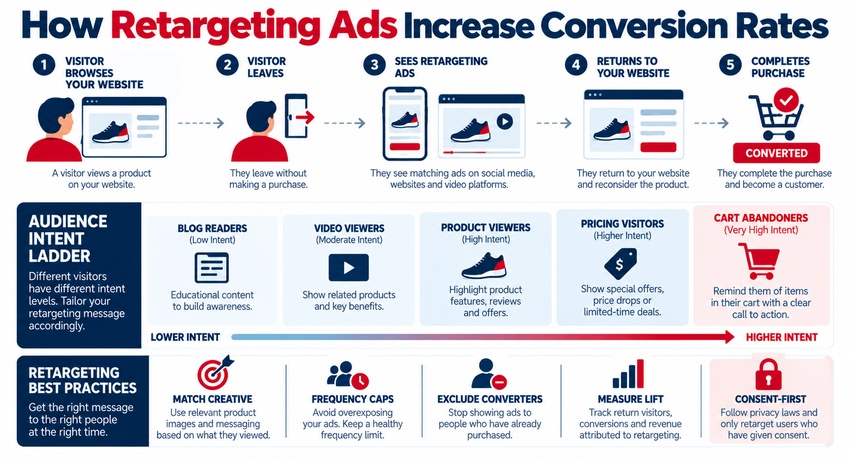
Retargeting ads increase conversion rates by re-engaging people who already showed interest in your business — visiting your website, viewing a product, starting a form, watching a video, or engaging on social media — but didn't convert. Because these audiences already know you, they're typically far more likely to act than cold prospects. Retargeting works best when you segment audiences by intent (cart abandoners vs. blog readers), tailor creative and offers to each segment, use the right platforms (Google, Meta, LinkedIn, YouTube, and others), set frequency caps and time windows to avoid ad fatigue, exclude recent converters, respect privacy and consent rules, and measure true incremental lift. This guide explains how retargeting works and how to build campaigns that turn almost-customers into customers.
Why Most Visitors Don't Convert the First Time
Visitors leave for many reasons: they're comparing options, need approval, aren't ready to buy, got distracted, or had questions. Retargeting keeps your brand present during their decision process, answers objections, and gives them a reason to come back.
How Retargeting Works
- A visitor interacts with your website, app, video, or social content
- With proper consent, a tracking tag, pixel, or customer list adds them to an audience
- Ad platforms show them relevant ads as they browse, watch videos, or use social media
- The ad brings them back to a page designed to convert
Retargeting vs. remarketing: the terms are often used interchangeably. Some marketers use "remarketing" for email-based re-engagement and "retargeting" for paid ads.
Retargeting Audience Segments
| Segment | Intent Level | Message and Offer |
|---|---|---|
| Cart or checkout abandoners | Very high | Product reminder, free shipping, limited-time incentive |
| Product or service page viewers | High | Benefits, reviews, comparison, FAQ |
| Pricing page visitors | High | Demo, consultation, guarantee |
| Form starters | High | Simplified form, reassurance |
| Blog readers | Low to medium | Related guide, lead magnet |
| Video viewers (50%+) | Medium | Case study, offer |
| Social engagers | Medium | Brand story, testimonials |
| Past customers | Varies | Cross-sell, upsell, replenishment |
| Email list (customer match) | Varies | Personalized offers |
Segmenting by intent lets you match message and incentive to readiness — see targeting and segmentation strategies for social media ads.
Retargeting Platforms
| Platform | Strengths |
|---|---|
| Google Ads (Display, YouTube, Demand Gen) | Massive reach across sites, apps, and YouTube |
| Meta (Facebook, Instagram) | Visual creative, dynamic product ads, strong mobile reach |
| B2B retargeting by company and role context | |
| TikTok | Short-form video for younger audiences |
| Product discovery and inspiration | |
| Microsoft Advertising | Search and audience network reach |
See how to use YouTube ads to promote your business and the ultimate guide to Facebook ads for small businesses.
Best Practices for High-Converting Retargeting
1. Match Creative to the Visitor's Behavior
Show the exact product viewed (dynamic ads), the service page they explored, or content related to the article they read.
2. Address Objections
Use ads to answer the questions that stopped visitors: pricing, reviews, guarantees, delivery times, or how the process works.
3. Use Time Windows Strategically
- Cart abandoners: short windows (1–7 days) with urgency
- Product viewers: 7–30 days
- Content readers: 30–90 days for nurturing
- B2B with long sales cycles: longer windows
4. Set Frequency Caps
Too many impressions cause annoyance and wasted spend. Cap frequency and rotate creative regularly.
5. Exclude Recent Converters
Exclude customers who just purchased (unless cross-selling) so you don't waste budget or irritate buyers.
6. Send Clicks to Relevant Landing Pages
Return visitors to the cart, the product, or a dedicated landing page — see effective landing page optimization.
7. Combine With Email
Abandoned cart emails and retargeting ads reinforce each other — see boost sales with these abandoned cart email strategies.
Privacy and Consent in 2026
Browser tracking restrictions, mobile privacy settings, and privacy laws affect retargeting audience sizes. To stay effective and compliant:
- Use a consent management platform and honor visitor choices
- Disclose retargeting in your privacy policy
- Use first-party data and customer lists with proper permissions
- Implement server-side conversion APIs where appropriate
- Avoid sensitive targeting categories (e.g., health conditions) that platforms restrict
Measuring Retargeting Performance
- Conversion rate and CPA compared with prospecting campaigns
- ROAS for e-commerce
- View-through vs. click-through conversions (interpret view-through cautiously)
- Frequency and CTR trends to detect fatigue
- Incrementality tests (holdout groups) to measure true lift
See how to calculate and maximize marketing ROI.
Example: Retargeting for an Online Furniture Store
An online furniture store had many product page visits but few purchases. It created segments for cart abandoners (3-day window, free delivery offer), product viewers (14-day window, dynamic ads with reviews), and blog readers (60-day window, design guide). It capped frequency, excluded recent buyers, and combined ads with cart recovery emails. Conversion rates from returning visitors improved, and a holdout test confirmed incremental sales. Use your real figures to measure lift.
Common Retargeting Mistakes
- One generic ad for all visitors
- No frequency caps
- Retargeting people who already bought
- Sending clicks to the homepage
- Ignoring consent requirements
- Judging success only by view-through conversions
Retargeting Campaign Checklist
- Tracking tags and consent management installed
- Audiences segmented by intent and recency
- Creative matched to each segment
- Time windows set per segment
- Frequency caps and creative rotation
- Recent converters excluded
- Landing pages matched to ads
- Email recovery flows aligned
- Incrementality or holdout test planned
Retargeting Creative Ideas by Funnel Stage
| Stage | Creative Approach | Example Message |
|---|---|---|
| Early (content readers) | Helpful content, lead magnets | "Get the free 2026 buyer's checklist" |
| Middle (product or service viewers) | Reviews, comparisons, demos | "See why 500+ local homeowners chose us" |
| Late (cart or pricing visitors) | Offers, guarantees, urgency | "Your cart is waiting — free shipping ends tonight" |
| Post-purchase | Cross-sell, referrals, reviews | "Complete your setup with these essentials" |
Refresh creative every few weeks and test formats — static images, carousels, short video, and dynamic product ads — to find what each segment responds to. Use your real customer counts and offers in ads rather than placeholder claims.
Key Takeaways
- Retargeting re-engages warm audiences who already showed interest.
- Segment by intent and tailor creative and offers to each group.
- Use time windows, frequency caps, and exclusions to control waste.
- Respect privacy and consent, and use first-party data.
- Measure incremental lift, not just platform-reported conversions.
Frequently Asked Questions
What are retargeting ads?
Retargeting ads are paid ads shown to people who previously interacted with your website, app, videos, or social content but didn't convert, encouraging them to return and complete an action.
Do retargeting ads really increase conversions?
Retargeting often converts better than cold prospecting because audiences already know your brand. Results vary by industry, offer, and execution, so measure incremental lift with holdout tests.
How long should retargeting campaigns run?
Time windows depend on intent and sales cycle length — short windows for cart abandoners, longer windows for content readers or B2B buyers. Test different windows and monitor frequency to avoid fatigue.
Is retargeting legal under privacy laws?
Retargeting is legal when you follow applicable privacy laws and platform policies, which typically means obtaining required consent, disclosing tracking in your privacy policy, and avoiding restricted sensitive categories.
What's the difference between retargeting and remarketing?
The terms are often used interchangeably. Some marketers use retargeting for paid ads based on browsing behavior and remarketing for re-engaging customers via email.
Want to turn more visitors into customers? AiScope Digital's online advertising services build retargeting campaigns that recover lost conversions — get a free ad account review today.