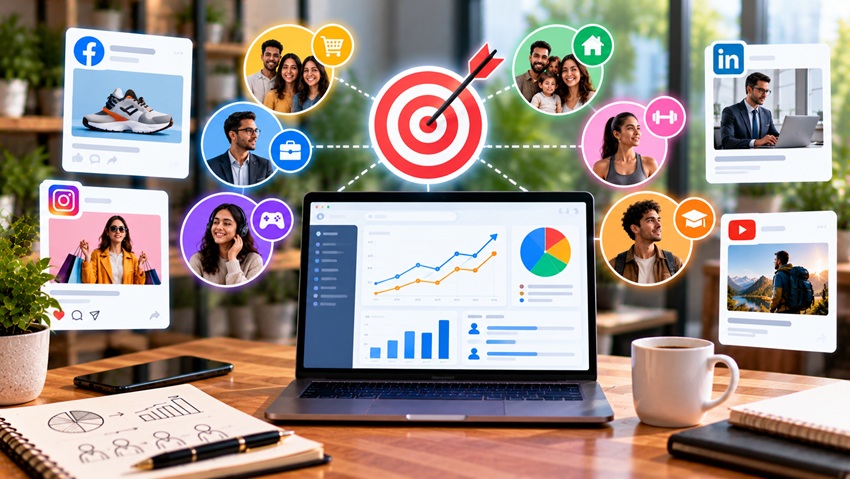
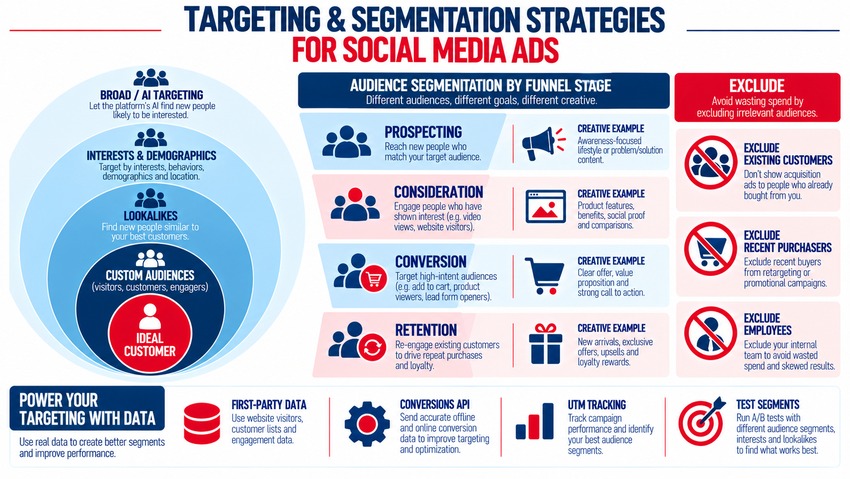
Effective social media ad targeting in 2026 combines your own first-party data with platform algorithms. The core strategies are: build custom audiences from website visitors, customer lists, video viewers, and engagers; expand reach with lookalike (similar) audiences based on your best customers; use interest, demographic, job, and behavioral targeting where it adds precision (especially on LinkedIn); test broad targeting with strong creative so AI-powered delivery can find buyers; segment campaigns by funnel stage (prospecting, retargeting, retention); apply exclusions so you don't waste spend; and measure each segment's cost per result. As privacy changes reduce tracking, first-party data, server-side conversion tracking, and creative that self-selects the right audience matter more than ever. Here's how to target and segment smarter.
Types of Social Ad Targeting
| Targeting Type | How It Works | Best For | Platforms |
|---|---|---|---|
| Demographics | Age, gender, location, language, income (where available) | Basic filtering and local businesses | All major platforms |
| Interests and behaviors | Based on activity, pages followed, content engaged | Reaching new audiences with relevant interests | Meta, TikTok, Pinterest, X |
| Professional attributes | Job title, function, seniority, company, industry | B2B campaigns | LinkedIn (some on Meta via interests) |
| Custom audiences | Website visitors, customer lists, app users, engagers | Retargeting and retention | All major platforms |
| Lookalike / similar audiences | People similar to a source audience | Prospecting with proven signals | Meta, TikTok, LinkedIn (predictive audiences), Pinterest |
| Keyword and conversation targeting | Based on searches, posts, or topics | Capturing active intent | X, Pinterest, TikTok (some), YouTube |
| Broad / AI-driven targeting | Minimal restrictions; algorithm finds buyers | Scaling with strong conversion data | Meta Advantage+, TikTok, others |
| Contextual / placement targeting | Specific channels, content categories, or placements | Brand safety and relevance | YouTube, some networks |
Step 1: Start With Your Ideal Customer Profile
Define who you want to reach: demographics, location, interests, job roles (for B2B), pain points, and buying triggers. Use CRM and analytics data to describe your best customers, not just assumptions.
Step 2: Build First-Party Custom Audiences
- Website visitors: all visitors, product viewers, cart abandoners, pricing page visitors
- Customer lists: purchasers, high-value customers, subscribers (uploaded and hashed for privacy)
- Engagers: video viewers, page/profile engagers, lead form openers
- App users: installers, active users, purchasers
Make sure your privacy policy and consent practices cover these uses. Email and social integration is covered in how to integrate email with social media campaigns.
Step 3: Create Lookalike Audiences
Base lookalikes on high-quality sources:
- Top customers by lifetime value
- Recent purchasers
- Qualified leads (not all leads)
- Engaged video viewers for awareness campaigns
Start with a narrow similarity (closest match) and expand as you scale. Test multiple sources to see which produces the best cost per result.
Step 4: Segment by Funnel Stage
| Funnel Stage | Audience | Message and Creative |
|---|---|---|
| Prospecting (cold) | Lookalikes, interests, broad targeting | Problem-aware hooks, brand story, education |
| Consideration (warm) | Video viewers, engagers, site visitors | Product benefits, demos, testimonials, comparisons |
| Conversion (hot) | Cart abandoners, pricing page visitors, lead form openers | Offers, urgency, guarantees, objection handling |
| Retention | Past customers | Cross-sells, loyalty perks, new launches |
| Re-engagement | Lapsed customers | Win-back offers, "what's new" messages |
Retargeting tactics are in how retargeting ads can increase your conversion rates.
Step 5: Test Broad Targeting With Strong Creative
Platforms increasingly use machine learning to find buyers. With enough conversion data, broad targeting (minimal interest restrictions) can outperform narrow segments because the algorithm optimizes delivery in real time. In this model, creative becomes your targeting: hooks, visuals, and messaging that speak to a specific audience attract the right people. Creative tips are in crafting high-converting social media ads.
Step 6: Use Exclusions
- Exclude existing customers from acquisition campaigns
- Exclude recent purchasers from cart retargeting
- Exclude employees and job seekers where possible
- Exclude converters from lead-gen campaigns
- Prevent overlapping audiences from competing against each other
Step 7: Platform-Specific Tips
- Meta (Facebook and Instagram): strong custom and lookalike audiences, Advantage+ automation, and broad targeting with good conversion data — see the ultimate guide to Facebook ads for small businesses
- LinkedIn: job title, function, seniority, company size, and account lists for B2B — see 7 tips on how to create effective LinkedIn ads for B2B marketing
- TikTok: interest and behavior targeting plus broad delivery with native creative
- X: keyword, conversation, and follower look-alike targeting — see how to run effective Twitter ad campaigns on a budget
- YouTube: custom segments from Google search behavior, in-market audiences, and placements — see how to use YouTube ads to promote your business
Step 8: Strengthen Tracking for a Privacy-First Era
- Implement server-side tracking (e.g., Meta Conversions API) alongside pixels
- Use UTM parameters and GA4 for cross-platform analysis
- Collect first-party data through lead magnets and loyalty programs
- Respect consent requirements and platform policies
Example: Segmenting an E-commerce Skincare Campaign
- Prospecting: broad targeting and a lookalike of top customers, using UGC videos about sensitive skin
- Consideration: retarget video viewers (50%+ watched) with ingredient explainers and reviews
- Conversion: retarget product viewers and cart abandoners with a bundle offer and free shipping threshold
- Retention: past purchasers see replenishment reminders and new launches
- Exclusions: recent purchasers excluded from conversion ads for 30 days
Measuring Segment Performance
Compare segments by cost per result, conversion rate, return on ad spend, frequency, and customer quality. Use holdout tests to measure incremental lift. Goal-setting guidance is in setting SMART goals for your social media campaigns.
Common Mistakes
- Over-narrowing audiences until delivery stalls
- Same creative for every funnel stage
- No exclusions, wasting spend on existing customers
- Lookalikes based on low-quality sources
- Ignoring tracking gaps from privacy changes
Audience Size and Overlap Guidelines
- Too small: audiences that are very narrow can deliver slowly and cost more per result; broaden locations, interests, or lookalike ranges
- Too broad without data: new accounts with few conversions may need more guidance through interests or custom audiences first
- Overlap: check audience overlap tools and consolidate similar ad sets so they don't compete in auctions
- Refresh: update customer lists and lookalike sources regularly so targeting reflects current buyers
Key Takeaways
- Combine first-party custom audiences, lookalikes, interests, and broad AI-driven targeting.
- Segment campaigns by funnel stage with tailored messages and creative.
- Let creative act as targeting when using broad audiences.
- Use exclusions to prevent wasted spend and audience overlap.
- Strengthen first-party data and server-side tracking for a privacy-first era.
Frequently Asked Questions
What is audience targeting in social media advertising?
Audience targeting is selecting who sees your ads based on factors like demographics, interests, behaviors, job attributes, custom lists of website visitors or customers, and lookalike audiences similar to your best customers.
What are lookalike audiences?
Lookalike audiences are groups of people the platform identifies as similar to a source audience you provide, such as your best customers or website visitors. They help you reach new prospects who share characteristics with people who already convert.
Is broad targeting better than detailed targeting?
Broad targeting can perform well when the platform has enough conversion data and your creative clearly speaks to the right audience, allowing algorithms to optimize delivery. Detailed targeting remains valuable for B2B, niche products, and accounts with limited data.
How should I segment social ads by funnel stage?
Use prospecting campaigns for cold audiences with educational or brand content, consideration campaigns for engagers and visitors with benefits and proof, conversion campaigns for high-intent audiences with offers, and retention campaigns for existing customers.
How do privacy changes affect social media ad targeting?
Privacy changes reduce third-party tracking and attribution accuracy. Advertisers increasingly rely on first-party data, server-side conversion tracking, consent-based data collection, and strong creative that helps algorithms find the right audience.
Want social ads that reach the right people at the right time? AiScope Digital's online advertising services and social media management services build data-driven targeting and segmentation strategies — get a free consultation today.