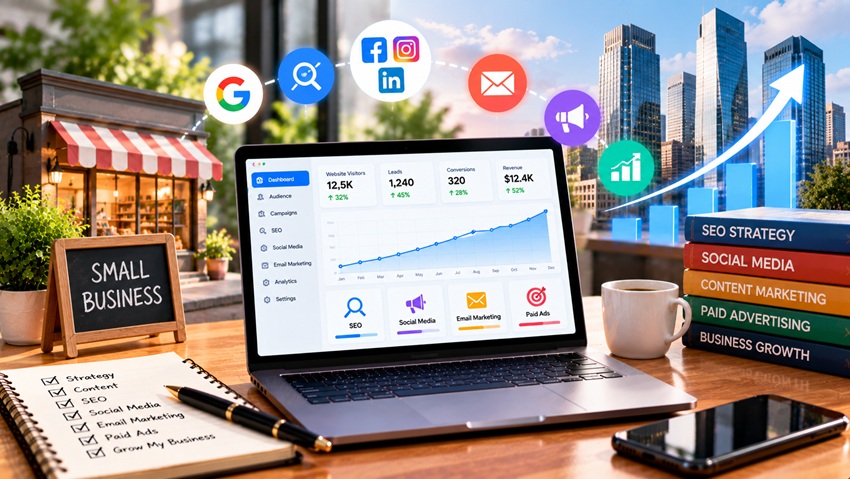
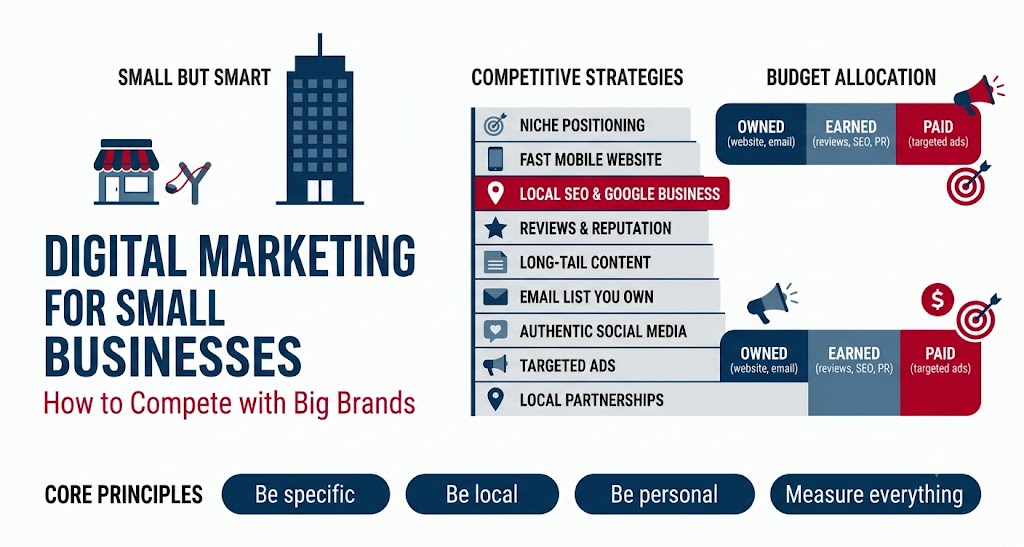
Small businesses compete with big brands online by being more specific, more local, more personal, and more agile. The most effective strategies are: own a clear niche and positioning, dominate local SEO and Google Business Profile, earn and showcase reviews, publish helpful content that answers customer questions, build an email list you own, show the people behind the brand on social media, run tightly targeted ads with clear goals, partner with local creators and businesses, and measure results to double down on what works. Big brands have bigger budgets, but small businesses can win on relevance, relationships, speed, and authenticity. Here's how to build a digital marketing plan that punches above its weight.
Small Business Advantages vs. Big Brands
| Small Business Advantage | How to Use It Online |
|---|---|
| Local knowledge | Local SEO, neighborhood content, community partnerships |
| Personal relationships | Founder-led content, fast replies, personalized email |
| Agility | Test new ideas quickly and adapt campaigns |
| Niche expertise | Specialized content and positioning |
| Authenticity | Behind-the-scenes stories, real customers, real team |
| Customer service | Reviews and word of mouth that showcase care |
Step 1: Define Your Niche and Positioning
Don't try to be everything to everyone. Define:
- Who you serve best (industry, location, customer type)
- The problem you solve better than anyone
- Why customers choose you (speed, expertise, service, values)
A clear positioning statement guides all messaging — see building a brand: the essential guide to creating a strong brand identity.
Step 2: Build a Strong Website Foundation
Your website should load fast, work beautifully on mobile, clearly explain what you do, show proof (reviews, case studies), and make contacting you easy. See why your business needs a modern website design and best practices for mobile-friendly website design.
Step 3: Win Local Search
Local SEO is where small businesses often beat national brands:
- Optimize Google Business Profile with categories, services, photos, and posts
- Keep NAP consistent across directories — see local citation building tips and best practices
- Create location and service pages
- Earn reviews regularly — see how to get more reviews for your local business
- Get links from local organizations and news
The complete list is in the ultimate checklist for local SEO optimization in 2026.
Step 4: Target Long-Tail Keywords With Helpful Content
Big brands dominate broad keywords; small businesses can win specific, long-tail searches:
- "Best emergency plumber in Pompano Beach open Sunday"
- "How much does a kitchen remodel cost in Boca Raton?"
- "Gluten-free bakery near Las Olas"
Answer real customer questions in blog posts, FAQs, and guides — see long-tail keywords: the key to voice search optimization and cost-effective small business SEO strategies.
Step 5: Build an Email List You Own
Social algorithms change; your email list is yours. Offer a helpful lead magnet, send a welcome series, and share useful updates, offers, and stories — see email marketing tactics to skyrocket your ROI.
Step 6: Show the People Behind the Brand on Social
Small businesses can be personal in ways big brands can't:
- Founder and team videos
- Behind-the-scenes content and customer stories
- Quick, friendly replies to comments and DMs — see how to use direct messaging to enhance customer relationships
- Focus on one or two platforms where your customers spend time
Step 7: Run Targeted, Budget-Smart Ads
- Use Google Search Ads for high-intent local searches
- Target tight geographic areas
- Retarget website visitors
- Promote proven organic posts
- Set clear goals and track cost per lead
Strategies are in top 7 PPC strategies for maximum ROI and the ultimate guide to Facebook ads for small businesses.
Step 8: Partner Locally
Collaborate with complementary businesses, local creators, community groups, and events. Partnerships expand reach, earn links and mentions, and build community trust — see finding the right influencers for your brand.
Step 9: Measure and Double Down
| Goal | Key Metrics |
|---|---|
| Visibility | Google Business Profile views, impressions, rankings |
| Website traffic | Organic sessions, referral traffic |
| Leads | Calls, forms, bookings, cost per lead |
| Sales | Revenue by channel, customer acquisition cost |
| Loyalty | Repeat customers, reviews, referrals |
Use GA4, Search Console, and CRM data — see how to calculate and maximize marketing ROI.
A Simple 90-Day Small Business Marketing Plan
- Days 1–30: fix website basics, optimize Google Business Profile, set up analytics, start review requests
- Days 31–60: publish four helpful local blog posts, launch a welcome email series, post consistently on one social platform
- Days 61–90: launch a small Google Ads campaign for top services, start one local partnership, review results and plan next quarter
Example: A Local Bakery Competing With Chains
A neighborhood bakery can't outspend national chains, so it:
- Optimizes Google Business Profile with daily specials and photos
- Posts short videos of bakers at work each morning
- Collects reviews with a QR code at checkout
- Emails subscribers weekly with new flavors and pre-order links
- Partners with a nearby coffee shop for co-promotions
- Runs small geo-targeted ads for custom cake orders
Its personal, local approach builds loyal customers that chains struggle to win.
Common Mistakes
- Trying to be on every platform at once
- Copying big-brand tactics without the budget
- Ignoring Google Business Profile and reviews
- No email list
- Running ads without tracking
- Inconsistent posting and messaging
Where to Focus Your Budget
| Business Stage | Priorities |
|---|---|
| Just starting | Website basics, Google Business Profile, reviews, one social platform |
| Growing | Local SEO content, email marketing, small search ad campaigns |
| Established | Content strategy, retargeting, partnerships, advanced analytics |
| Scaling | Multi-channel campaigns, automation, CRM integration, brand building |
Investing in owned and earned channels — your website, email list, reviews, and SEO — builds assets that keep producing results, while paid ads deliver faster, more immediate traffic.
Key Takeaways
- Small businesses win online through niche focus, local relevance, relationships, and agility.
- Build a fast, mobile-friendly website and dominate local SEO.
- Target long-tail keywords with helpful content and earn reviews consistently.
- Own your audience with email and show real people on social media.
- Use targeted ads and local partnerships, then measure and double down on what works.
Frequently Asked Questions
How can a small business compete with big brands online?
Small businesses compete by focusing on a niche, dominating local SEO, earning reviews, creating helpful long-tail content, building an email list, showing authentic people on social media, running targeted ads, and partnering locally.
What is the best digital marketing strategy for small businesses?
There's no single best strategy, but most small businesses benefit from a strong mobile-friendly website, optimized Google Business Profile, consistent reviews, helpful content, email marketing, and targeted search or social ads with clear tracking.
How much should a small business spend on digital marketing?
Budgets vary by industry, goals, and growth stage. Start with what you can sustain, prioritize high-intent channels like local SEO and search ads, track cost per lead and revenue, and increase investment in channels that deliver results.
Is local SEO important for small businesses?
Yes. Local SEO helps small businesses appear in Google's Map Pack and local searches, where customers are actively looking for nearby services. It's often one of the most cost-effective ways to generate calls, visits, and leads.
Should small businesses be on every social media platform?
No. Focus on one or two platforms where your customers spend time and post consistently with authentic, helpful content. Spreading too thin often leads to inconsistent results.
Ready to compete with the big brands — and win? AiScope Digital's online marketing services and search engine optimization services help small businesses grow with smart, measurable strategies — get a free consultation today.