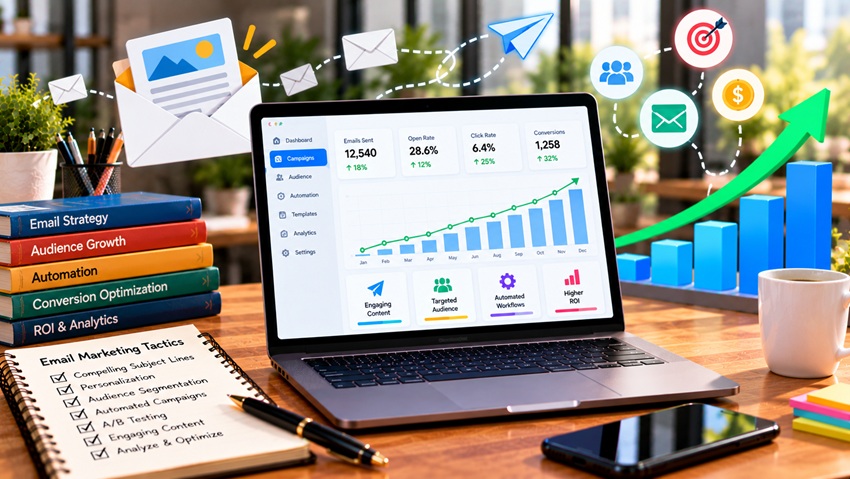
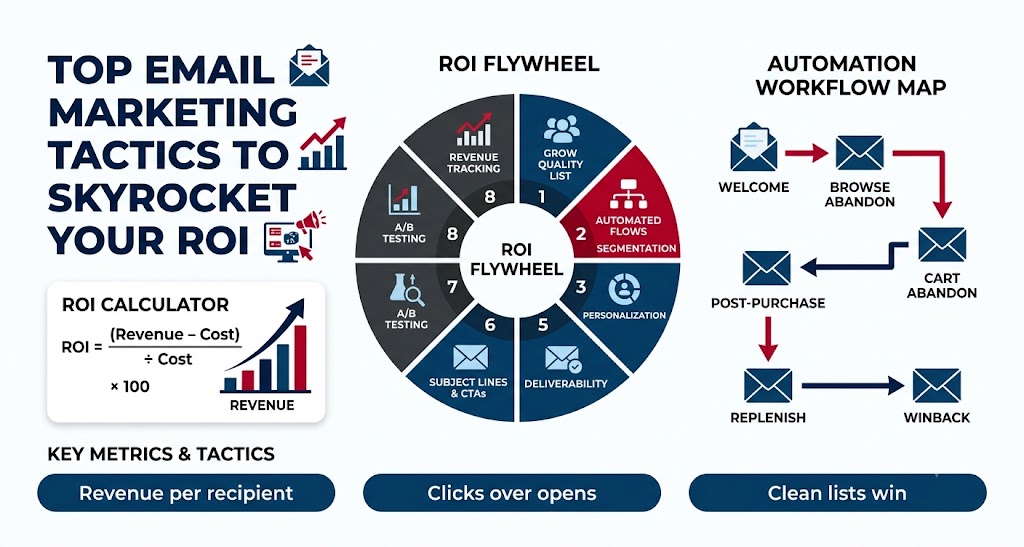
Email marketing consistently ranks among the highest-ROI marketing channels because you own the audience and can send relevant messages at low cost. To maximize ROI: grow a permission-based list with valuable lead magnets, segment subscribers by behavior and interests, prioritize automated flows (welcome, abandoned cart, browse abandonment, post-purchase, and winback), personalize content and product recommendations, protect deliverability with authentication and list hygiene, write compelling subject lines and CTAs, test continuously, and track revenue per recipient rather than vanity metrics. Small improvements across these levers compound into major revenue gains. Here are the tactics that move ROI the most.
How to Calculate Email ROI
Email ROI = (Revenue from email − Cost of email) ÷ Cost of email × 100
Costs include your email platform, design and copywriting, tools, and team or agency time. Track revenue with platform integrations, UTM links in GA4, and CRM data. ROI frameworks are in how to calculate and maximize marketing ROI.
Tactic 1: Grow a Quality, Permission-Based List
- Offer valuable lead magnets: guides, checklists, discounts, quizzes — see how to design engaging quizzes for lead generation
- Place sign-up forms strategically (exit intent, blog posts, checkout)
- Use social media to drive sign-ups — see how to integrate email with social media campaigns
- Never buy lists — they hurt deliverability and may violate laws
Tactic 2: Prioritize Automated Flows
Automated emails often generate a large share of email revenue because they're triggered by behavior and perfectly timed:
| Flow | Trigger | Revenue Role |
|---|---|---|
| Welcome series | New subscriber | Introduces brand, converts first purchase |
| Abandoned cart | Cart left without checkout | Recovers lost sales |
| Browse abandonment | Product viewed, no cart | Re-engages interested shoppers |
| Post-purchase | Order placed | Cross-sells, reviews, loyalty |
| Replenishment | Predicted reorder time | Repeat purchases |
| Winback | Inactivity | Reactivates lapsed customers |
| Birthday / anniversary | Date-based | Personal offers that drive loyalty |
| Lead nurture (B2B) | Download or demo request | Moves leads toward sales |
Cart recovery tactics are in boost sales with these abandoned cart email strategies.
Tactic 3: Segment Your List
Send different messages to different groups: new vs. repeat customers, VIPs, product interests, location, engagement level, and lifecycle stage. Segmented campaigns usually outperform one-size-fits-all blasts.
Tactic 4: Personalize Beyond First Names
- Dynamic content blocks by segment — see the power of dynamic content in emails
- Product recommendations — see how to use product recommendations in your emails
- AI-powered send-time optimization and predictive segments — see using AI to personalize email marketing
Tactic 5: Protect Deliverability
If emails don't reach the inbox, nothing else matters:
- Authenticate with SPF, DKIM, and DMARC
- Offer one-click unsubscribe
- Keep spam complaint rates low
- Remove hard bounces and sunset long-inactive subscribers
- Send consistently and avoid sudden volume spikes
Details are in top tips for improving email deliverability.
Tactic 6: Write Subject Lines and Copy That Convert
- Clear, specific subject lines with benefits or curiosity — see 10 subject line hacks to boost your open rates
- Preheaders that complement the subject line
- Short, scannable copy focused on one goal — see top copywriting tips for email marketing
- Strong, benefit-driven CTAs — see writing compelling CTAs for email campaigns
Tactic 7: Use Urgency and Offers Strategically
Limited-time offers, early access, and seasonal campaigns drive spikes in revenue — but overuse trains subscribers to wait for discounts. See creating urgency: limited-time offers in email marketing.
Tactic 8: Design for Mobile
Most emails are opened on phones. Use single-column layouts, large tap targets, readable fonts, and compressed images — see how to use visuals to enhance your emails.
Tactic 9: Test Continuously
A/B test subject lines, offers, layouts, CTAs, send times, and segments. Judge results by clicks, conversions, and revenue, since privacy features inflate opens — see A/B testing: what it is and how to do it right.
Tactic 10: Track the Right Metrics
| Metric | Why It Matters for ROI |
|---|---|
| Revenue per recipient (RPR) | Compares campaigns fairly |
| Conversion rate | Shows how well emails drive action |
| Click-through rate | Indicates content relevance |
| List growth rate | Ensures future revenue potential |
| Unsubscribe and complaint rates | Protects list health and deliverability |
| Customer lifetime value | Shows long-term email impact |
Measurement methods are in using analytics tools to measure email performance.
Example: Increasing ROI for an Online Retailer
A retailer relies on weekly promotional blasts. To improve ROI, it:
- Launches a three-email welcome series with a first-order incentive
- Adds abandoned cart and browse abandonment flows
- Segments VIPs for early access instead of discounts
- Sunsets subscribers inactive for 12 months after a re-engagement attempt
- Tests product recommendation blocks in newsletters
Revenue per recipient rises as automated flows capture high-intent moments and deliverability improves from a cleaner list.
Common Mistakes
- Sending the same email to everyone
- Ignoring automation
- Measuring success by open rates alone
- Over-discounting
- Poor list hygiene leading to spam placement
- Weak or multiple competing CTAs
Email Program Benchmarks: Compare Against Yourself
Industry averages vary widely by sector, list type, and platform measurement. Instead of chasing generic benchmarks:
- Record baseline metrics for each campaign type (newsletter, promotion, automation)
- Set improvement targets for click-through rate, conversion rate, and revenue per recipient
- Review results monthly and annotate major changes (new flows, segmentation, design updates)
- Compare year-over-year for seasonal campaigns
Quick Wins to Improve Email ROI This Month
- Launch or refresh your welcome series
- Turn on abandoned cart and browse abandonment flows
- Remove hard bounces and suppress long-inactive subscribers
- Add a product recommendation block to newsletters
- Test one subject line variable per campaign
- Add UTM parameters to every link for accurate revenue tracking
Example: Building a Simple Email Revenue Engine
A specialty coffee brand with a modest list restructures its program:
- Welcome series: three emails introducing the roastery story, best sellers, and a first-order offer
- Browse and cart flows: reminders featuring viewed coffees and brewing tips
- Replenishment: a reminder timed to when a bag typically runs out
- Newsletter: a weekly brew guide with one featured product
Automations now run every day without extra work, while the newsletter builds loyalty.
Key Takeaways
- Email delivers strong ROI because you own the audience and costs are low.
- Automated flows like welcome, cart abandonment, and post-purchase often drive the most revenue.
- Segment, personalize, and recommend products to increase relevance.
- Protect deliverability with authentication, list hygiene, and easy unsubscribes.
- Test continuously and track revenue per recipient, conversions, and list health.
Frequently Asked Questions
What is a good ROI for email marketing?
Email marketing is widely regarded as one of the highest-ROI channels, but results vary by industry, list quality, and strategy. Track your own ROI by comparing email-attributed revenue with all email costs, and improve it through automation, segmentation, and testing.
Which email marketing tactics drive the most revenue?
Automated flows such as welcome series, abandoned cart, browse abandonment, post-purchase, and winback emails often drive significant revenue because they're triggered by customer behavior. Segmentation and personalization also boost results.
How do I calculate email marketing ROI?
Subtract total email marketing costs from revenue generated by email, divide by the costs, and multiply by 100. Include platform fees, tools, design, copywriting, and team or agency time in costs.
How can I improve email deliverability?
Authenticate your domain with SPF, DKIM, and DMARC, offer easy one-click unsubscribes, keep complaint rates low, remove bounces and inactive subscribers, send consistently, and only email people who opted in.
How often should I send marketing emails?
It depends on your audience and content. Many brands send weekly newsletters plus automated flows. Monitor engagement, unsubscribes, and revenue to find the right frequency, and let subscribers choose preferences where possible.
Ready to turn your email list into a revenue engine? AiScope Digital's email marketing services build automated flows, segmentation, and testing programs that maximize ROI — get a free consultation today.