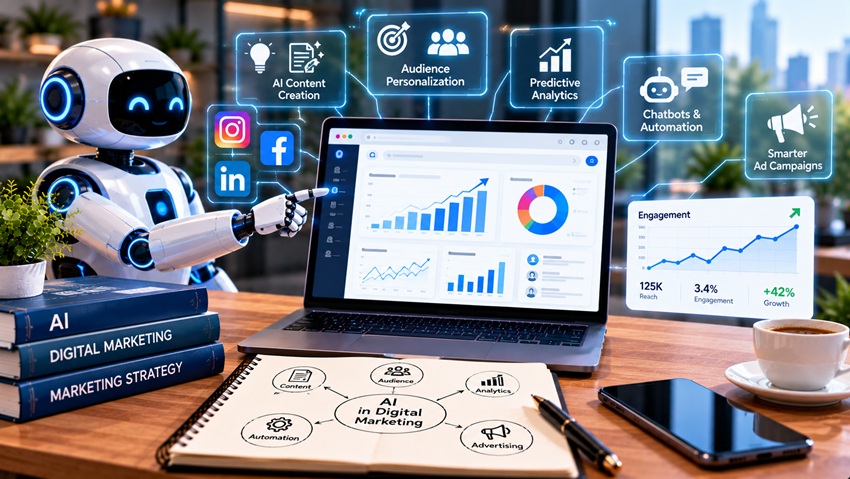
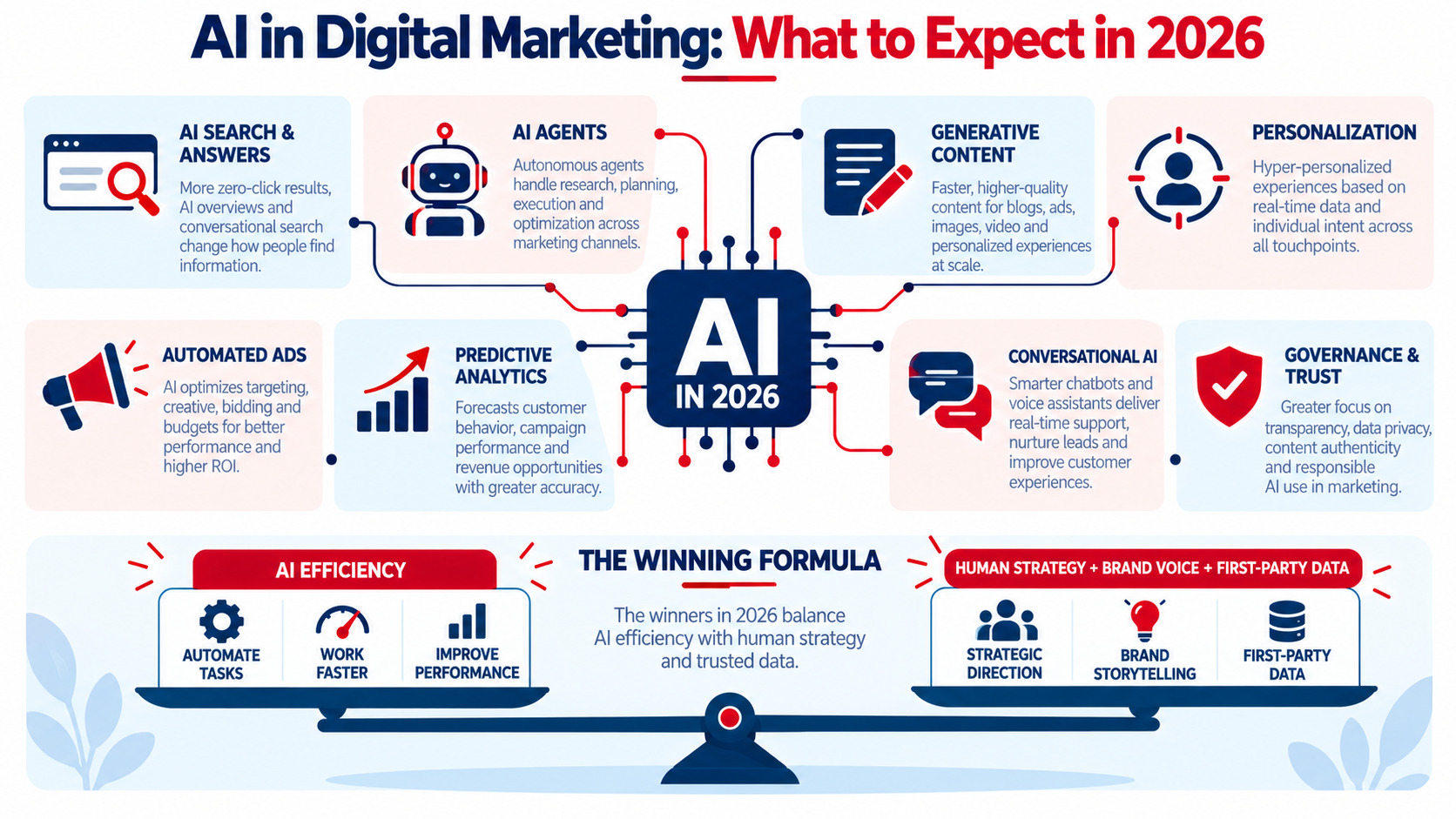
In 2026, AI is no longer a side tool in digital marketing — it's built into search engines, ad platforms, CRMs, email tools, and content workflows. The biggest changes to expect are: AI-powered search and assistants that answer questions directly and cite sources; AI agents that research, compare, and increasingly act on behalf of users; generative AI accelerating content, creative, and video production; deeper personalization across email, websites, and ads; automated ad campaigns that optimize targeting, bidding, and creative; predictive analytics that forecast churn, lifetime value, and demand; conversational AI for customer engagement; and stronger emphasis on privacy, governance, and human oversight. Businesses that combine AI efficiency with human strategy, brand voice, and first-party data will gain the most. Here's what each shift means and how to prepare.
AI in Digital Marketing: 2026 Overview
| AI Trend | What's Changing | Marketing Impact |
|---|---|---|
| AI search and answer engines | Search features and assistants summarize answers | Visibility depends on being cited, not just ranked |
| AI agents | Assistants research and complete tasks for users | Brands need machine-readable, trustworthy information |
| Generative content and creative | Faster drafts, images, and video | More output; quality and originality matter more |
| Personalization at scale | Dynamic messages per user and moment | Higher relevance and conversion potential |
| Automated advertising | Platforms optimize bids, audiences, creative | Strategy shifts to inputs: data, creative, goals |
| Predictive analytics | Forecasts behavior and value | Smarter budgets and retention |
| Conversational AI | Chatbots and voice assistants handle inquiries | Faster service and lead capture |
| Governance and trust | Policies, disclosures, privacy rules | Responsible AI becomes a brand differentiator |
1. AI-Powered Search Changes How Customers Find You
AI-generated answers in search and AI assistants increasingly respond to questions without a click. To stay visible:
- Structure content with concise answers, clear headings, and comparison tables
- Demonstrate expertise with credentialed authors and original insights
- Use schema to clarify entities — see maximize schema markup SEO for better rankings
- Track brand mentions and citations in AI answers, not only rankings
See top 5 SEO trends 2026 you can't miss and AI-enhanced SEO to revolutionize your business.
2. AI Agents Become a New Audience
AI agents can compare products, summarize reviews, check availability, and in some cases book or buy. Marketers should make key information easy for machines to read: accurate pricing, specifications, availability, policies, hours, and reviews in structured, consistent formats across your website and listings.
3. Generative AI Accelerates Content and Creative
AI helps teams brainstorm, outline, draft, resize, translate, and produce variations of copy, images, and video. The opportunity is speed; the risk is generic content. Winning teams use AI for production and keep humans responsible for strategy, expertise, brand voice, fact-checking, and originality — see creating an SEO content strategy to drive results.
4. Personalization at Scale
AI tailors subject lines, send times, product recommendations, website content, and offers to individual behavior — see using AI to personalize email marketing. First-party data from your CRM, website, and email is the fuel, so data quality and consent matter.
5. Automated Advertising Campaigns
Ad platforms increasingly automate targeting, bidding, placements, and creative combinations. Marketers' leverage shifts to:
- Clean conversion tracking and offline conversion imports
- High-quality, varied creative assets
- Clear goals and value signals (e.g., lead quality, revenue)
- First-party audience data
- Strategic testing and budget allocation
See top 7 PPC strategies for maximum ROI.
6. Predictive Analytics Guides Decisions
AI models forecast which leads are likely to convert, which customers may churn, and which channels will deliver the best return, helping teams allocate budgets and personalize retention — see predictive analytics marketing for decisions and how data analytics marketing powers modern campaigns.
7. Conversational AI for Engagement and Lead Capture
AI chatbots and assistants answer questions, qualify leads, book appointments, and support customers around the clock. Best practice: clear disclosure, accurate knowledge bases, easy handoff to humans, and privacy safeguards — see the power of AI chatbots for customer engagement.
8. Governance, Privacy, and Trust
As AI use grows, so do expectations for transparency and responsible use:
- Disclose AI-generated content or interactions where appropriate or required
- Respect privacy laws and consent for data use
- Review outputs for accuracy, bias, and brand safety
- Protect confidential data in AI tools
- Follow platform policies and evolving regulations
How to Prepare Your Marketing for AI in 2026
| Area | Action Steps |
|---|---|
| Strategy | Define where AI adds value; set goals and guardrails |
| Data | Clean CRM data, consent management, first-party data collection |
| Content | AI-assisted workflows with human expertise and editing |
| Search | Answer-first content, schema, authority, AI citation tracking |
| Advertising | Strong tracking, creative variety, value-based goals |
| Team | Train staff on tools, prompts, and review processes |
| Measurement | Incrementality, attribution, and ROI tracking |
Example: A Mid-Size Retailer Adopting AI
A home goods retailer used AI to generate product description drafts reviewed by merchandisers, personalized email recommendations based on browsing history, launched an AI chat assistant for order and product questions with human handoff, and fed offline sales data into ad platforms for better optimization.
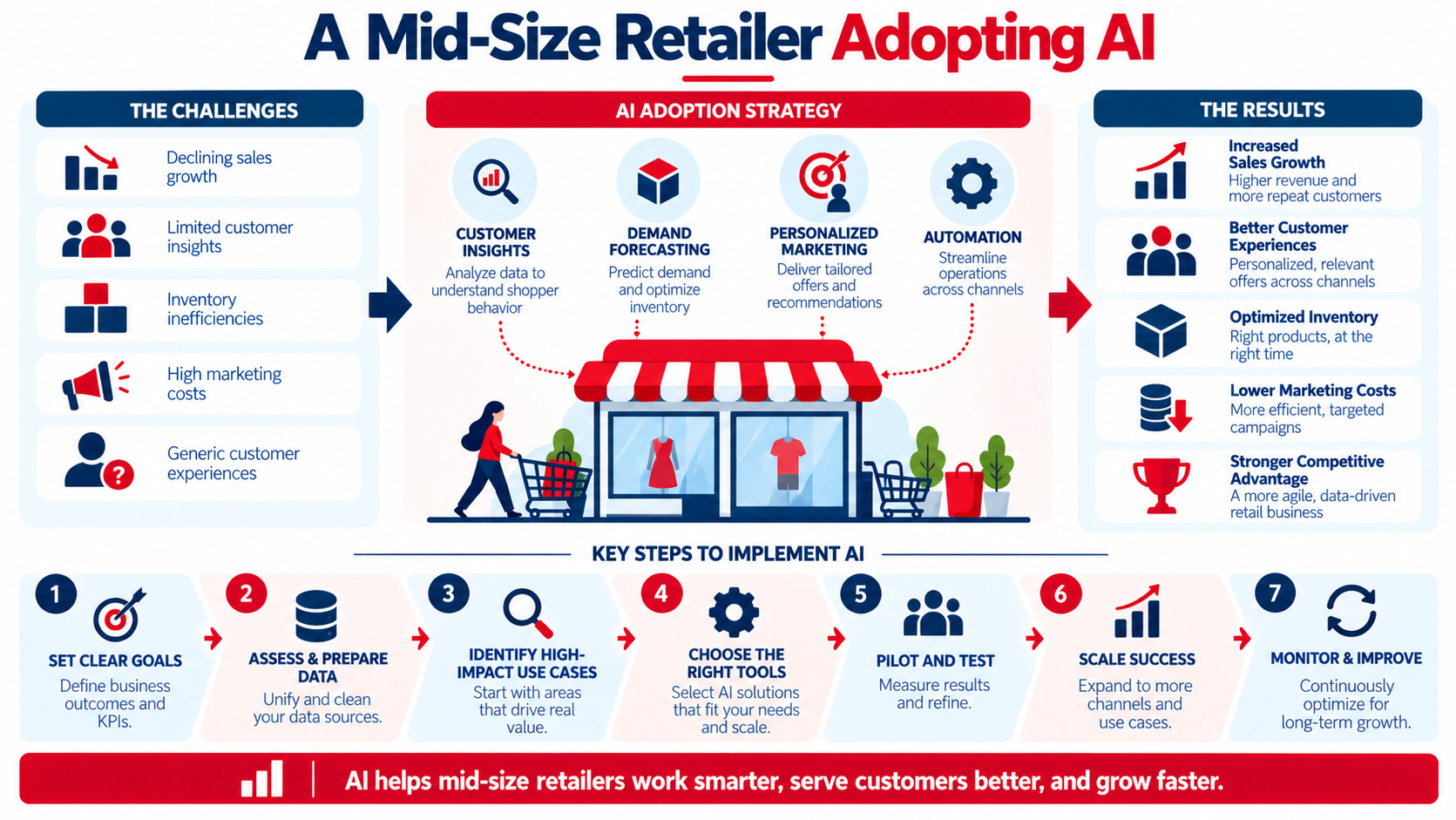
It also restructured buying guides with answer-first summaries for AI search. The team produced more content faster and improved email engagement, while keeping brand voice consistent through human review. Use your real figures to measure results.
AI Marketing Readiness Checklist
- AI use cases prioritized by business value
- AI policy covering disclosure, privacy, data, and review
- CRM and first-party data cleaned and consented
- Human review built into AI content workflows
- Answer-first content and schema for AI search
- Conversion tracking and value signals feeding ad platforms
- Chatbot with accurate knowledge base and human handoff
- Team trained on tools and quality standards
- KPIs and testing plan to measure AI impact
Where AI Adds the Most Value — and Where Humans Still Lead
| AI Handles Well | Humans Lead |
|---|---|
| First drafts, variations, and resizing | Strategy, positioning, and creative direction |
| Data analysis and pattern detection | Interpreting insights in business context |
| Bid and budget optimization | Setting goals, guardrails, and priorities |
| Personalization at scale | Brand voice, empathy, and relationships |
| 24/7 routine customer questions | Complex, sensitive, or high-value conversations |
| Summarizing research | Original expertise, opinions, and storytelling |
Plan workflows so AI accelerates repetitive work while people own decisions, quality, and the customer relationship.
Key Takeaways
- AI is now embedded across search, ads, content, email, and analytics.
- Visibility increasingly depends on being cited in AI-generated answers.
- Generative AI speeds production; human expertise keeps quality high.
- First-party data powers personalization, automation, and prediction.
- Responsible governance and transparency build trust.
Frequently Asked Questions
How will AI change digital marketing in 2026?
AI will shape how people search, how ads are optimized, how content is produced, how messages are personalized, and how businesses predict customer behavior. Marketers will focus more on strategy, data quality, creative direction, and oversight.
Will AI replace digital marketers?
AI automates many tasks, but marketers remain essential for strategy, brand voice, creativity, customer understanding, ethics, and decision-making. Roles are shifting toward directing, reviewing, and optimizing AI-driven work.
How can small businesses use AI in marketing?
Small businesses can use AI to draft content and social posts, personalize emails, power chatbots, analyze performance data, generate ad variations, and research keywords — always reviewing outputs for accuracy and brand fit.
What is AI search optimization?
AI search optimization means structuring and strengthening content so AI-powered search features and assistants can understand, trust, and cite it, using concise answers, clear structure, schema, expertise signals, and consistent brand information.
What are the risks of using AI in marketing?
Risks include inaccurate or generic content, privacy violations, bias, brand inconsistency, over-reliance on automation, and regulatory issues. Clear policies, human review, and responsible data practices reduce these risks.
Ready to put AI to work in your marketing? As an AI-powered agency, AiScope Digital's online marketing services combine AI efficiency with human strategy — get a free AI marketing consultation today.